
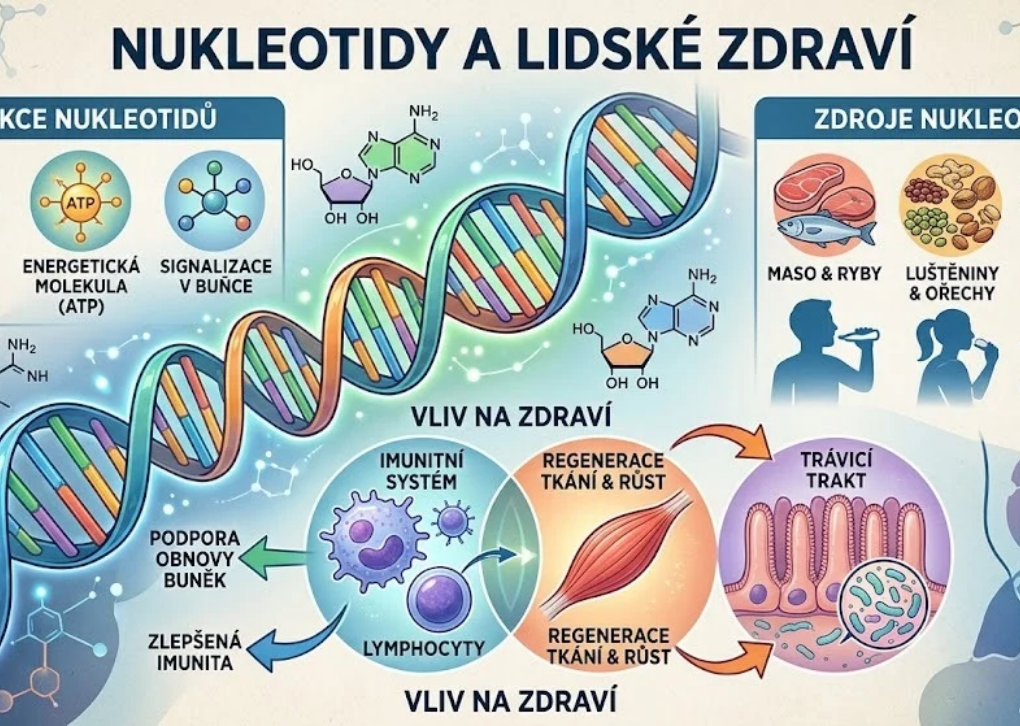
Nukleotidy and Human Health are closely connected, but the relationship is more interesting than supplement advertisements suggest. Nukleotidy is the Czech word for nucleotides—tiny molecules that help cells store genetic instructions, transfer energy, and respond to signals. The essential question is not whether your body needs them; it does. It is whether consuming extra nucleotides produces measurable health benefits.
Understanding Nukleotidy in this context can help you make sense of claims involving immunity, gut health, recovery, aging, and infant nutrition. This guide separates established biochemistry from encouraging early research and marketing that runs ahead of the evidence.
What Are Nukleotidy? A Simple Explanation
Every nucleotide contains three parts: a nitrogen-containing base, a five-carbon sugar, and one or more phosphate groups. The sugar is ribose in RNA and deoxyribose in DNA, while the bases provide the chemical alphabet used to encode biological information. The National Human Genome Research Institute describes these units as the fundamental building blocks of nucleic acids.
Think of DNA as an instruction manual and individual nucleotides as the letters that make it readable. Their order carries information, while chemical bonds connect the units into long, stable chains. The same molecular family performs jobs far beyond information storage.
The Five Bases Behind DNA and RNA
DNA uses adenine (A), thymine (T), cytosine (C), and guanine (G). RNA uses adenine, uracil (U), cytosine, and guanine, replacing thymine with uracil. In DNA’s double helix, A pairs with T and C pairs with G; RNA uses different pairing rules depending on its structure and role.
Two base families are worth knowing: purines (adenine and guanine) and pyrimidines (cytosine, thymine, and uracil). Their distinction matters in nucleotide metabolism and in understanding why some dietary choices influence uric acid.
Nucleotide vs. Nucleoside: The Often-Missed Difference
A nucleoside has a base plus sugar, but no phosphate group. Add phosphate and it becomes a nucleotide; link nucleotides together and you get nucleic acids such as DNA or RNA. These terms are related, not interchangeable, especially when assessing Nukleotidy product labels or interpreting research.
For example, adenosine is a nucleoside, AMP is a nucleotide with one phosphate, and ATP has three phosphates. A study involving adenosine or a specific nucleotide precursor cannot automatically substantiate claims for every product marketed under Nukleotidy.
Why Nukleotidy Matter for Human Health
The clearest evidence concerns what nucleotides do inside cells, rather than what happens after swallowing a supplement. Their roles span five interconnected systems, and problems in any one can influence normal growth or function.
1. Genetic Information, DNA Replication and Repair
Before a cell divides, it must copy its DNA with extraordinary precision. Cells assemble deoxyribonucleotides into new strands, and repair enzymes use appropriate building blocks when damaged sections need replacement. A balanced supply of Nukleotidy precursors is therefore essential for cell renewal.
That process is particularly active in tissues that turn over quickly, including the intestinal lining and blood-forming tissues. Still, faster cell division is not automatically better; the body regulates synthesis, repair, and growth carefully.
2. Cellular Energy: ATP Is Not a Dietary Energy Shortcut
Adenosine triphosphate (ATP) is the cell’s immediate energy currency. When an ATP molecule participates in a reaction and loses a phosphate group, the released free energy can be coupled to processes such as muscle contraction, active transport, and synthesis of cellular components.
Here is the crucial nuance: ATP produced by your cells does not translate into an evidence-based promise that oral nucleotide capsules will instantly improve stamina. Cellular energy depends on nutrient metabolism, oxygen availability, enzyme activity, and coordinated ATP regeneration—not simply the presence of extra nucleotides in a drink.
3. RNA and Protein Production
Genes must be expressed before many of their instructions become useful. Messenger RNA (mRNA) carries genetic messages, transfer RNA (tRNA) helps deliver amino acids, and ribosomal RNA (rRNA) forms part of the machinery that assembles proteins.
Nukleotidy make this communication system possible. This explains their indirect importance for enzymes, hormones made from proteins, structural tissues, and the proteins involved in immune defense.
4. Communication Between Cells
Certain nucleotides act as chemical messengers. Cyclic AMP (cAMP), for instance, relays signals within cells, while ATP and related molecules can also participate in extracellular signaling through purinergic receptors.
These signaling systems influence numerous normal physiological responses. However, a laboratory finding about an ATP receptor does not prove that an orally consumed nucleotide supplement will activate that receptor in the same way.
5. Metabolism and Enzyme Cofactors
Nucleotide-derived structures also form parts of important cofactors, including NAD and FAD, which participate in oxidation-reduction reactions. Other nucleotide-linked compounds help transfer chemical groups as cells manufacture and modify molecules.
The breadth of these roles explains why Nukleotidy attract interest in metabolic research. It does not establish one universal dose, one universal supplement formula, or one guaranteed outcome for human health.
How Does the Body Obtain Nukleotidy?
Your cells are not completely dependent on dietary supply. The body produces nucleotides through de novo synthesis, which builds them from simpler materials, and salvage pathways, which recycle bases and nucleosides from normal molecular turnover.
These pathways continuously adjust Nukleotidy availability to cellular demand. The Reactome pathway overview describes how synthesis, recycling, interconversion, and degradation jointly regulate the balance of these molecules.
Why Nutrient Status Still Matters
Making nucleotides requires more than eating foods that contain them. Folate-dependent one-carbon metabolism contributes to purine production and the formation of thymidylate, a building block needed for DNA; adequate overall nutrition supports these normal biochemical pathways.
Vitamin B12 status is also relevant to healthy folate metabolism, but it is misleading to portray either vitamin as a direct substitute for nucleotide therapy. The biochemistry of thymidylate synthesis shows why these processes must be understood as part of a broader nutritional system.
Food Sources of Nukleotidy: What to Eat
Cells from plants, animals, fungi, and microorganisms contain DNA and RNA, so ordinary food naturally supplies nucleic-acid-related compounds. Digestion breaks much of this material into smaller constituents, including nucleosides and bases, rather than delivering intact dietary DNA directly into your genome.
Common dietary sources include:
- Fish, poultry, and meat: Provide nucleic-acid-containing tissue alongside protein and other nutrients.
- Beans, lentils, and peas: Offer plant-derived nucleic acids, fiber, and valuable minerals.
- Mushrooms and yeast-derived foods: Contain nucleic-acid material, although amounts vary substantially by product.
- Milk and dairy foods: Supply dietary nucleotide-related compounds in a broader nutrient matrix.
- Human breast milk: Naturally contains nucleotide-related constituents important to the discussion of early-life nutrition.
There is no practical reason for most healthy adults to maximize dietary Nukleotidy intake or chase a particular food solely because its cells contain DNA. A varied eating pattern provides much more than nucleotide precursors, including protein, fiber, vitamins, and minerals that support the body’s own synthesis pathways.
Nukleotidy and Gut Health: Where Research Becomes Interesting
The intestinal lining is renewed frequently, creating ongoing demand for materials needed in cell maintenance and division. Researchers have explored whether exogenous nucleotides influence intestinal maturation, barrier function, recovery, and gut microbiota under specific conditions.
One randomized trial in formula-fed infants found differences in selected gut bacterial patterns when nucleotide-supplemented formula was compared with a control formula. That is evidence of a measurable microbiota-related effect in a particular population, not proof that nucleotide supplements treat irritable bowel syndrome, inflammatory bowel disease, or leaky-gut symptoms in adults. See the infant microbiota trial.
The evidence is uneven because infant studies, animal experiments, laboratory models, and adult dietary trials ask different questions. A better interpretation of Nukleotidy research is promising for certain mechanisms, but not established as a general digestive treatment.
Can Nukleotidy Support the Immune System?
Immune cells need nucleotide precursors when they activate, multiply, and produce molecules involved in responding to infection. This biological requirement gives researchers a plausible reason to test dietary Nukleotidy, particularly during growth or physiological stress.
A 2007 systematic review and meta-analysis reported better antibody responses to some childhood vaccinations and fewer diarrhea episodes in trials of nucleotide-supplemented infant formula. Yet these findings concern defined infant formulas and outcomes; they cannot be generalized to disease prevention or enhanced immunity in healthy adults.
Researchers sometimes describe dietary nucleotides as conditionally essential during periods of rapid growth, recovery, or stress. That is a scientific hypothesis applied to specific situations, not a blanket determination that everyone needs an extra product. Treat claims that Nukleotidy “boost immunity overnight” as marketing, not clinical guidance.
Nukleotidy in Infant Nutrition: Useful but Not a Magic Ingredient
Human milk naturally provides nucleotide-related compounds, which has encouraged manufacturers to add nucleotides to some infant formulas. Studies have tested immune markers, diarrhea, microbiota, and early growth, with some encouraging findings.
For example, a randomized trial involving 200 formula-fed infants found differences in some early growth measurements between supplemented and comparison formulas. Importantly, the authors called for more research on whether such differences translate into meaningful long-term developmental benefits.
A public-health review from Hong Kong’s Centre for Food Safety noted that international consensus on additional benefits was lacking and that Codex did not require nucleotide addition. Parents should choose feeding options with their pediatric professional, not rely on a single front-of-pack claim.
What Do Recent Human Trials Say About Aging and Performance?
This is where the science has progressed beyond theoretical discussions. Two randomized studies published in 2025 explored nucleotide supplementation in older adults, offering more relevant human data than claims based solely on test tubes or animal models.
In the TALENTs trial, 121 adults aged 60–70 were assigned to 1.2 grams daily of nucleotides or placebo for 19 weeks. Researchers reported a difference in a DNA-methylation-based aging marker and in HOMA-IR, an estimate related to insulin resistance, but found no significant between-group effect on telomere length. Read the published trial.
A separate 10-week trial with 69 older adults investigated two nucleotide-containing preparations and reported differences in several physical, cognitive, and inflammatory measures versus placebo. One formula contained other yeast-derived nutrients, making it especially important not to attribute every observed change to nucleotides alone. See the trial in Nutrients.
Both studies make Nukleotidy worth investigating, yet biological-age biomarkers are not the same as demonstrated longer life, and small, short trials cannot establish years of safety or clinical benefit. A 2026 research overview likewise identifies effective doses, long-term safety, and population-specific outcomes as unresolved questions.
Risks, Purines and the Supplement Question
Not all Nukleotidy-related compounds have identical metabolic effects. When purines are broken down, the body produces uric acid, and elevated urate can contribute to gout in susceptible people.
The CDC’s gout guidance identifies organ meats, certain seafood, alcohol, and sugary drinks among dietary issues worth discussing in gout management. That does not mean every food containing nucleic acids must be avoided: research on healthy plant-based diets shows that vegetables and legumes do not carry the same risk pattern as some animal-source foods and sugary beverages.
If you have gout, hyperuricemia, kidney disease, or a history of uric-acid stones, consult your healthcare professional before experimenting with concentrated nucleotide preparations. People who are pregnant, breastfeeding, immunocompromised, or taking ongoing medication should also seek individualized guidance rather than assume a product is harmless because it is sold as a nutrient.
The US Food and Drug Administration does not approve dietary supplements for safety and effectiveness before marketing. For most healthy adults, there is no universally established recommended daily allowance or standard therapeutic dose for nucleotide supplements.
How to Evaluate a Nukleotidy Supplement Label
Start with the exact ingredient: does the manufacturer specify AMP, CMP, GMP, UMP, or another compound, or simply say “nucleotide complex”? Next, check the quantity per serving, the source material, third-party quality testing, and whether advertised benefits were actually studied using that precise formulation.
Look for human trials reporting clinically meaningful outcomes, not just changes in laboratory markers or animal immune-cell activity. Be wary of assertions that a product repairs DNA, reverses aging, prevents infection, or treats chronic disease without high-quality human evidence.
Key Takeaways: Nukleotidy and Human Health
- Biological necessity is firmly established: Nucleotides support genetic material, energy transfer, signaling, and metabolism.
- Your body can synthesize and recycle them: Healthy people are not necessarily dependent on supplements for an adequate supply.
- Foods provide a broad nutritional package: Eating varied protein sources, legumes, and vegetables is more useful than targeting a speculative nucleotide number.
- Supplement findings remain population-specific: Infant nutrition and small older-adult trials are encouraging, but do not establish routine benefits for everyone.
- Safety depends on context: Purine metabolism, underlying conditions, product composition, and unknown long-term effects deserve attention.
Frequently Asked Questions About Nukleotidy
1. What is the primary function of nucleotides in the human body?
Their best-known function is forming the genetic material in DNA and RNA, but this is only part of the story. Nucleotides also participate in ATP-based energy transfer, chemical signaling, and important enzyme-cofactor systems. The same molecular family therefore connects gene expression, normal metabolism, and cellular maintenance.
2. Can the body produce nucleotides without eating them directly?
Yes. Human cells use de novo synthesis to make nucleotides and salvage pathways to recycle components recovered from molecular breakdown. Dietary sources can contribute materials, especially under certain physiological conditions, but there is no evidence that every healthy adult needs a separate nucleotide supplement.
3. Do nucleotide supplements improve gut health or immunity?
Some infant-formula trials have reported changes in immune responses, diarrhea episodes, or gut microbial patterns. Those findings are scientifically relevant but do not prove that supplements prevent infections or treat adult gastrointestinal conditions. If a product claims such benefits, ask for controlled human studies using the same dose and ingredients.
4. Are Nukleotidy supplements safe to take every day?
Safety cannot be answered for all formulas with one yes or no. Short-term adult trials have reported reassuring results for particular preparations, but long-term safety, optimal dose, and effects in vulnerable groups are not fully established. Anyone with gout, kidney problems, or complex medical needs should seek professional advice before regular use.
5. Are nucleotides the same as DNA, RNA, or NAD supplements?
No. Nucleotides are individual chemical building blocks, while DNA and RNA are long chains made from those units; NAD is a nucleotide-derived coenzyme with a different biochemical role. Specific NAD precursors such as NMN have their own research literature and should not be treated as equivalent to an ordinary mixed-nucleotide supplement. Matching the ingredient to the actual scientific study is the key to avoiding misleading comparisons.
Final Verdict: Focus on Evidence Before Buying
Nukleotidy are indispensable to life, but their importance in cellular biology should never be confused with proof that taking more will automatically produce better health. The most practical starting point is a varied diet, appropriate management of medical conditions, and skepticism toward supplements promising rapid repair, stronger immunity, or reversed aging.
If you are considering supplementation for a specific reason, write down the intended outcome, check the exact compound and dose, and review the human evidence with a qualified healthcare professional. Choose measurable benefits over impressive biological language—that is the difference between understanding nucleotides and falling for hype.







Leave a Reply