
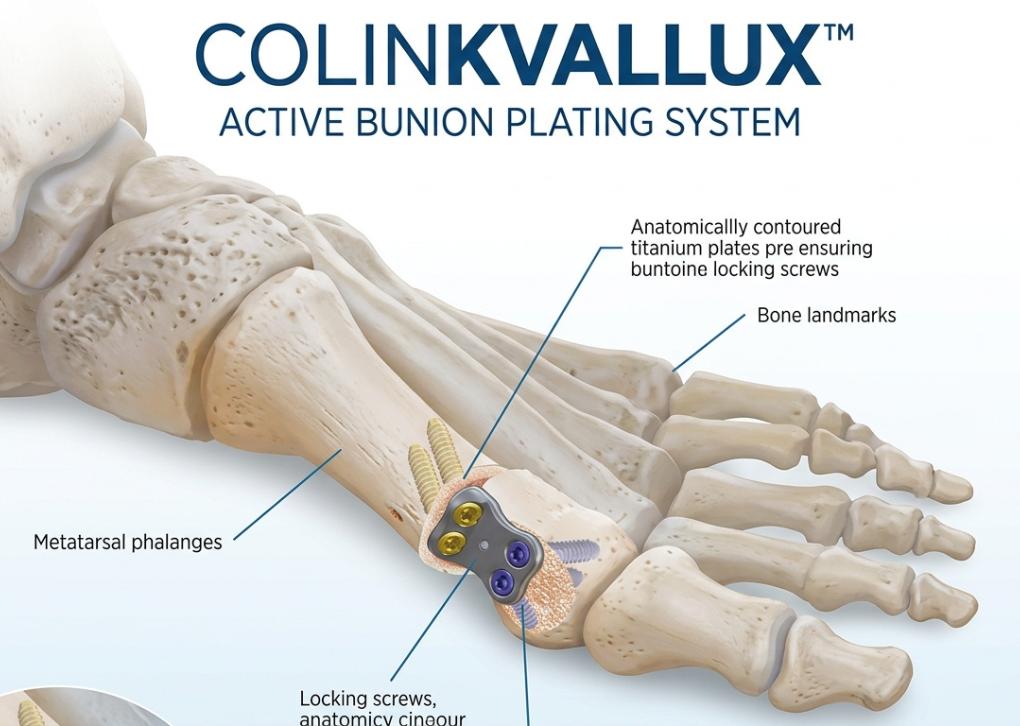
If you landed on Colinkvallux.com while researching bunion surgery, the most useful first step is to separate the website address from the medical product whose name it appears to reference. CoLink Vallux is a real orthopedic fixation system used in hallux valgus correction, but authoritative product and regulatory information is currently verifiable through CONMED, the U.S. Food and Drug Administration, and AccessGUDID rather than through assumptions about a similarly named domain.
That distinction matters. Medical-device research sits squarely in a high-trust category: readers need to know who made a claim, whether a device is cleared for a specific indication, what the evidence actually says, and where marketing language ends. During research for this article on September 18, 2026, an automated attempt to retrieve the exact domain returned a 502 Bad Gateway response; that is a point-in-time technical observation, not proof that the domain is permanently unavailable.
What Is Colinkvallux.com?
At the time of this review, Colinkvallux.com could not be independently evaluated as a functioning source because the direct retrieval attempt failed. That means it would be irresponsible to describe its ownership, editorial policies, privacy practices, or medical content as facts without seeing the live pages.
What can be verified is the product name behind the query. CoLink Vallux is an orthopedic plating system developed by In2Bones USA for correction procedures involving the hallux, including hallux valgus. The FDA database lists the CoLink Vallux Plating System under 510(k) number K212487, with a substantial-equivalence decision dated November 18, 2021.
The practical takeaway is simple: treat the domain as something that requires verification, while treating FDA, CONMED, and AccessGUDID records as primary or authoritative references for device status and labeling-related facts. That gives you a reliable source hierarchy before you assess claims from the site itself.
The Verified Medical Product Behind Colinkvallux.com
CONMED describes CoLink Vallux as an Active Bunion Plating System designed as a joint-sparing, minimally invasive solution for triplanar hallux valgus correction. Its product page describes an implant-guided translational osteotomy, a low-profile or “zero-prominence” plating concept, and variable-angle locking technology with polyaxial screw placement and 30 degrees of locking variability.
Those are product-design claims, not guarantees of a particular patient outcome. A surgeon still has to determine whether the deformity, bone quality, joint condition, soft tissues, comorbidities, and patient goals make a particular correction strategy appropriate.
FDA Status: Cleared, Not “FDA Approved”
The regulatory language around searches for this domain deserves precision. The FDA record states that the CoLink Vallux Plating System is a prescription orthopedic device with the classification name “Plate, Fixation, Bone.” Its cleared indication includes fixation of translational osteotomies and corrective procedures of the hallux and associated disorders such as hallux valgus.
The system went through the 510(k) pathway. FDA explains that a 510(k) clearance is based on a determination of substantial equivalence to a legally marketed predicate device; it is not the same regulatory pathway as Premarket Approval, or PMA. Calling a 510(k)-cleared device “FDA approved” is therefore inaccurate.
That nuance is especially important when evaluating any health website. If Colinkvallux.com or another page uses regulatory status as a trust signal, check whether the terminology matches the FDA record exactly.
Who Makes CoLink Vallux Today?
The FDA clearance identifies In2Bones USA, LLC as the applicant. In June 2022, CONMED Corporation completed its acquisition of In2Bones Global, making In2Bones a wholly owned CONMED subsidiary. CONMED’s current product catalog now hosts the CoLink Vallux product information.
That corporate history helps readers avoid a common source of confusion. Older literature may show In2Bones branding, while current commercial pages may sit under CONMED.
How the CoLink Vallux System Is Intended to Work
The core clinical problem is hallux valgus, commonly called a bunion: a deformity involving alignment of the great toe and first ray. Corrective surgery may use osteotomy—surgically cutting and repositioning bone—followed by internal fixation to hold the corrected position while healing occurs.
The CoLink Vallux concept combines that corrective osteotomy with a plate-and-screw construct. According to CONMED, the system is intended to support a minimally invasive, joint-sparing correction while allowing polyaxial screw placement through variable-angle locking technology.
AccessGUDID currently lists the CoLink Vallux plate as in commercial distribution, identifies In2Bones USA as the company, and marks the device as prescription use and single-use. The GUDID record also identifies model/catalog number P90 ST031 for the plate.
For a patient, the important point is not the catalog number. It is that the implant is only one part of the treatment. Surgical planning, deformity severity, bone positioning, fixation technique, postoperative protection, wound care, rehabilitation, and surgeon experience all influence the final result.
Is Colinkvallux.com an Official Medical Website?
A domain name that matches a product does not automatically establish official ownership. Because Colinkvallux.com was not retrievable during this review, its relationship—if any—to CONMED or In2Bones could not be confirmed from the live site itself.
The safer verification method is to work outward from established sources. The current CONMED product page names the system and provides product literature; the FDA database confirms the 510(k); and AccessGUDID confirms device identification and commercial-distribution details.
Before relying on Colinkvallux.com for medical or purchasing information, verify whether it clearly identifies the publisher, links to official labeling, names the legal manufacturer, and distinguishes educational content from promotional material. Those signals are more meaningful than a product-matching domain name by itself.
A Trust Checklist for Evaluating Colinkvallux.com
If the domain becomes accessible, do not judge it by design polish alone. For a medical-device site, credibility should be visible in the underlying documentation and editorial behavior.
Use this checklist:
- Publisher identity: Look for a legal company name, physical business information, and a contact channel that can be independently verified.
- Regulatory references: Any statement about U.S. clearance should match FDA 510(k) K212487 and use “cleared,” not “approved.”
- Indications for use: Claims should stay within the cleared scope involving hallux corrective procedures, including hallux valgus.
- Source quality: Strong pages link to FDA records, manufacturer literature, peer-reviewed studies, or recognized clinical organizations rather than copying unsourced claims from blogs.
- Risk disclosure: A credible page should not present surgery as risk-free, universally suitable, or guaranteed to produce a specific recovery time.
- Commercial transparency: Sponsored content, lead-generation forms, distributor relationships, or affiliate arrangements should be disclosed.
- Privacy and security: If the site collects health details or contact information, readers should be able to find a clear privacy policy and understand how submitted data will be used.
This framework gives visitors a way to assess evidence instead of relying on branding alone. It also reflects the kind of transparency Google’s quality systems expect from pages dealing with health and other Your Money or Your Life (YMYL) subjects.
What Does Research Say About Minimally Invasive Hallux Valgus Surgery?
This is where careful wording matters most. Evidence about minimally invasive hallux valgus surgery as a category should not be presented as direct proof that one specific implant produces the same outcomes.
A 2024 living systematic review and meta-analysis covering multiple hallux valgus procedures found that both open and minimally invasive techniques improved clinical and radiographic outcomes. The authors reported stronger hallux valgus angle correction for third-generation MIS procedures in their pooled analysis, while also noting the need for more consistent reporting and that technique selection remains debated.
Another 2024 systematic review focused on severe hallux valgus found significant improvements in clinical and radiological measures across included MIS studies, but it also reported complications such as infection, union problems, and loss of correction. The study evaluated minimally invasive techniques broadly; it should not be read as a product-specific outcome study for the CoLink Vallux system.
That evidence is useful context for readers researching the topic, but the hierarchy of claims must remain intact: general MIS evidence is not the same as device-specific comparative evidence. A well-sourced page should make that difference obvious rather than allowing readers to infer product superiority from broader surgical literature.
Benefits Often Associated With the CoLink Vallux Design
The design characteristics promoted by CONMED suggest several intended procedural advantages. The system is described as joint-sparing, minimally invasive, implant-guided, and capable of variable-angle locking.
In practical terms, these features may give a surgeon options for fixation trajectory and correction strategy. But “may” is the operative word. A product feature can support a surgical objective without guaranteeing less pain, faster healing, fewer complications, or a better long-term result for every patient.
If Colinkvallux.com makes stronger outcome claims, readers should look for direct clinical evidence supporting the exact statement. Testimonials and manufacturer descriptions are not substitutes for comparative clinical data.
Risks, Limitations, and Questions Patients Should Ask
Bunion correction is surgery. Even when performed through smaller incisions, it still involves bone work, fixation, anesthesia, postoperative healing, and the possibility of complications.
Rather than trying to self-select a procedure from a website, patients should use Colinkvallux.com or any other educational resource to prepare better questions for a qualified foot-and-ankle surgeon. The goal should be to understand both the deformity being treated and why a particular technique has been selected.
Ask your surgeon what the exact severity and three-dimensional pattern of the hallux valgus is, and why the proposed osteotomy and fixation method is preferred over another MIS procedure, an open technique, or a fusion procedure. It is also reasonable to ask how frequently the surgeon performs that exact operation and how their own complication and revision experience compares with published evidence.
Patients should also discuss nonunion, malunion, infection, recurrence, nerve symptoms, hardware irritation, weight-bearing restrictions, rehabilitation, and the circumstances in which implant removal might be considered. Recovery estimates should be individualized rather than treated as promises from a marketing page.
What Colinkvallux.com Should Publish to Demonstrate Strong E-E-A-T
For a YMYL medical topic, Colinkvallux.com would need more than keyword-rich product copy to earn durable trust. The strongest version of the site would identify medically qualified reviewers, date every clinical page, cite primary sources, disclose conflicts of interest, and maintain a visible corrections policy.
It should also separate three kinds of content that are often blurred online: manufacturer specifications, regulatory facts, and independent clinical evidence. That separation makes it easier for readers to understand what is known, what is claimed by the manufacturer, and what remains uncertain.
A strong page would also explain the limits of FDA clearance in plain English. FDA states that the 510(k) process uses a comparative substantial-equivalence standard, while PMA relies on an independent demonstration for higher-risk devices.
How to Verify Information From Colinkvallux.com Before Acting on It
If you encounter a medical claim on Colinkvallux.com, verify it with a three-source rule before using it to make a health decision. The more consequential the claim—particularly one involving safety, surgical outcomes, or recovery—the stronger the evidence should be.
First, check the FDA record for regulatory status and indications. Second, compare product specifications with the current CONMED page. Third, search peer-reviewed literature for outcomes related to the surgical technique, making sure the study actually examined the same procedure or device rather than a vaguely similar operation.
For treatment decisions, the final step is not another website. It is a consultation with a licensed clinician who can review imaging, examine the foot, discuss nonoperative options, and explain whether surgery is appropriate.
FAQ About Colinkvallux.com and CoLink Vallux
1. What Is Colinkvallux.com?
Colinkvallux.com is a domain name that appears to reference the CoLink Vallux orthopedic product, but the domain itself could not be reliably retrieved during this research session. The verified medical product is the CoLink Vallux Plating System, with official information available through CONMED and U.S. regulatory databases.
The distinction is important because a matching web address does not, by itself, establish manufacturer ownership or medical authority. Readers should verify the publisher before submitting personal information or relying on treatment claims.
2. Is CoLink Vallux FDA Approved?
The more accurate term is FDA cleared. The CoLink Vallux Plating System received 510(k) clearance under K212487 on November 18, 2021, after FDA determined it was substantially equivalent to legally marketed predicate devices.
FDA specifically distinguishes 510(k) clearance from PMA approval. When evaluating medical content, that wording is not a minor technicality—it tells you which regulatory pathway was used.
3. What Is the CoLink Vallux System Used For?
The FDA-cleared indication includes fixation of translational osteotomies and corrective procedures of the hallux and associated disorders such as hallux valgus. CONMED markets it as a minimally invasive, joint-sparing active bunion plating system for triplanar correction.
It remains a prescription medical device rather than a consumer product. Whether it is appropriate for a particular bunion deformity requires individual surgical assessment.
4. Is Minimally Invasive Bunion Surgery Better Than Open Surgery?
There is no universal answer for every deformity or patient. Recent systematic reviews show that both open and minimally invasive techniques can improve hallux valgus outcomes, with some analyses finding advantages in certain radiographic measures for newer MIS techniques.
Procedure choice still depends on deformity pattern, surgeon expertise, patient factors, and the quality of evidence for the specific technique. Evidence supporting MIS broadly should not automatically be converted into a superiority claim for one branded implant.
5. Can I Decide Whether I Need CoLink Vallux From Colinkvallux.com?
No website can determine that safely from general information alone. Colinkvallux.com may help you learn terminology or prepare questions, but candidacy for a specific osteotomy and implant requires clinical assessment, usually including examination and imaging, by a qualified surgeon.
Use online research to become a better-informed participant in the consultation. Do not use a product page, testimonial, or search result as a substitute for individualized diagnosis and surgical planning.
Final Takeaway: Use Colinkvallux.com as a Starting Point, Not the Final Authority
The most important fact about Colinkvallux.com is the distinction between a domain and a verified medical-device record. CoLink Vallux is a real prescription orthopedic plating system with FDA 510(k) clearance and current CONMED product documentation, while the exact website could not be independently assessed during this review.
If you are researching treatment, verify every major claim against FDA and manufacturer documentation, then discuss the procedure with a licensed foot-and-ankle specialist. If you publish or manage the site, strengthen it with named expert review, primary-source citations, transparent ownership, balanced risk information, and clear update dates.








Leave a Reply