
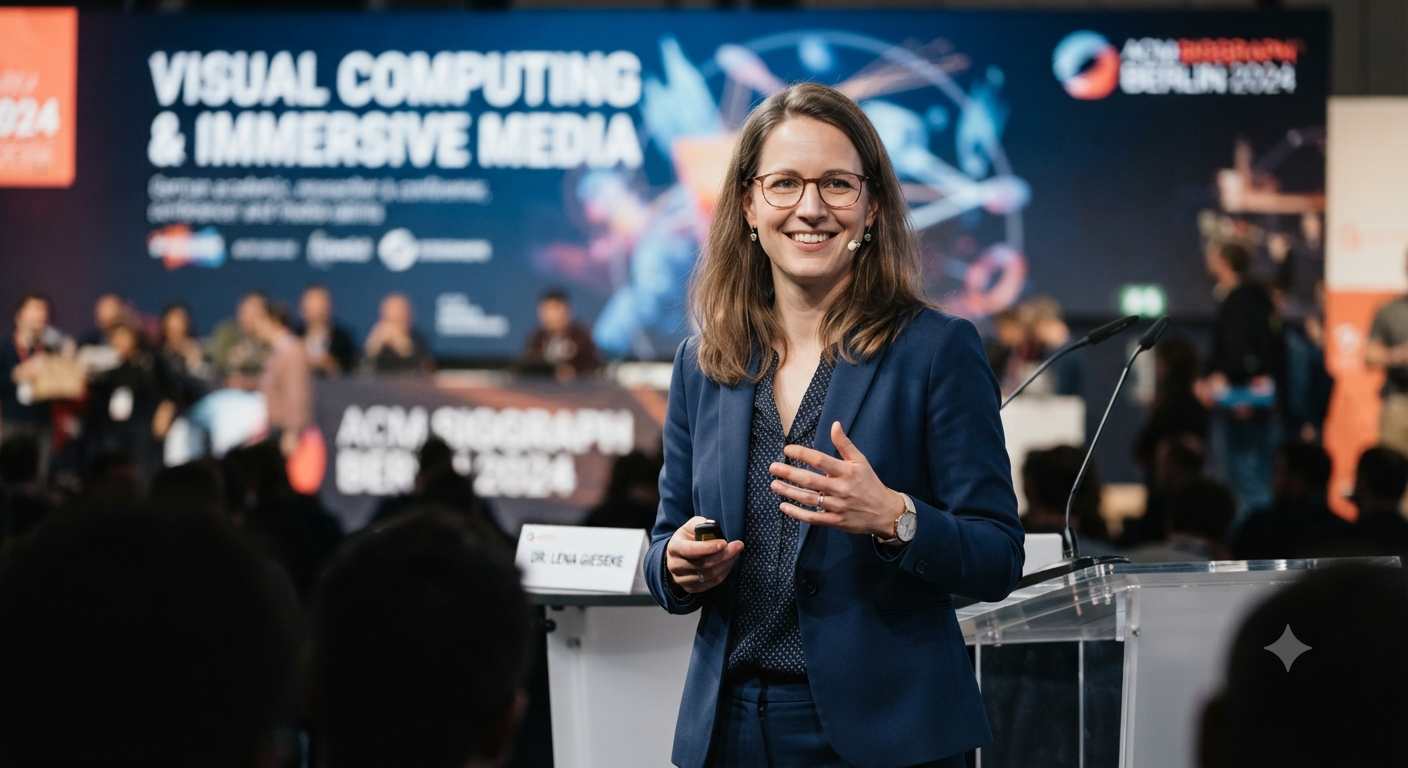
Lena Gieseke is often introduced online with one narrow label: Tim Burton’s former wife. That description is factually relevant, but it leaves out the far more substantial story of a German visual-effects professional who moved from 3D production into computer-science research, patented creative technology, and became a professor responsible for shaping an interdisciplinary master’s program.
Her documented career spans 3D animation, visual effects, procedural design, software development, GPU programming, machine learning, technical direction, and sustainable film production. The strongest available evidence comes not from celebrity-biography websites, but from her official university profile, peer-reviewed publications, film-credit databases, and the University of Stuttgart’s dissertation archive.
Who Is Lena Gieseke?
Lena Gieseke is a German computer graphics specialist, former visual-effects artist, software developer, filmmaker, researcher, and professor. She currently serves as Professor of Visual Media Technologies / Technical Direction at Filmuniversität Babelsberg KONRAD WOLF and is associated with the university’s M.A. Creative Technologies program.
Her professional path is unusual because it connects three fields that are often treated separately: artistic image-making, production technology, and academic computer science. Rather than remaining only a studio artist, she turned practical problems from digital production into research questions involving procedural systems, visual control, human-computer interaction, and computational creativity.
Lena Gieseke at a Glance
- Nationality: German
- Known for: Visual effects, 3D computer animation, procedural graphics, research, and higher education
- Current role: Professor of Visual Media Technologies / Technical Direction
- Institution: Filmuniversität Babelsberg KONRAD WOLF
- Academic qualification: Ph.D. from the University of Stuttgart
- Notable research area: Procedural generation and control of visual pattern designs
- Industry background: Software development, 3D artistry, visual-effects research and development
- Publicly discussed former spouse: Filmmaker Tim Burton
These details are supported by institutional and professional sources. Claims frequently repeated online about her exact birthday, childhood, family background, wealth, or private relationships are much less consistently documented.
Why Lena Gieseke Is More Than “Tim Burton’s Ex-Wife”
Search results tend to prioritize celebrity relationships because Tim Burton is internationally famous. Yet the available professional record shows that Lena Gieseke built an independent career with recognizable achievements in both industry and academia.
This distinction matters for accuracy and E-E-A-T. A useful biography should separate documented work from search-engine repetition. Her marriage belongs in the story, but it should not overshadow her film-production experience, doctoral research, patent work, teaching, and role in developing creative-technology education.
Her official profile states that she worked for several years as a software developer and 3D artist in the visual-effects and 3D computer-animation industry before returning to academia in 2012. It also identifies her as the dean responsible for curriculum development in the Creative Technologies master’s program.
Lena Gieseke’s Early Life and Education: What Is Actually Verified?
Many entertainment websites publish a precise birth date, often September 12, 1965, and attach detailed stories about her early education. However, her official university biography does not provide a date of birth, hometown, parents, or childhood history. A responsible profile should therefore treat those details as unverified rather than established fact.
What can be confirmed is her advanced academic training. The University of Stuttgart archive lists her 2018 dissertation, Control Mechanisms for the Procedural Generation of Visual Pattern Designs. The film university states that she completed her Ph.D. as part of the Visual Computing group in the Department of Computer Science.
From 2012 to 2015, she received a scholarship through the Digital Media doctoral program. In 2015, she also spent four months as a visiting researcher at Adobe Research in San Jose, California, connecting her academic work with a major creative-software research environment.
From 3D Artist to Visual-Effects Researcher
Before entering academic life full-time, Lena Gieseke worked in the production side of digital imagery. Her roles included 3D artist, modeler, software developer, and research-and-development contributor, particularly in work connected with ScanlineVFX.
Film-credit records associate her with productions including 2012, Immortals, Berlin ’36, Vicky the Viking, Vicky and the Treasure of the Gods, and other German film or television projects. The exact credited role varies by production: she is listed as a modeler on 2012, a 3D artist on several German projects, and an R&D contributor on later work.
That range is important. Modeling is an artistic-technical task involving the creation of digital objects and environments, while R&D work focuses on the tools, scripts, pipelines, or methods artists use to produce images efficiently. Her credits suggest a shift from creating assets toward solving broader production problems.
Notable Visual-Effects Credits
Her best-known screen credits include:
- 2012 (2009): Credited as a modeler associated with ScanlineVFX
- Berlin ’36 (2009): Credited as a 3D artist
- Vicky and the Treasure of the Gods (2011): Credited in research and development
- Immortals (2011): Listed among her recognized visual-effects work
- Westflug – Entführung aus Liebe (2010): Credited in R&D
These are crew roles, not acting appearances. That clarification is useful because some low-quality biographies describe her as if she were a public-facing film celebrity, when her work was primarily behind the scenes.
“A 3D Exploration of Picasso’s Guernica”
One of the most distinctive projects associated with Lena Gieseke is A 3D Exploration of Picasso’s Guernica, an animation created in 2007. Instead of treating Pablo Picasso’s painting as a flat composition, the project uses three-dimensional movement to guide viewers through its figures, spatial relationships, and emotional structure.
The film university records screenings at the Unabhängiges FilmFest in Osnabrück, Ars Electronica in Linz, and the Seoul Design Fair. This international festival exposure helps explain why the project remains one of the clearest examples of her ability to combine art interpretation with digital visualization.
The work also foreshadows her later research interests. It asks a question central to computational media: how can technology provide a new form of access to an existing visual artwork without simply reproducing it?
Lena Gieseke’s Ph.D. and Procedural Graphics Research
Procedural generation uses rules, parameters, and algorithms to create visual content. Instead of manually drawing every ornament, texture, or pattern, a designer builds a system capable of producing many related variations.
Lena Gieseke’s doctoral work focused on the challenge hidden inside that flexibility: procedural systems may offer thousands of possible parameter combinations, but artists still need intuitive ways to control the result. Her research therefore examined mechanisms that make algorithmic pattern creation more accessible, navigable, and visually meaningful.
Her publication record includes work on procedural textures, parameter retrieval, image decomposition, ornamentation, and creative pattern generation. The ACM paper Organized Order in Ornamentation examines how decorative systems balance structure, accent, and symmetry, while later survey work maps the control mechanisms used in creative pattern-generation systems.
Adobe Research and a U.S. Patent
The 2015 research stay at Adobe led to collaboration on Interactive Generation of Procedural Ornaments, later listed as a U.S. patent. The system concerns interactive ways to produce ornament designs through procedural methods rather than static templates.
This is a meaningful career milestone because patents sit at the intersection of theory and application. The work was not only an academic discussion of design systems; it contributed to a documented technological invention with potential relevance to creative software and digital design workflows.
Professor, Dean and Curriculum Builder
Lena Gieseke now holds a professorship at Filmuniversität Babelsberg KONRAD WOLF, one of Germany’s major film-focused higher-education institutions. Her official profile identifies her as Professor of Visual Media Technologies / Technical Direction and states that she is responsible for developing the curriculum of the M.A. Creative Technologies program.
Technical direction is the bridge between artistic goals and production systems. A technical director may help design pipelines, write tools, manage digital assets, improve rendering or shading workflows, and ensure that artists can execute complex ideas reliably.
Her listed teaching and research interests include:
- Computer graphics and procedural generation
- Materials, textures, and shading
- Software development and GPU programming
- 3D animation and production pipelines
- Machine learning
- Human-computer interaction
- Creative control mechanisms
- Sustainable film production
The inclusion of sustainable production is especially notable. Modern film and animation rely on energy-intensive computing, rendering, storage, and virtual-production infrastructure, making sustainability an increasingly important technical and organizational concern.
Research Projects and Industry-Relevant Innovation
Her university profile lists projects involving machine-learning-assisted animation cleanup, XR and interaction research, AI-supported design exploration, 3D texture-painting workflows, and sound visualization. These topics show that her work is not confined to traditional computer graphics; it extends into interactive systems and new production methods.
A 2022 publication, Towards Production-Ready Machine Learning for Animation Cleanups, reflects a practical emphasis. The phrase “production-ready” is significant because many machine-learning demonstrations work in controlled experiments but struggle with the consistency, editability, and reliability demanded by professional animation pipelines.
That industry-aware perspective is one of the strongest threads running through her career. She has worked on production teams, studied computational systems, collaborated with commercial research, and taught students preparing for technical creative roles.
Lena Gieseke and Tim Burton: What Is Known?
Lena Gieseke was married to American filmmaker Tim Burton, but publicly available sources disagree about the exact starting year. People describes the marriage as lasting from 1987 to 1991, while IMDb gives a February 1989 wedding date; The Independent calls it a four-year marriage ending in 1991. The safest conclusion is that they were married in the late 1980s and divorced in 1991.
This source conflict is often ignored by biography sites, which repeat one date as certain. A well-researched article should acknowledge the inconsistency rather than manufacture confidence.
Little reliable first-person information is available about why the marriage ended. Claims about infidelity, personality conflicts, or private conversations are frequently repeated without direct, authoritative sourcing. Unless supported by an interview, court record, or credible biography, those explanations should not be presented as fact.
Did Lena Gieseke and Tim Burton Have Children?
There is no credible evidence that the former couple had children together. Burton’s two publicly known children were born during his later relationship with Helena Bonham Carter, according to established profiles of that relationship.
The absence of shared children may explain why there is little continuing public coverage of the former marriage. Gieseke also appears to have maintained a private personal life while building a visible professional and academic identity.
Privacy, Age and Net-Worth Claims
Celebrity-biography pages frequently publish an exact age, estimated net worth, body measurements, and relationship status for Lena Gieseke. Most of those claims do not appear in her institutional biography, academic profiles, film credits, or peer-reviewed work.
That does not automatically make every claim false. It means the information lacks strong public verification. In particular, net-worth estimates should be treated skeptically because professorial salaries, private assets, past studio compensation, investments, and liabilities are not publicly disclosed in any authoritative profile reviewed for this article.
For readers, the practical rule is simple: trust university records for her academic position, publication databases for research, screen-credit databases for film work, and reputable journalism for the Burton marriage. Treat unsourced personal statistics as speculation.
What Makes Lena Gieseke’s Career Significant?
Her career illustrates how creative technology has evolved. In earlier visual-effects pipelines, artists and developers were often placed in separate categories. Modern production increasingly depends on people who understand both aesthetics and computation.
Lena Gieseke’s work sits directly in that overlap. She has contributed to film imagery, studied artist-friendly procedural controls, explored interactive design systems, worked with Adobe Research, and helped shape a graduate curriculum around creative technologies.
Three broader lessons emerge from her career:
- Creative coding is not separate from art. It can become the mechanism through which artistic choices are expanded and controlled.
- Industry experience can generate research questions. Pipeline problems, parameter complexity, and production constraints can become subjects of academic study.
- Technical direction is a strategic discipline. It turns experimental tools into repeatable processes that creative teams can actually use.
Common Myths and Misleading Claims
“She is famous only because of Tim Burton”
The marriage explains much of the public search interest, but her professional identity is independently documented through film credits, a Ph.D., publications, a patent, festival screenings, and a professorship.
“She was an actress in major films”
She is associated with films through visual-effects and technical departments, not as an on-screen performer. Her work included modeling, 3D artistry, and R&D.
“Her exact net worth is publicly known”
No authoritative source reviewed here provides a verified financial figure. Online estimates should be labeled as estimates, not facts.
“Every website agrees on her marriage date”
They do not. Reputable and industry sources conflict on whether the marriage began in 1987 or 1989, though they agree it ended in 1991.
Frequently Asked Questions About Lena Gieseke
1. What does Lena Gieseke do now?
She is a professor of Visual Media Technologies / Technical Direction at Filmuniversität Babelsberg KONRAD WOLF. She also has curriculum-development responsibility within the M.A. Creative Technologies program and works across computer graphics, software development, procedural generation, machine learning, interaction, and sustainable film production.
2. Which movies did Lena Gieseke work on?
Her credited visual-effects work is associated with productions such as 2012, Immortals, Berlin ’36, Vicky the Viking, and Vicky and the Treasure of the Gods. Depending on the project, her roles included modeler, 3D artist, and research-and-development contributor.
3. When was Lena Gieseke married to Tim Burton?
Sources agree that the marriage ended in 1991, but they conflict on when it began. Some reputable profiles say 1987, while IMDb lists February 1989. It is therefore more accurate to say they married in the late 1980s and divorced in 1991 than to present one disputed date as certain.
4. What is Lena Gieseke’s educational background?
She earned a Ph.D. from the University of Stuttgart in computer science-related visual computing. Her dissertation examined control mechanisms for procedurally generated visual pattern designs, and she also completed a visiting-research period at Adobe Research in 2015.
5. What is Lena Gieseke’s net worth?
No reliable public source provides a verified net-worth figure. Estimates on entertainment websites are not supported by public financial statements, and they should not be treated as confirmed information.
Conclusion: Look Beyond the Celebrity Connection
Lena Gieseke’s marriage to Tim Burton is a searchable part of her biography, but it is not the strongest measure of her professional importance. Her more enduring contribution lies in the connection she has built between visual storytelling, 3D production, software systems, procedural design, academic research, and creative-technology education.
Readers researching her should prioritize original institutional profiles, publication archives, patent records, and verified film credits. That approach reveals a far richer story: not simply the former wife of a famous director, but a technically accomplished creative professional who moved from visual-effects production into research and university leadership.











Leave a Reply