
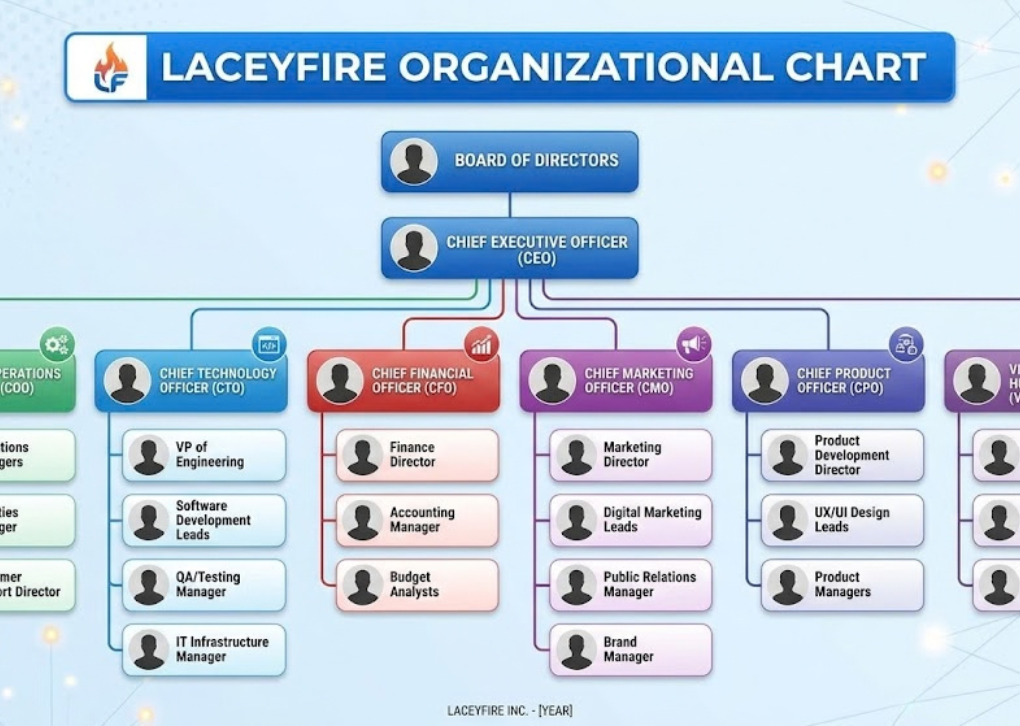
If you are searching for the Laceyfire.com organizational chart, you are probably trying to understand who leads Lacey Fire District 3, how authority moves from elected officials to operational crews, and where functions such as emergency operations, training, EMS, logistics, finance, and administration fit. The structure is more than a list of job titles: it explains how a large fire and emergency medical service organization turns policy, funding, staffing, training, and incident command into 24/7 public safety.
Lacey Fire District 3 is formally Thurston County Fire Protection District No. 3, a special-purpose fire district in Washington. A Washington State Auditor report describes it as governed by a five-member elected Board of Commissioners, with the board appointing a Fire Chief who oversees daily operations; the same report noted 142 full-time firefighters, paramedics, and administrative employees plus 22 volunteers during the period reviewed.
That governance model is the foundation of the Laceyfire.com organizational chart. At the top is public oversight through elected commissioners. Beneath that is executive leadership, followed by command, operational, and support functions that keep emergency response running.
What the Laceyfire.com Organizational Chart Shows at a Glance
The simplest way to read the Laceyfire.com organizational chart is as a chain of accountability rather than a rigid corporate ladder. Fire districts must combine two very different systems: public-sector governance and an emergency incident-command culture where decisions may need to be made in seconds.
A useful high-level view is:
- Community and taxpayers elect the Board of Fire Commissioners.
- Board of Fire Commissioners sets policy, adopts budgets, provides strategic oversight, and appoints the Fire Chief.
- Fire Chief provides executive leadership and is responsible for district-wide administration and service delivery.
- Deputy and Assistant Chiefs lead major functions such as operations, administration, training, medical services, logistics, community risk reduction, health and safety, or related portfolios as assignments evolve.
- Battalion Chiefs and company officers translate policy and operational direction into shift-level supervision and incident command.
- Lieutenants, firefighters, firefighter/EMTs, and firefighter/paramedics deliver frontline emergency services.
- Professional administrative and support staff handle finance, human resources, technology, records, facilities, procurement, planning, public outreach, and other essential functions.
The specific labels can change as the district reorganizes, but the accountability logic remains consistent. A 2019 regional fire-services study described LFD3 as using a hierarchical chain of command and reported that its widest span of control at that time was one supervisor to six subordinates, which the consultants considered relatively high for the industry.
Governance: Why the Board Sits Above the Fire Chief
Any accurate explanation of the Laceyfire.com organizational chart has to start with governance. Lacey Fire District 3 is not simply a department inside the City of Lacey. It operates as a fire protection district under Washington law, which gives its elected commissioners a direct policy and oversight role.
The State Auditor says the district is governed by five elected commissioners serving staggered six-year terms. The board appoints the Fire Chief, while the chief is responsible for overseeing daily district operations.
That division matters. Commissioners are not meant to function as on-scene commanders or day-to-day station supervisors. Their role is institutional: budgets, policy, long-term direction, accountability, major capital decisions, and oversight of the chief.
The Board’s Place in the Laceyfire.com Organizational Chart
On the Laceyfire.com organizational chart, the Board of Fire Commissioners should be understood as the governing body rather than a conventional management department. It represents the public and establishes the framework within which the professional fire-service organization operates.
This is also why board minutes, budgets, resolutions, strategic documents, and public meetings are useful companion resources when researching the chart. They reveal not just who reports to whom, but how major decisions are authorized.
Fire Chief: Executive Leadership at the Center of the Structure
The Fire Chief is the central executive position in the Laceyfire.com organizational chart. Current public records identify Jennifer Schmidt as Fire Chief of Lacey Fire District 3, including 2026 Thurston 911 board records and regional EMS documentation.
The chief’s role connects elected governance with professional execution. That means turning board-approved priorities into staffing plans, operational standards, training expectations, financial decisions, interagency agreements, risk-reduction programs, and measurable service outcomes.
This is a particularly demanding role because LFD3 serves a large and growing population across a broad service area. The district’s public-facing profile describes service to roughly 107,000 people across about 70 square miles in North Thurston County and the City of Lacey.
Deputy Chiefs: Operations and Administration
Below the Fire Chief, the Laceyfire.com organizational chart includes senior command roles that divide executive workload into major functional areas. This is necessary because a modern fire district is simultaneously an emergency-response agency, EMS provider, training organization, public employer, fleet operator, facilities manager, public-education organization, and taxpayer-funded government entity.
Recent public records identify Chris Patti as Deputy Chief of Operations. The title is corroborated by 2026 reporting from The Olympian and by East Olympia Fire District 6, which lists Patti in an operations leadership role under an interlocal relationship with Lacey Fire District 3.
Public regional-planning records also identify Michael Cerovski as Deputy Chief of Administration. That distinction is important because it demonstrates how the district separates field-oriented operational leadership from the administrative work needed to support the organization.
Operations Side of the Laceyfire.com Organizational Chart
The operations side of the Laceyfire.com organizational chart is where emergency readiness becomes field performance. This branch typically encompasses shift staffing, emergency response, incident command, deployment, operational policies, mutual aid, special operations, and supervision of field personnel.
Battalion chiefs are especially important here. They bridge senior command and station-level companies, coordinate resources across multiple units, and may take command of larger incidents.
Public compensation records for 2024 show multiple battalion chief positions within Lacey Fire District 3, reflecting the need for substantial command coverage across the organization.
Administration Side of the Structure
The administrative branch supports everything that responders need before an alarm ever sounds. Budgeting, HR, procurement, information systems, data analysis, policy management, records, capital planning, contracts, payroll, and regulatory compliance may not appear dramatic, but operational reliability depends on them.
This is one reason the Laceyfire.com organizational chart should not be read as a ranking of importance. A fire engine cannot remain response-ready without purchasing, maintenance, scheduling, payroll, IT, communications, finance, and people-management systems behind it.
Assistant Chiefs and Specialized Leadership Functions
The next layer of the Laceyfire.com organizational chart includes assistant-chief and specialty leadership assignments. These portfolios can shift over time as service demand, staffing, partnerships, and strategic priorities change, so readers should always check the latest official chart rather than relying indefinitely on an older screenshot.
Recent sources identify Chris Frost as Assistant Chief–Logistics, while regional fire-agency pages identify Jake Hunter in an assistant-chief training role. Other public records show that LFD3 has also used assistant-chief-level leadership for community risk reduction and related specialized functions.
This layer helps prevent the Fire Chief and deputy chiefs from becoming management bottlenecks. Training, fleet readiness, facilities, equipment, EMS quality, safety, prevention, and community risk reduction each require subject-matter leadership as the district grows.
Battalion Chiefs, Lieutenants, and the Frontline Chain of Command
For residents, the most visible part of the Laceyfire.com organizational chart is the emergency-response chain. When a 911 call comes in, organizational design becomes practical: crews need clear supervision, defined authority, predictable staffing, and a scalable command structure.
Battalion chiefs generally supervise a larger operational area or collection of companies. Company officers such as lieutenants lead individual crews and are responsible for day-to-day readiness, personnel supervision, station duties, training implementation, and tactical leadership.
Below them are firefighters, EMTs, and paramedics who perform the hands-on work of fire suppression, emergency medical care, rescue, vehicle extrication, hazard mitigation, and other responses. LFD3 also operates within Thurston County’s broader EMS system; the county states that Lacey, Olympia, and Tumwater serve as integrated Advanced Life Support providers, with paramedic transport units staffed by dual-role fire/EMS personnel.
Where EMS Fits in the Laceyfire.com Organizational Chart
EMS is not a side program. It is a core part of the Laceyfire.com organizational chart because modern fire-service call volume is heavily influenced by medical incidents, and LFD3 participates in a countywide Medic One framework.
Thurston County describes Lacey Fire District 3 as one of the integrated agencies providing Advanced Life Support (ALS). That means medical-services leadership has to coordinate clinical standards, paramedic staffing, continuing education, quality assurance, equipment, medical direction, and countywide system relationships.
The practical takeaway is that a reader should not assume every command role is organized only around fire suppression. The chart reflects a multi-hazard public-safety agency where EMS, fire, rescue, prevention, logistics, and administration overlap.
Logistics, Fleet, Facilities, and Technology
The Laceyfire.com organizational chart also reveals why logistics deserves senior leadership attention. Fire-service logistics covers far more than ordering supplies. It can include apparatus, protective equipment, station systems, radios, tools, breathing apparatus, inventory, repair coordination, and major facility projects.
Current public sources identify an Assistant Chief–Logistics role, and the district has continued to invest in capital and equipment planning. A 2026 procurement notice described multiple concurrent capital-facility projects intended to improve operational readiness, system capacity, and long-term service delivery.
Technology is increasingly part of that same operational backbone. LFD3 has recently recruited dedicated IT support, a sign that emergency-service organizations now depend on networks, mobile systems, telecommunications, security systems, hardware lifecycle management, and reliable digital communications.
Finance and Human Resources Are Operational Capabilities Too
A strong reading of the Laceyfire.com organizational chart includes civilian professional functions, not just uniformed ranks. Finance and HR affect hiring capacity, labor relations, benefits, payroll, budgeting, audits, grants, purchasing, workforce planning, and regulatory compliance.
The State Auditor’s report shows why these functions carry real weight. For 2023, the district operated with general-fund appropriations of approximately $37.7 million, compared with about $27.6 million in 2022 and $28.1 million in 2021.
Public employment records also identify finance and HR director-level positions within LFD3. That is a useful signal for searchers who expect a fire department chart to show only firefighters and chiefs: the modern organization requires substantial professional infrastructure behind emergency response.
Why the Organizational Structure Matters to Emergency Performance
The value of the Laceyfire.com organizational chart becomes easier to see when you compare it with actual service demand. Thurston 911 Communications reported 16,409 Fire/EMS events dispatched to Lacey Fire District 3 in 2024, the highest total shown for the listed county fire/EMS agencies in that report.
High call volume creates management pressure. Someone must ensure stations are staffed, apparatus is available, supervisors are reachable, EMS standards are met, training is current, payroll is accurate, equipment is replaced, and major incidents can rapidly scale to a larger command structure.
That is what a well-designed hierarchy does. It distributes responsibility without losing accountability.
How to Read the Laceyfire.com Organizational Chart Correctly
People often make one of two mistakes when viewing a fire-service chart. They either treat every box as a fixed job description, or they assume rank alone explains who controls every situation.
The Laceyfire.com organizational chart is better understood as an administrative map. During emergency incidents, the Incident Command System can create temporary functional assignments based on the event, resources, and hazards.
Administrative rank influences authority and responsibility, but incident organization may expand into command, operations, planning, logistics, safety, staging, or other functions as needed. A complex incident therefore may not mirror the static organization chart box-for-box.
This distinction is important for journalists, job applicants, vendors, public-administration researchers, and residents trying to identify the right contact. The person responsible for a long-term capital project may not be the person who commands a structure fire, even if both sit within the same overall hierarchy.
How Lacey Fire District 3 Has Evolved
The Laceyfire.com organizational chart also makes more sense when viewed historically. LFD3 began as a fire protection district and later absorbed the City of Lacey into its service area through annexation.
A regional fire-services study explains that the district originally surrounded much of the city, provided contracted fire protection, and annexed the City of Lacey into the district in 2010.
Since then, population, call volume, staffing, facilities, EMS responsibilities, and regional partnerships have continued to grow. That naturally creates more specialization and additional supervisory layers.
The district also works across jurisdictional boundaries. Recent reporting shows LFD3 administratively overseeing East Olympia Fire District 6 under an interlocal agreement while continuing regional mutual-aid and special-operations partnerships.
Regional Partnerships Add Another Layer of Complexity
A traditional organization chart shows internal reporting lines, but fire and EMS services rarely operate in isolation. Lacey Fire District 3 routinely interacts with countywide dispatch, neighboring fire agencies, Medic One, law enforcement, emergency management, and specialized response teams.
For example, reporting on a 2025 response described LFD3 firefighters operating as part of the countywide Special Operations Rescue Team alongside personnel from other agencies.
That regional approach means a firefighter or chief officer can remain an LFD3 employee while operating inside a broader multi-agency command system during a major emergency. Understanding this distinction prevents readers from confusing organizational employment with incident-specific command assignments.
Why Span of Control Matters
One of the more useful insights hidden behind the Laceyfire.com organizational chart is the concept of span of control—the number of people or organizational units directly supervised by one manager.
The 2019 regional study reported a maximum LFD3 span of control of one-to-six, describing it as being on the high side of industry norms.
Why does that matter? Too many direct reports can overwhelm supervisors, especially in a high-consequence organization. Too many layers, however, can slow decisions and increase bureaucracy.
The goal is balance. Clear battalion, company, administrative, and specialty leadership roles allow responsibility to be distributed while preserving a recognizable chain of command.
What the Laceyfire.com Organizational Chart Tells Residents
For residents, the Laceyfire.com organizational chart provides a transparency tool. It shows where policy authority sits, who manages the organization, how emergency operations are supervised, and which support functions make service delivery possible.
It also helps distinguish the roles of elected commissioners from professional fire leadership. Questions about public policy, budgets, and governance may belong at the board level, while operational or program-specific questions are more appropriately directed through district staff.
For job seekers, the chart shows potential career paths. For vendors, it clarifies which division may own a procurement or technical decision. For researchers, it offers a framework for understanding how resources are allocated.
Why Older Organizational Charts Can Be Misleading
Fire-district structures evolve. Promotions occur, chiefs retire, programs move between divisions, new administrative positions are created, and regional agreements can expand a leader’s responsibilities.
That matters when researching the Laceyfire.com organizational chart because search engines may surface old annual reports, archived organizational diagrams, salary databases, or third-party directories next to recent information.
A title from several years ago should therefore not automatically be treated as current. The strongest research process is to prioritize the latest district records, board documents, regional government records, and recent reporting, then use historical material only to explain how the organization developed.
FAQ About Lacey Fire District 3’s Organizational Structure
Who is at the top of the Laceyfire.com organizational chart?
The governing authority is the five-member elected Board of Fire Commissioners. The board appoints and oversees the Fire Chief, while the Fire Chief manages day-to-day district operations. Current public records identify Jennifer Schmidt as Fire Chief.
Who is the current Fire Chief of Lacey Fire District 3?
Current 2026 regional public-safety records identify Jennifer Schmidt as Fire Chief of Lacey Fire District 3. She also appears in Thurston 911 governance records representing the district.
What does the operations branch do?
The operations branch manages frontline emergency-response readiness, including shift operations, staffing, field supervision, incident response, resource deployment, and command. Recent public sources identify Chris Patti as Deputy Chief of Operations.
Where do battalion chiefs fit in the hierarchy?
Battalion chiefs generally sit between senior command staff and company officers. They supervise multiple companies or operational areas, coordinate resources, support shift management, and take command roles during significant incidents; public 2024 employment records show multiple battalion-chief positions at LFD3.
Is the Laceyfire.com organizational chart permanent?
No. The overall governance model is relatively stable, but assignments, division names, and specific leadership portfolios can change as the district reorganizes, adds services, enters interlocal agreements, or responds to changing community needs.
Anyone relying on the chart for hiring, procurement, journalism, research, or official contact should therefore verify the latest version through Lacey Fire District 3’s current website, board records, annual reports, and other recent government documents.
Conclusion: Use the Chart as a Map of Accountability
The Laceyfire.com organizational chart is most useful when you treat it as a map of accountability. The Board of Fire Commissioners provides public governance; the Fire Chief provides executive leadership; deputy and assistant chiefs manage major portfolios; battalion chiefs and company officers supervise field operations; firefighters, EMTs, and paramedics deliver emergency services; and professional support teams keep the entire system functioning.
If you are researching Lacey Fire District 3 for employment, public records, reporting, procurement, or community information, start with the district’s organizational structure and then cross-check the latest board minutes, annual reports, budget documents, and regional public-safety records. That approach gives you both the formal chain of command and the current reality behind it.














Leave a Reply