
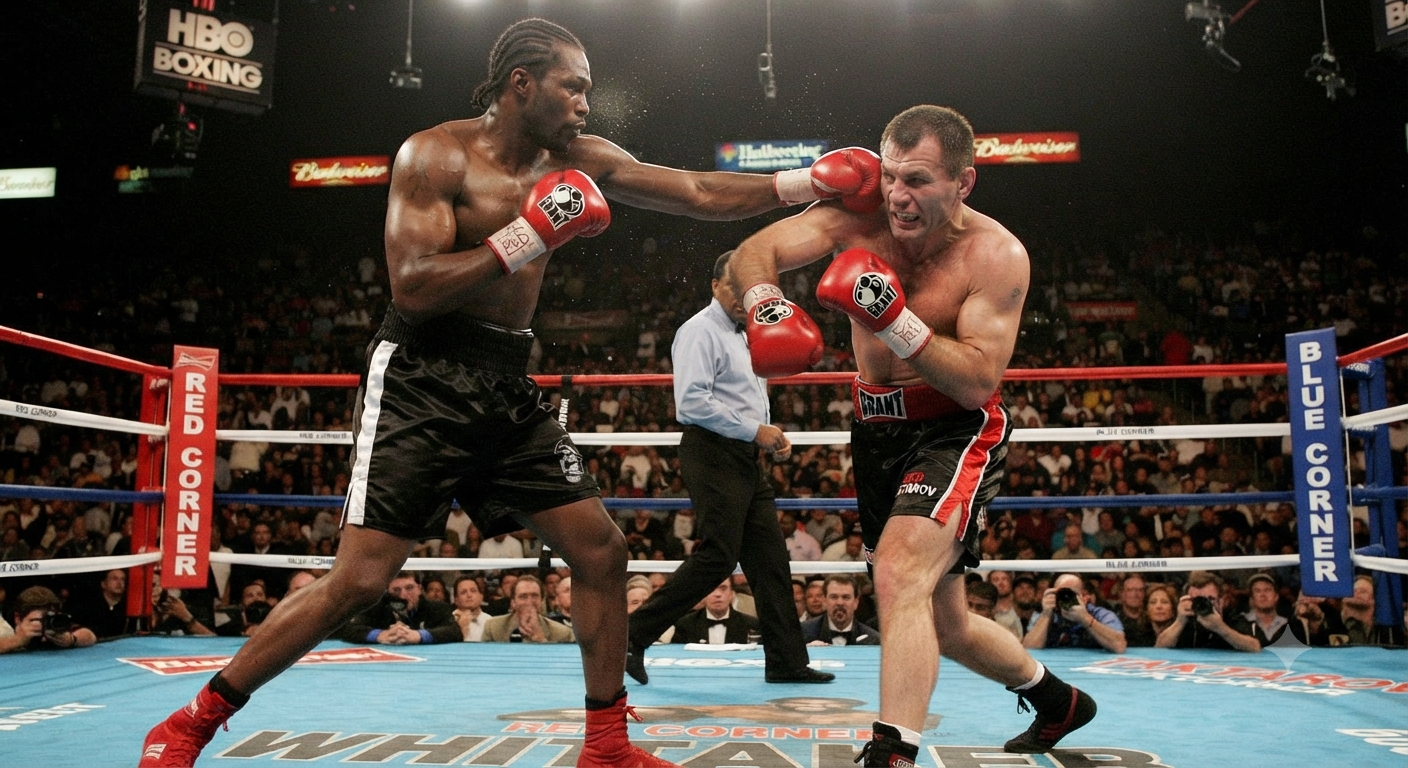
The Lance Whitaker vs Oleg Taktarov matchup has become a surprisingly common combat-sports search. It sounds plausible: Whitaker was a towering American heavyweight boxer, while Taktarov was a rugged Russian submission specialist and early UFC tournament champion.
Yet the most important fact is also the one many online pages miss—there is no credible record that these two men ever met in an official boxing, MMA, kickboxing, or exhibition contest.
That does not make the comparison meaningless. Quite the opposite. Once the historical confusion is cleared up, Lance Whitaker vs Oleg Taktarov becomes an excellent case study in how rules, range, body type, and specialist skills can completely change the likely outcome of a fight.
Quick Answer: Did Lance Whitaker Fight Oleg Taktarov?
No verified fight database or official event record lists a bout between them. Whitaker’s professional boxing record identifies him as a 6-foot-8 orthodox heavyweight with a 35-7-1 record and 28 knockouts, while Taktarov’s documented career belongs primarily to mixed martial arts, including his UFC 6 tournament victory. Their recorded opponent lists do not intersect.
The confusion probably comes from Whitaker’s real fight against Oleg Maskaev on March 10, 2001. Whitaker stopped Maskaev in the second round after hurting him with a right hand and finishing the sequence at 1:03. Maskaev and Taktarov were both Russian combat-sports figures named Oleg, but they were different athletes with different careers.
That distinction is essential. The Lance Whitaker vs Oleg Taktarov search should be approached as a fact-checking question, not accepted as proof of a real event.
Any article claiming to report an official winner of Lance Whitaker vs Oleg Taktarov should be treated cautiously unless it provides a genuine date, venue, sanctioning body, event card, and independently verifiable result.
Lance Whitaker: The Giant Heavyweight Boxer
Lance “Mount” Whitaker was built like a classic super-heavyweight problem. BoxRec lists him at 6 feet 8 inches, with an 84-inch reach, an orthodox stance, and a professional career running from 1996 to 2010.
His official BoxRec profile records 35 wins, seven losses, one draw, and 28 knockouts.
Before turning professional, Whitaker won the 1993 National Golden Gloves super-heavyweight title and the 1994 United States AAU national amateur super-heavyweight championship. Those achievements matter because they show that his size was supported by structured boxing experience rather than raw physicality alone.
Whitaker’s Main Strengths
Whitaker’s most obvious weapon was distance. Against a much shorter opponent, his jab and straight right could force the other man to cross a dangerous stretch of open space before reaching clinching or punching range.
His key advantages included:
- Exceptional height and reach for a heavyweight
- Fight-ending power, reflected in 28 stoppage wins
- A strong amateur boxing foundation
- A long jab and straight-punching lane
- Experience against established heavyweight contenders
The best-known example of Whitaker’s destructive potential was his knockout of Oleg Maskaev. That performance also explains why Lance Whitaker vs Oleg Taktarov can sound believable to readers who remember only the opponent’s first name.
The Washington Post described Whitaker staggering Maskaev early in the second round, following him across the ring, and finishing him with a combination that ended the contest.
Whitaker’s Vulnerabilities
Huge heavyweights are not automatically unbeatable. Their height can become a liability when opponents get underneath the jab, attack the body, force clinches, or make them reset their feet.
Whitaker’s final recorded fight illustrates that danger. Franklin Lawrence, giving away major height and reach, closed the distance and repeatedly landed compact right hands before knocking Whitaker out in the seventh round.
The fight account noted that Whitaker’s slower legs and inadequate inside defense allowed Lawrence to neutralize physical advantages that looked imposing from the outside.
That weakness becomes especially relevant in a hypothetical Lance Whitaker vs Oleg Taktarov MMA contest. Slipping inside would not lead only to punches. It could also produce body locks, trips, takedowns, leg attacks, and submission opportunities.
Oleg Taktarov: The Submission Specialist
Oleg Taktarov represented a completely different combat tradition. Pancrase lists his background as including sambo, judo, wrestling, aikido, kickboxing, and vale tudo, while Sherdog records a professional MMA mark of 17 wins, five losses, and two draws.
Fourteen of those 17 victories came by submission.
Taktarov’s defining achievement came at UFC 6 on July 14, 1995. He submitted Dave Beneteau in the quarterfinal, Anthony Macias in the semifinal, and Tank Abbott in the final to win the tournament.
The final lasted 17 minutes and 45 seconds, demonstrating the patience and endurance that became central to his reputation.
Taktarov’s Main Strengths
Taktarov was not simply a wrestler trying to survive on the feet. His fighting identity was built around positional pressure, clinch control, fatigue management, and opportunistic submissions.
His most important advantages were:
- Elite submission awareness
- Sambo and judo-based grappling
- Proven tournament endurance
- Comfort in chaotic, rule-light contests
- Ability to attack chokes and leg locks
- Patience under physical pressure
Sherdog’s career breakdown credits him with 14 submission wins, representing the overwhelming majority of his victories. That statistical profile makes the central tactical question in Lance Whitaker vs Oleg Taktarov easy to identify: could Taktarov survive long enough to get past the jab and bring the boxer to the floor?
Taktarov’s Vulnerabilities
In the Lance Whitaker vs Oleg Taktarov debate, Taktarov was not a conventional knockout artist. His striking was functional rather than polished at an elite professional boxing level.
He could absorb punishment and create entries, but standing at long range against a 6-foot-8 heavyweight boxer would be an extremely dangerous assignment.
His career also included knockout defeats, showing that toughness did not make him immune to clean power. A specialist grappler who remained upright too long against Whitaker would be giving the boxer exactly the type of contest he needed.
Lance Whitaker vs Oleg Taktarov: Tale of the Tape
| Category | Lance Whitaker | Oleg Taktarov |
|---|---|---|
| Primary sport | Professional boxing | Mixed martial arts |
| Approximate height | 6’8″ | About 6’0″ |
| Approximate reach | 84 inches | Not consistently documented |
| Typical competitive weight | Heavyweight, often above 240 pounds | Roughly 210–215 pounds |
| Recorded professional mark | 35-7-1, 28 knockouts | 17-5-2, 14 submissions |
| Signature skill | Long-range punching power | Submission grappling |
| Major achievement | National amateur titles and regional professional titles | UFC 6 tournament champion |
| Best route to victory | Jab, straight right and early knockout | Clinch, takedown, leg lock or choke |
The Lance Whitaker vs Oleg Taktarov tale of the tape shows why a single prediction is intellectually weak. This matchup cannot be analyzed properly without first defining the rules.
Who Wins Under Professional Boxing Rules?
Under standard boxing rules, Lance Whitaker vs Oleg Taktarov strongly favors Whitaker. Taktarov would not be allowed to use takedowns, trips, throws, submissions, prolonged wrestling, or ground control—the tools that made him historically effective.
Whitaker would also have a dramatic height and reach advantage. His simplest game plan would be to establish the jab, maintain a long stance, punish low entries with uppercuts, and tie up whenever Taktarov rushed inside.
The likely result would be:
Prediction: Lance Whitaker by knockout or technical knockout.
Taktarov’s toughness could extend the contest, particularly if he used a high guard and tried to crowd the taller man. Still, toughness alone is not a substitute for elite defensive boxing.
Every failed entry would expose him to Whitaker’s straight right hand, jab, uppercut, or short combination.
In a boxing-only version of Lance Whitaker vs Oleg Taktarov, the rules remove nearly all of Taktarov’s strongest weapons while protecting Whitaker from the ground game. That is a decisive structural advantage, not merely a stylistic preference.
Whitaker’s Ideal Boxing Game Plan
Whitaker would not need to chase a dramatic knockout immediately. A disciplined approach would reduce unnecessary risk.
He would likely need to:
- Control the center and force Taktarov to initiate.
- Use the jab repeatedly rather than loading up on every punch.
- Step backward at an angle when Taktarov rushed forward.
- Throw the uppercut when Taktarov lowered his level.
- Use legal clinches to prevent messy inside exchanges.
- Attack the body once Taktarov became preoccupied with defending the head.
The longer the fight remained a conventional boxing match, the more comfortable Whitaker would become.
Who Wins Under MMA or Early UFC Rules?
Under MMA rules, Lance Whitaker vs Oleg Taktarov changes sharply. Whitaker’s jab, reach, size, and power would remain dangerous, but he would now need to defend clinches, takedowns, trips, chokes, and lower-body submissions.
Taktarov’s first objective would not be to trade punches. He would likely stay compact, move behind feints, crash into the clinch, and attack Whitaker’s balance.
A very tall boxer presents long legs, a higher center of gravity, and potentially unfamiliar reactions during grappling exchanges. Those are features an experienced sambo practitioner can exploit.
The likely result under MMA rules would be:
Prediction: Oleg Taktarov by submission, provided he survives the opening exchanges.
Whitaker would have a genuine early-knockout chance. One clean right hand, uppercut, or short combination could end the fight before Taktarov established contact.
However, if Taktarov secured a body lock, forced a scramble, or reached one of Whitaker’s legs, the technical gap on the ground would probably become more important than the size gap.
Therefore, the MMA version of Lance Whitaker vs Oleg Taktarov favors Taktarov, but it is not risk-free. The first minute would be the Russian’s most dangerous period; every minute following a successful takedown would increasingly favor his submission game.
Taktarov’s Ideal MMA Game Plan
Taktarov’s plan would need to be direct but carefully timed. Running forward without preparation could lead to a devastating knockout.
A more realistic strategy would involve:
- Keeping a high guard during the opening exchanges.
- Using feints to make Whitaker commit to the jab.
- Entering behind a slipped punch, rather than from open space.
- Connecting his hands around the waist or hips.
- Using an inside trip or body-lock takedown.
- Attacking the legs during the scramble.
- Avoiding unnecessary separation once the fight reached the ground.
Taktarov would not need to hold Whitaker down for several rounds. He would need one controlled scramble in which the boxer exposed his neck, arm, knee, or ankle.
What About Kickboxing Rules?
Kickboxing creates a middle ground, although the exact ruleset matters. If takedowns and extended clinching were prohibited, Whitaker’s reach and hands would still make him the favorite.
Taktarov could use kicks to attack the lead leg, but his recorded career does not suggest that he was a more refined long-range kickboxer than Whitaker was a professional boxer.
Under a ruleset allowing limited throws or aggressive clinch work, Taktarov’s chances would improve. Even then, without submissions or sustained ground fighting, he would lose much of his biggest competitive advantage.
Prediction under conventional kickboxing rules: Whitaker by stoppage or decision.
In this version of Lance Whitaker vs Oleg Taktarov, leg kicks would give Taktarov an additional weapon, but Whitaker’s reach, hands, and size would remain the defining factors.
Why the Matchup Keeps Appearing Online
The phrase Lance Whitaker vs Oleg Taktarov appears to be driven more by name confusion and hypothetical comparison than by an actual event. The strongest explanation is the documented Whitaker–Maskaev bout, combined with Taktarov’s greater recognition among early UFC fans.
Several factors make the mix-up easy:
- Whitaker really did fight a Russian heavyweight named Oleg
- Oleg Maskaev and Oleg Taktarov were active in overlapping eras
- Taktarov became famous among American combat-sports audiences
- Search engines associate related names and combat-sports entities
- Low-quality summaries can repeat an unsupported premise
- Readers may remember the first name but forget the surname
For anyone publishing about Lance Whitaker vs Oleg Taktarov, this is where E-E-A-T matters. A trustworthy page should distinguish established records from speculation, identify conflicting data, link claims to credible databases, and avoid inventing a winner for a fight that never occurred.
Oleg Maskaev and Oleg Taktarov Were Different Fighters
This distinction deserves its own explanation because it solves much of the mystery.
Oleg Maskaev was a Russian-born professional heavyweight boxer. He competed against major boxing names and later became a heavyweight world titleholder.
Oleg Taktarov, by contrast, became famous through early mixed martial arts. His reputation was built around sambo, grappling, submissions, and his UFC 6 tournament victory.
Whitaker fought Maskaev—not Taktarov. The real bout happened on March 10, 2001, and Whitaker won by second-round knockout.
This is the single most useful fact for readers trying to understand why Lance Whitaker vs Oleg Taktarov appears in search results despite the absence of a documented contest.
The Most Realistic Tactical Scenario
A realistic hypothetical Lance Whitaker vs Oleg Taktarov fight would be decided by the first successful phase transition.
If Whitaker maintained boxing distance, the contest could end abruptly. His jab would disrupt Taktarov’s forward movement, while the right cross and uppercut would threaten any poorly timed entry.
If Taktarov reached the clinch without being badly hurt, the advantage could reverse. He would not need to outmuscle Whitaker in a static test of strength.
Instead, he would need to disturb the taller man’s posture, connect his hips, and force a scramble where technical grappling knowledge mattered.
The matchup can therefore be reduced to one clear equation:
Whitaker wins at distance. Taktarov wins through sustained grappling.
That principle is more useful than pretending one athlete was universally “better.” Combat sports are governed by constraints, and the rulebook decides which skills are legal, repeatable, and valuable.
Final Verdict
There was no documented official Lance Whitaker vs Oleg Taktarov fight, so there is no legitimate historical winner. The most likely source of confusion is Lance Whitaker’s real second-round knockout of Oleg Maskaev in 2001.
In a hypothetical matchup, the verdict depends on the sport.
Whitaker should be strongly favored in boxing and conventional kickboxing because of his size, reach, punching mechanics, and professional ring experience. Taktarov should be favored under MMA or early UFC-style rules because of his clinch skill, takedown options, and proven submission record.
The correct takeaway is simple: verify the event before debating the result, and define the rules before choosing a winner.
Frequently Asked Questions
1. Did Lance Whitaker ever fight Oleg Taktarov?
No credible boxing or MMA record shows an official contest between them. Whitaker’s documented boxing ledger and Taktarov’s recorded MMA history list different opponents, with no head-to-head meeting.
2. Who won Lance Whitaker vs Oleg Taktarov?
Nobody won because no verified official fight took place. Pages presenting a definite result may be confusing Taktarov with Oleg Maskaev, whom Whitaker knocked out in the second round on March 10, 2001.
3. Who would win in a boxing match?
Whitaker would be the clear favorite. He was a 6-foot-8 professional heavyweight with an 84-inch reach and 28 recorded knockout wins.
Taktarov’s strongest competitive weapons were grappling and submissions, which boxing rules prohibit.
4. Who would win in an MMA fight?
Taktarov would likely be favored if he could survive Whitaker’s early punching attacks. His route would be to close the distance, establish a clinch, complete a takedown, and pursue a choke or leg lock.
Fourteen of his 17 recorded MMA wins came by submission.
5. Did Lance Whitaker fight Oleg Maskaev?
Yes. Whitaker knocked out Maskaev at 1:03 of the second round on March 10, 2001.
That real bout is the most plausible reason people search for Lance Whitaker vs Oleg Taktarov as though it were a historical event.






Leave a Reply