
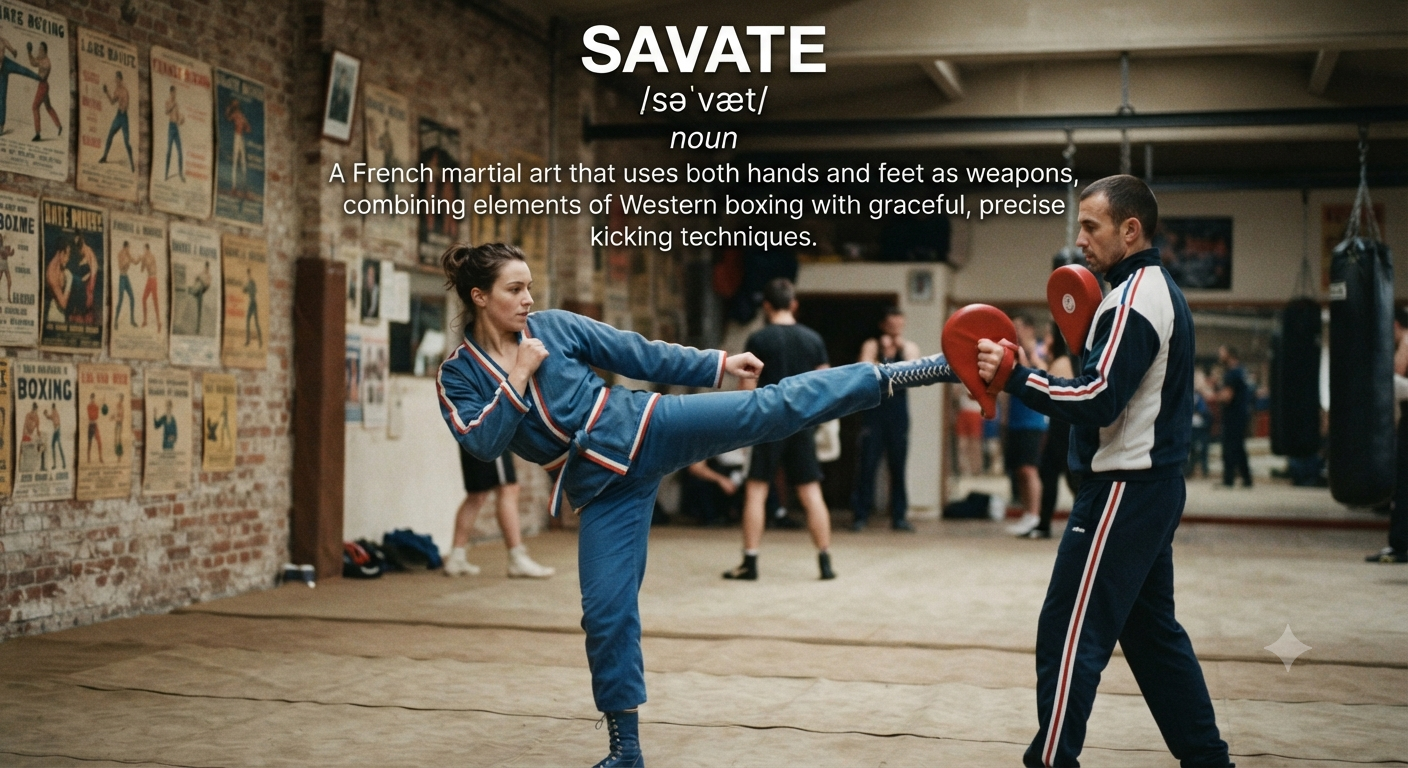
If you are searching for Savate définition in English, the clearest answer is this: savate means “old shoe” or “slipper” in everyday French, but in martial arts it refers to French boxing, a combat sport that combines punches with precise kicks delivered while wearing specialised shoes.
The correct translation depends entirely on context. Cambridge lists “old shoe,” “slipper,” and “French boxing” as English equivalents, while Collins defines the sporting term as a form of boxing in which both the hands and feet may be used.
That short translation answers the vocabulary question, but it does not explain why a combat sport is named after worn footwear, how Savate differs from kickboxing, or what practitioners actually do in training.
This guide provides the full meaning, pronunciation, history, rules, techniques, and cultural context behind the term.
Savate Définition in English: The Direct Meaning
The phrase Savate définition in English can be understood in two ways:
- Literal French-to-English meaning: an old, worn shoe, slipper, or boot.
- Martial-arts meaning: Savate, also called Boxe Française, French boxing, or French kickboxing.
In normal French conversation, une savate may refer to a worn-out shoe or an old slipper. When the word is capitalised, discussed in a gym, or paired with boxe française, it usually identifies the French combat sport.
A concise dictionary-style definition would be:
Savate is a French combat sport in which trained competitors use boxing punches and codified kicks, normally while wearing gloves and specialised footwear.
This definition is more accurate than simply calling it “kickboxing.” Savate has its own history, terminology, legal striking surfaces, competition formats, tactical rhythm, and technical standards.
What Does “Définition” Mean in the Search Phrase?
The word définition is simply the French spelling of definition. Therefore, Savate définition in English effectively means, “What is the definition of savate in English?”
More natural English search queries include:
- What does savate mean in English?
- What is Savate?
- Savate English definition
- Savate French boxing meaning
- What is Boxe Française?
- Is Savate a type of kickboxing?
For Savate définition in English, understanding this language pattern matters because the searcher may want either a translation or a martial-arts explanation.
A complete answer must provide both rather than assuming only one search intent.
How to Pronounce Savate in English
Savate is commonly pronounced approximately “suh-VAT,” with the stress placed on the second syllable. Collins represents the pronunciation as /səˈvæt/.
The final e is not pronounced as a separate syllable. English speakers sometimes say “sa-vayt” or “sa-vah-tee,” but these versions do not closely reflect the standard French pronunciation.
For practical use:
- French-style approximation: suh-VAT
- Stress: second syllable
- Avoid saying: sa-VATE-ee
- Phonetic form: /səˈvæt/
In a Savate définition in English guide, pronunciation is a small but useful detail because it makes conversations with coaches, students, and martial-arts practitioners clearer.
Why Does Savate Mean “Old Shoe”?
For Savate définition in English, the unusual name is best explained through its connection to footwear.
The French word savate historically referred to an old or worn shoe, and modern dictionaries still preserve that literal meaning. The martial art also became strongly associated with kicking and, unlike many barefoot striking systems, competitive Savate uses specially designed footwear.
The exact history behind the name is more complex than one popular legend. Savate grew from several French kicking and self-defence traditions associated with urban fighters, sailors, military training, physical education, and working-class communities.
That evolution is important to Savate définition in English: the sport was not created in one moment by one person. It developed gradually from popular combat practices into a codified discipline.
A Brief History Behind Savate Définition in English
For anyone researching Savate définition in English, history explains why the term now represents far more than a type of shoe.
The French Savate federation traces early forms of savatte to popular fighting practices around Paris. Its historical record identifies Michel Casseux, also known as Michel Pisseux, as the founder of an early Savate training hall in Paris around 1820.
Charles Lecour and the birth of French boxing
In 1838, Charles Lecour reportedly observed an English boxing match and recognised the value of combining English punching methods with French kicking techniques.
This combination helped produce what later became known as boxe française, meaning French boxing. The term was increasingly used during the nineteenth century as the practice moved from informal fighting into organised instruction.
Academic research describes Savate, chausson, and French boxing as combat activities characterised by punching and kicking. Their development can be traced to nineteenth-century France, although official recognition as an organised combat sport came later.
From street practice to technical discipline
Early Savate was connected to practical self-defence and popular fighting. As teachers systematised it, the activity gained:
- formal lessons and dedicated training halls;
- controlled technical movements;
- named punching and kicking techniques;
- rules governing legal strikes;
- protective equipment;
- competitive judging;
- educational and fitness applications.
The International Savate Federation presents the modern discipline as the product of a long transformation. Raw combat methods gradually became a refined martial art built around movement, strategy, control, and technical accuracy.
This history gives Savate définition in English its cultural depth and explains the apparent contradiction in the name. A word once associated with worn footwear and street fighting now identifies a disciplined international sport.
What Is Savate Boxe Française?
Savate Boxe Française is the formal name commonly used for the sporting discipline.
The French federation defines it as a combat sport using striking movements made with specified areas of the feet and the front of the fists. These movements must follow precise technical rules and established mechanical principles.
In practical Savate définition in English terms, the sport combines:
- Western boxing punches;
- specialised foot-based kicks;
- mobile and economical footwork;
- distance management;
- feints and deceptive movements;
- defensive evasions;
- tactical combinations;
- controlled or powerful contact, depending on the format.
The official technical philosophy traditionally stresses that Savate movements should be educational, aesthetically correct, and effective. In other words, athletes are expected to execute techniques with proper form rather than relying only on aggression or physical force.
What are Savate fighters called?
Male practitioners are traditionally called tireurs, while female practitioners are called tireuses.
In this context, the terms refer to the athletes participating in Savate competition. Official French competition documents use these terms when describing competitors in Assaut and Combat.
Savate Définition in English Through Its Core Techniques
The best way to understand Savate définition in English is to examine how the sport moves.
Savate is not simply Western boxing with random kicks added. Its kicking mechanics, striking surfaces, body positions, defensive movements, and combinations are carefully classified.
Fouetté
The fouetté is a whipping, circular kick. It may look similar to a roundhouse kick, but the chambering, striking surface, footwear, and technical mechanics give the Savate version its own character.
A practitioner normally chambers the leg, extends it toward the target, and returns it under control.
Chassé
The chassé is a thrusting or piston-like kick. Depending on the variation and body position, it may resemble either a front kick or a side kick.
The technique is frequently used to:
- maintain distance;
- interrupt an opponent’s advance;
- target the torso;
- create space;
- set up a punching combination.
Revers
The revers is a reverse or sweeping kick delivered through a curved, lateral, frontal, or turning path.
Control is essential because the technique may travel through a wider arc than a direct kick. Timing, flexibility, and spatial awareness determine whether it lands effectively.
Coup de pied bas
The coup de pied bas is a low-line kick performed with distinctive Savate mechanics.
It should not be treated as identical to the shin-driven low kick commonly associated with Muay Thai. Savate kicking rules focus on authorised foot and shoe surfaces rather than simply swinging the shin into the opponent.
Boxing punches
Savate also incorporates recognised Western boxing punches, including:
- the jab;
- the straight rear hand or cross;
- the hook;
- the uppercut.
The real technical challenge is combining punches and kicks without losing balance, distance, defensive awareness, or tactical structure.
The Role of Shoes in Savate Définition in English
In any accurate Savate définition in English, footwear is one of the sport’s clearest identifying features.
Competitors wear special Savate shoes or boots rather than competing barefoot. The footwear allows authorised parts of the foot to be used within a highly controlled striking system.
This changes both technique and tactics. A trained athlete must understand:
- which part of the foot or shoe should make contact;
- which targets are permitted;
- how to control the leg after impact;
- how footwear changes effective range;
- how to avoid illegal or uncontrolled contact.
The shoe is not merely a uniform item. It is an integral part of Savate’s technical identity.
The French federation’s rules describe strikes made with specified surfaces of the feet and the front of the fists. This codification separates Savate from the loose idea of unrestricted kick fighting.
Assaut vs Combat: The Two Main Competition Formats
A technically complete Savate définition in English must distinguish between Assaut and Combat, the two main forms of sporting confrontation.
They share the same technical foundation, but they differ significantly in the amount of permitted force.
Assaut: controlled technical contact
Assaut is the controlled-contact form of Savate competition.
Athletes are judged according to technical mastery, accuracy, tactical intelligence, style, clean touches, and their ability to control each strike. Excessive power is prohibited.
The objective is not to knock out the opponent. A competitor who repeatedly uses excessive force may be warned, penalised, or disqualified.
Assaut is particularly valuable for:
- developing technical control;
- youth participation;
- beginner competition;
- tactical experimentation;
- improving accuracy;
- learning to perform under pressure;
- gaining competitive experience without intentional knockout power.
Although the contact is controlled, Assaut should not be mistaken for an easy or non-competitive activity. It requires speed, timing, endurance, precision, and rapid decision-making.
Combat: power and effectiveness
Combat allows forceful striking under the relevant competition rules.
Judges consider technique, accuracy, effectiveness, tactical behaviour, and competitive performance. Because power is permitted, a stoppage or knockout may occur.
Competitors must wear the required protective equipment and undergo appropriate preparation before entering this format.
The French federation clearly differentiates Combat from Assaut by allowing power in Combat while excluding it from Assaut. This distinction is central to any reliable Savate définition in English explanation.
It also shows why the statement “Savate is always full contact” is inaccurate.
Savate Définition in English vs Kickboxing
People using the query Savate définition in English often want to know whether Savate is simply the French name for kickboxing.
The answer is no, although Savate belongs to the wider family of striking combat sports.
Important differences include:
- Footwear: Savate competitors use specialised shoes, while many kickboxing rulesets require athletes to compete barefoot.
- Kicking surfaces: Savate emphasises defined foot and shoe surfaces.
- Technical vocabulary: Savate uses French names such as fouetté, chassé, revers, and coup de pied bas.
- Competition formats: Savate formally separates controlled Assaut from power-based Combat.
- Historical background: Savate developed from French combat practices and later incorporated English boxing.
- Movement style: Savate often emphasises upright posture, mobility, long-range kicks, rapid combinations, and precise distance management.
- Aesthetic standards: Correct form and controlled execution are important elements of technical evaluation.
“French kickboxing” is therefore a helpful introductory description, especially for someone encountering the sport for the first time.
However, French boxing or Savate Boxe Française is more culturally and technically precise.
Savate Définition in English vs Muay Thai
When Savate définition in English is compared with Muay Thai, both emerge as sophisticated striking arts, but their competitive identities are very different.
Savate primarily focuses on codified punches and foot-based kicks. Athletes normally compete in specialised shoes.
Muay Thai is often called the sport of eight limbs because its competitive system uses fists, elbows, knees, and shins. These weapons create a greater emphasis on close-range striking and clinch-related tactics.
Other broad differences include:
- Savate uses footwear; Muay Thai is normally practised barefoot.
- Savate kicks generally use authorised areas of the foot or shoe.
- Muay Thai frequently uses shin-based round kicks.
- Savate competition does not use the same elbow-and-knee striking structure.
- Savate often prioritises mobile, long-range movement.
- Muay Thai commonly includes stronger close-range and clinch-based exchanges.
Neither system is automatically superior. Their practical value depends on coaching quality, athlete experience, training goals, rules, and the circumstances in which the techniques are applied.
Is Savate a Martial Art, Combat Sport or Self-Defence System?
For Savate définition in English, it can be described as all three, but context matters.
Savate Boxe Française
This is the codified combat-sport branch. It includes technical training, partner drills, Assaut, and Combat competition.
Savate Défense
Savate Défense is a related self-defence discipline. Its training is more specifically oriented toward practical protection rather than only winning a sporting contest.
Sport techniques and self-defence techniques are not automatically identical. Sporting movements are performed within agreed rules, while self-protection training must consider awareness, escape, legal responsibility, uneven environments, and unpredictable threats.
Savate Forme
Savate Forme uses Savate movements in fitness-focused combinations and choreographed training, often accompanied by music.
The French federation describes it as a practice that can support cardiovascular conditioning, physical fitness, and muscular development without requiring direct opposition.
Therefore, a precise Savate définition in English should identify which branch is being discussed instead of presenting every Savate activity as full-contact fighting.
What Skills Does Savate Develop?
A complete Savate définition in English also covers the abilities that regular, properly coached training may develop.
Coordination
Students learn to connect punches, kicks, steps, defensive movements, feints, and changes of direction.
This hand-foot integration can be challenging at first because the athlete must strike without losing posture or balance.
Distance management
Savate teaches practitioners to recognise when they are:
- outside striking distance;
- within kicking range;
- within punching range;
- too close to execute a chosen technique safely.
Understanding range helps athletes choose the correct movement rather than attacking blindly.
Balance
Kicking requires the athlete to stand temporarily on one leg. Proper posture, hip control, supporting-foot placement, and core stability are essential.
Accuracy
Savate is highly dependent on clean targeting and legal striking surfaces.
This becomes especially important in Assaut, where technical control and accurate touches matter more than raw power.
Cardiovascular fitness
Footwork, defensive movement, combinations, pad work, and partner drills can create demanding cardiovascular sessions.
Flexibility and mobility
Regular kicking practice may improve usable hip mobility and leg range when training is progressive and technically supervised.
Tactical awareness
Athletes learn to recognise rhythm, reactions, openings, habits, and predictable defensive patterns.
They also learn how to create an opening through feints rather than waiting for one to appear.
Self-control
Control is particularly important in Assaut. Competitors must execute fast, accurate techniques without turning every contact into a power strike.
These benefits are not automatic. They depend on consistent attendance, qualified instruction, sensible progression, appropriate recovery, and safe training partners.
Is Savate Suitable for Beginners?
For beginners reading Savate définition in English, the practical answer is yes: Savate can be beginner-friendly when taught in a structured club.
New students normally begin with:
- stance and guard;
- basic footwork;
- straight punches;
- introductory kicks;
- defensive movements;
- balance drills;
- pad or bag work;
- controlled partner exercises.
Beginners should learn control before attempting maximum speed or power. A technically correct kick delivered slowly is more useful than a wild kick delivered forcefully.
A responsible programme should prioritise:
- safe posture and movement;
- correct striking surfaces;
- control before power;
- defensive awareness;
- progressive conditioning;
- suitable protective equipment;
- gradual introduction to sparring.
Students should not judge a school only by how exhausting or aggressive its classes appear. Coaching quality, safeguarding, technical correction, cleanliness, and responsible contact levels matter more than theatrical toughness.
How to Choose a Club After Reading Savate Définition in English
After learning Savate définition in English, the next practical step may be finding legitimate instruction.
Look for a club that offers:
- affiliation with a recognised national Savate organisation;
- coaches with verifiable qualifications;
- clear beginner instruction;
- separate technical and sparring progressions;
- suitable safety procedures;
- maintained training equipment;
- controlled contact for inexperienced students;
- a respectful training culture;
- transparent grading or competition pathways.
Observe a class before committing to long-term membership.
Students should be corrected constructively, sparring intensity should reflect ability, and beginners should not be pressured into hard contact before they have developed the necessary defensive skills.
The International Savate Federation is the worldwide governing organisation for Savate and Canne de Combat. National bodies organise domestic clubs, coaching qualifications, technical development, and competition structures.
Common Misunderstandings About Savate Définition in English
“Savate only means a shoe”
That is the literal dictionary meaning, but the word also identifies a recognised French combat sport.
Context determines which definition applies.
“Savate is identical to kickboxing”
Savate belongs to the wider family of striking sports, but its footwear, French terminology, kicking mechanics, history, and competition formats give it a distinct identity.
“All Savate bouts are full contact”
This is incorrect.
Assaut excludes power and rewards control, precision, style, and technical quality. Combat allows powerful striking under its specific rules.
“Savate is only about kicking”
Modern Savate Boxe Française combines punches and kicks.
The ability to move smoothly between hand and foot techniques is a central part of Savate strategy.
“Savate fighters kick with their shins”
Savate’s sporting system is based on authorised areas of the foot or shoe rather than treating the shin as the main kicking surface.
“Special shoes make kicking easy”
Shoes change the striking system, but they do not remove the need for timing, balance, flexibility, distance control, and accuracy.
Poorly delivered kicks remain ineffective and may become unsafe.
“Controlled contact means there is no competition”
Assaut can be highly competitive. Athletes must demonstrate speed, timing, tactical awareness, accuracy, and emotional control while avoiding excessive power.
Savate Définition in English: A One-Sentence Answer
Here is the simplest accurate answer:
Savate is a French martial art and combat sport, also called French boxing, that combines Western boxing punches with technically codified kicks delivered while wearing specialised shoes; the French word itself literally means an old shoe or slipper.
That sentence satisfies both translation intent and sporting intent without oversimplifying either.
Frequently Asked Questions
1. What is the exact English meaning of the French word “savate”?
In ordinary French, savate can mean an old shoe, worn-out shoe, or slipper.
In a martial-arts context, it means Savate, French boxing, or sometimes French kickboxing. Cambridge’s French-English entry includes both the everyday footwear meanings and the combat-sport meaning.
2. Is Savate the same as French boxing?
Yes. Savate Boxe Française and French boxing refer to the same core combat sport.
The term “Savate” highlights its French kicking roots, while “Boxe Française” reflects the later combination of those kicking methods with English-style boxing punches.
3. Are knees and elbows allowed in competitive Savate?
Standard Savate Boxe Française competition focuses on codified punches and kicks.
It should not be confused with Muay Thai, whose competitive system includes fists, elbows, knees, and shins. Exact permitted actions, targets, equipment, and contact levels should always be checked in the current regulations of the relevant federation or event.
4. Why do Savate fighters wear shoes?
Shoes are part of Savate’s history and technical identity.
Special footwear supports a system in which defined areas of the foot or shoe are used for authorised kicks. Because footwear affects distance, contact, and striking surfaces, competitors must learn accurate and controlled delivery.
5. Is Savate effective for fitness and self-defence?
Savate training can support cardiovascular fitness, coordination, balance, mobility, timing, distance control, and striking ability.
Its sporting branch is designed for regulated competition, while Savate Défense is more specifically oriented toward self-protection. Practical effectiveness depends on the instructor, training realism, individual consistency, and the situation in which the skills are applied.
Conclusion: Understanding Savate Définition in English Clearly
The most accurate response to Savate définition in English is not limited to one translation.
Literally, savate means an old shoe or slipper. Technically, Savate is French boxing: a refined striking sport that combines Western boxing punches, distinctive foot-based kicks, specialised footwear, disciplined movement, and tactical control.
Remember the three essentials:
- Assaut rewards controlled, accurate, and technically polished contact.
- Combat permits power and may result in a stoppage.
- Boxe Française is the formal sporting identity of Savate.
To move beyond Savate définition in English, watch a class taught by a qualified instructor, compare its footwork and kicking mechanics with other striking arts, and consult the latest rules of a recognised Savate federation before training or competing.








Leave a Reply