
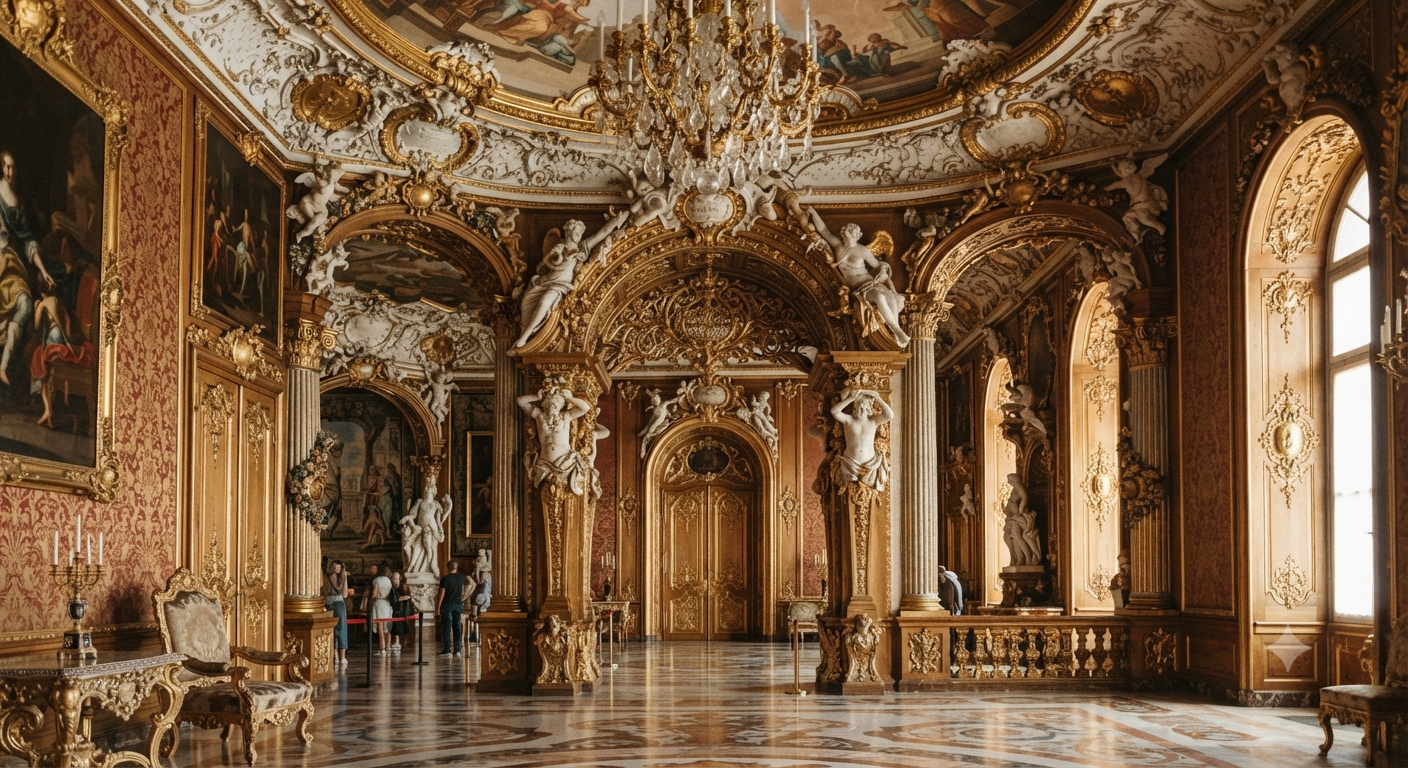
If you are wondering what Ornate means, the simplest answer is highly decorated, elaborate, or covered with detailed ornamentation. The adjective “ornate” is commonly used for buildings, furniture, jewelry, clothing, interiors, and other things that have many decorative details. It can also describe language or writing that is unusually elaborate or filled with decorative wording.
That basic definition is useful, but it does not tell the whole story. Ornate means more than merely attractive or decorated: the word usually suggests a noticeable richness of detail, and in some contexts it can hint that the decoration or language feels excessive. Merriam-Webster defines the adjective in terms of elaborate decoration and florid style, while Cambridge similarly notes complicated decoration and, for language, wording that can be overly complicated.
Quick Meaning of Ornate
In everyday English, Ornate means elaborately decorated or designed with many intricate details. A plain wooden frame, for example, is decorative only if it has some visual embellishment; an ornate frame is more likely to feature carved leaves, scrolls, flowers, gilding, repeating motifs, or other conspicuous details.
The word can describe both physical appearance and style of expression. That is why you might hear about an “ornate palace” in a travel description and “ornate prose” in a book review. In both cases, the underlying idea is the same: something has been made more elaborate through added detail.
What Does Ornate Mean in Simple English?
Put simply, Ornate means “very decorated” or “decorated in a detailed and elaborate way.” It usually describes something that looks richer and more complex than a simple or minimalist version of the same thing.
Imagine two doors. One is a flat wooden panel with a plain handle; the other has carved vines, decorative metalwork, patterned glass, and a sculpted frame. The second door would naturally be described as ornate because its appearance depends heavily on embellishment and intricate design.
The same logic works with language. A sentence that communicates an idea directly is plain, while a sentence loaded with elaborate metaphors, unusual adjectives, and ceremonial phrasing may be called ornate. Cambridge notes that this literary use can carry a mainly disapproving tone when the wording feels unnecessarily complicated.
Ornate Means More Than “Beautiful”
A common mistake is treating “ornate” as a direct synonym for beautiful. It is not. Something can be ornate and beautiful, but it can also be ornate and unattractive, overwhelming, old-fashioned, theatrical, or excessive.
The word primarily describes the amount and complexity of decoration, not whether the speaker personally likes it. An ornate gold ceiling may impress one visitor and feel gaudy to another. Both people can accurately call it ornate because the term identifies the elaborate decorative style rather than giving a simple positive rating.
This distinction matters in precise writing. If you say a necklace is beautiful, you are evaluating its appearance; if you say it is ornate, you are describing its elaborate construction or embellishment. The two ideas often overlap, but they are not interchangeable. This is why Ornate means something more specific than a general compliment.
Ornate Pronunciation and Part of Speech
“Ornate” is an adjective, so it modifies a noun: ornate chair, ornate costume, ornate architecture, ornate lettering, or ornate language. Merriam-Webster gives the pronunciation approximately as or-NATE, with the main stress on the second syllable.
The related adverb is ornately, as in “the hall was ornately decorated,” and the noun is ornateness, referring to the quality of being ornate. Merriam-Webster lists both derived forms.
Ornate Meaning in Architecture and Interior Design
In architecture, Ornate means richly embellished with visible decorative detail. The word may be used for carved stonework, moldings, patterned ceilings, elaborate columns, decorative facades, metalwork, mosaics, gilded surfaces, sculptural details, or richly worked doors and windows.
Calling a building ornate does not identify one specific architectural period. It describes what you can observe about its decoration. A historic theater, religious building, palace, mansion, civic hall, or even a modern luxury interior can be described as ornate if the design relies heavily on visual embellishment.
This makes the term especially useful when contrasting design philosophies. Minimalist design tends to reduce decorative elements, while an ornate design draws attention to surface treatment, craftsmanship, pattern, texture, and detail.
Ornate Meaning in Writing and Speech
When used for language, Ornate means elaborate, embellished, or rhetorically decorative. Merriam-Webster specifically connects the term with elaborate rhetoric or florid style, while Collins describes ornate writing as overembellished or flowery.
This use is often more critical than the visual one. A reviewer might praise a novelist’s ornate prose when the elaborate language creates atmosphere, but another reviewer could use the same phrase to suggest that the writing is showy, dense, or harder to understand than necessary.
Context therefore determines whether “ornate” sounds admiring, neutral, or disapproving. When discussing physical design, it may simply signal richness and detail. When discussing prose, speeches, or rhetoric, it more often invites the question: does the decoration add beauty, or does it get in the way of clarity?
Ornate Meaning With Examples
Seeing the adjective in realistic sentences is one of the fastest ways to understand it. In all of the examples below, Ornate means that the object or style contains noticeably elaborate decorative detail.
- The hotel lobby had an ornate ceiling covered in carved patterns and gold accents.
- She wore an ornate necklace set with colored stones and delicate metalwork.
- The antique cabinet had ornate handles and floral carvings.
- Visitors stopped to photograph the ornate entrance of the old theater.
- His ornate writing style impressed some readers but frustrated others.
- The invitation used ornate lettering that looked elegant but was difficult to read.
- A simple frame would suit the room better than the ornate one.
- The designer balanced an ornate mirror with plain, modern furniture.
Notice that the adjective works naturally before nouns and can also appear after linking verbs, as in “the decoration was ornate.” The key is that the thing being described should genuinely possess a high degree of embellishment.
Ornate Synonyms: Which Word Should You Choose?
If Ornate means richly or elaborately decorated, several nearby words may seem interchangeable. They are related, but each carries a slightly different emphasis.
| Word | Best Used When You Want to Emphasize |
|---|---|
| Elaborate | Complexity, detail, or careful construction |
| Decorative | The purpose of making something more attractive |
| Ornamental | Decoration rather than practical function |
| Embellished | Added details or adornments |
| Lavish | Richness, abundance, or expense |
| Opulent | Luxurious richness and wealth |
| Showy | Conspicuous display, sometimes with criticism |
| Florid | Excessively elaborate style, especially language |
“Decorative” is broader and weaker than “ornate.” Merriam-Webster defines decorative as serving to decorate, whereas its definition of ornate emphasizes elaborate or excessive decoration. That difference explains why a single patterned cushion may be decorative without being ornate.
“Florid” is particularly useful when the subject is writing or rhetoric, while opulent places more emphasis on luxury and wealth. “Elaborate” is often the safest substitute when you want to stress complexity without strongly implying beauty, luxury, or excess.
Ornate Antonyms and Opposite Meanings
To understand Ornate means more clearly, compare it with its conceptual opposites. Words such as plain, simple, unadorned, undecorated, austere, restrained, minimalist, and spare generally point away from embellishment.
A plain room may still be carefully designed, and a minimalist object can still be expensive or beautiful. The contrast is about visual or verbal complexity. Ornate styling adds detail; restrained styling removes or limits it.
This is why “simple” and “ornate” often work well as opposites in product descriptions, design writing, and literary criticism. The contrast is immediately understandable because it focuses on the degree of decoration.
Ornate vs. Elaborate
People often ask whether ornate and elaborate mean exactly the same thing. Not quite. Ornate means elaborately decorated, whereas elaborate can describe anything that is highly detailed, complicated, or carefully developed, even when decoration is not involved.
An elaborate plan may contain dozens of stages, but calling a plan ornate would sound unusual unless you were criticizing its rhetorical presentation. An ornate chair, on the other hand, is likely to have visible carved, painted, gilded, patterned, or sculpted decoration.
Use elaborate for complexity in general. Use ornate when decoration, embellishment, or stylistic richness is central to what you mean.
Ornate vs. Decorative
“Decorative” simply indicates that something contributes to appearance or ornamentation. Ornate means a higher degree of decoration—usually enough detail that the decoration becomes one of the object’s defining characteristics.
A small stripe on a vase is decorative. A vase covered in raised floral motifs, metallic accents, sculpted handles, and intricate borders is ornate. This difference in intensity makes “ornate” a more vivid and specific adjective.
The distinction also prevents exaggerated descriptions. Calling every attractive object ornate weakens the word; reserve it for things whose embellishment is genuinely elaborate.
Ornate vs. Opulent
“Ornate” focuses on detail, while “opulent” focuses more strongly on luxury, richness, and abundance. A handcrafted wooden screen can be highly ornate even if it is not made from expensive materials.
An opulent hotel suite may include marble, silk, large spaces, expensive furniture, and luxurious finishes without every object being intricately decorated. The terms overlap frequently, but they describe different dimensions of style.
When both apply, “ornate and opulent” is not necessarily redundant. It can mean that a place is both elaborately decorated and visibly luxurious.
Is Ornate a Positive or Negative Word?
One reason people search Ornate means is that the word’s emotional tone changes with context. In a museum guide, architecture article, jewelry description, or historical discussion, “ornate” can be neutral or admiring.
In criticism, however, it can suggest too much decoration. Merriam-Webster explicitly includes the possibility of excessive decoration, while Cambridge marks its description of overly complicated ornate language as mainly disapproving.
A useful test is to look at the noun being described and the surrounding adjectives. “Beautifully ornate woodwork” is clearly complimentary. “Needlessly ornate prose” is clearly critical. The adjective itself leaves room for both reactions.
Where Does the Word Ornate Come From?
The history of the word helps explain its modern meaning. Etymonline traces “ornate” in English to around 1400 and links it to Latin ornatus, associated with being furnished, adorned, decorated, or embellished; it also notes that the earliest English reference concerned literary style.
That history is interesting because modern English still uses the word in those same two broad areas: physical decoration and expressive style. The connection between adornment and carefully worked language has survived for centuries.
Understanding the origin also makes related words easier to recognize. Ornament, ornamental, ornamentation, ornate, ornately, and ornateness all belong to the same semantic family of adornment and decorative addition. Etymonline also traces “ornamental” through “ornament,” reinforcing that shared history.
Common Mistakes When Using Ornate
The first mistake is assuming Ornate means simply “old.” An object can be antique without being ornate, and a newly made object can be extremely ornate. Merriam-Webster defines “antique” in terms of age or an earlier period or style, which is a different concept from elaborate decoration.
The second mistake is using “ornate” only for expensive things. Price is not part of the core meaning. A low-cost handmade box covered in intricate painted patterns may be ornate, while an expensive minimalist watch may not be.
The third mistake is overlooking the potentially negative tone. If you describe a colleague’s report as “ornate,” they may hear that as criticism of unnecessarily elaborate language. For professional communication, “detailed,” “polished,” or “elegant” may be safer if you do not intend to imply excess.
How to Use Ornate Naturally
Once you know Ornate means richly detailed rather than simply attractive, usage becomes straightforward. Choose the word when decoration is visually or stylistically prominent enough to deserve attention.
It works particularly well with nouns such as architecture, ceiling, facade, frame, furniture, jewelry, mirror, carving, pattern, lettering, design, costume, prose, language, and style. These nouns can naturally carry visible or rhetorical embellishment.
Before using the word, ask one question: “Am I describing beauty, or am I describing elaborate decoration?” If your main point is beauty, choose “beautiful” or “elegant.” If your main point is intricate embellishment, “ornate” is more precise.
Why the Exact Meaning Matters
Understanding Ornate means more accurately improves both vocabulary and descriptive writing. Strong writers do not choose synonyms only because they sound similar; they choose words according to the exact feature they want readers to notice.
“Beautiful,” “luxurious,” “decorative,” “elaborate,” and “ornate” can all appear in the same description, yet each contributes something different. The more precisely you separate those meanings, the more vivid and trustworthy your writing becomes.
This precision is especially useful in architecture, fashion, interior design, art criticism, literature, product descriptions, travel writing, and academic vocabulary. In those contexts, remembering what Ornate means helps prevent vague or misleading description. A well-chosen adjective can communicate several visual or stylistic qualities without forcing the reader through a long explanation.
FAQ About Ornate Means
What does ornate mean in one word?
If you need a one-word equivalent, Ornate means roughly elaborate. Depending on context, “embellished,” “decorated,” “lavish,” or “florid” may also work, but none is an exact substitute in every sentence.
The most reliable choice depends on what is being described. For physical objects, “elaborately decorated” is usually the clearest paraphrase; for writing, “florid” or “overembellished” may capture the intended nuance better.
What does ornate mean in a sentence?
In the sentence “The room had an ornate ceiling,” Ornate means the ceiling contains a great deal of detailed decoration. It might include carved patterns, painted motifs, moldings, gold accents, or other elaborate features.
The adjective tells you about the ceiling’s decorative complexity, not merely its age, cost, or beauty.
Does ornate mean fancy?
Sometimes, but “fancy” is broader and more informal. Ornate means specifically that something is elaborately decorated or stylistically embellished, while “fancy” can also mean expensive, sophisticated, special, or high-class depending on context.
So an ornate chair may look fancy, but a sleek luxury car can also be called fancy even if its design is visually minimal.
Can a person be described as ornate?
Usually the word describes a person’s clothing, accessories, appearance, language, or style rather than the person directly. You might say “she wore an ornate costume” or “he spoke in an ornate style.”
Calling a person “ornate” is possible as a creative or literary choice, but it sounds less natural in everyday English than applying the adjective to something the person wears, creates, or says.
What is the difference between ornate and ornamental?
Ornate means heavily or elaborately decorated, while ornamental generally means serving as decoration or adding visual attractiveness. Something ornamental does not have to be highly detailed.
For example, a simple ribbon attached for appearance can be ornamental, but an ornate ribbon design would suggest intricate patterns, embroidery, beading, or other elaborate details. Etymonline traces “ornamental” to the ornament word family, which helps explain the close relationship between the terms.
Final Takeaway
The easiest definition to remember is this: Ornate means elaborately decorated, richly detailed, or stylistically embellished. It can describe physical objects such as buildings, jewelry, furniture, and clothing, as well as language that is florid or unusually elaborate.
Use the word when decoration and complexity are central to what you are describing, not simply when something looks beautiful. The next time you encounter “ornate,” check whether the writer is emphasizing intricate design, rhetorical flourish, or even excess; that context will tell you exactly how the word is being used.











Leave a Reply