
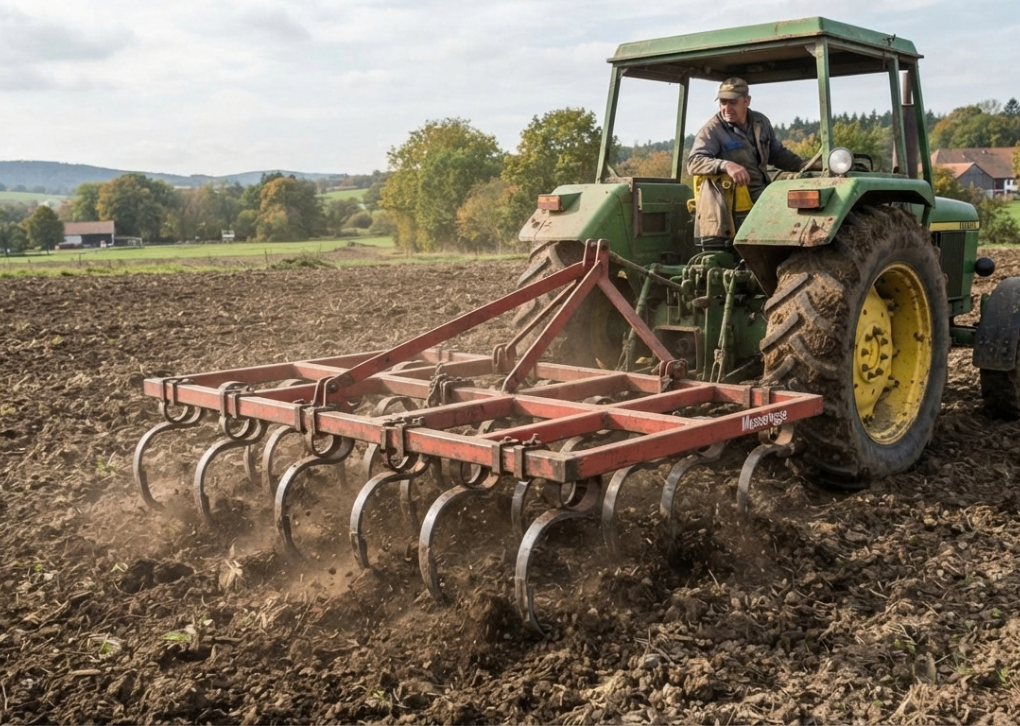
Messeregge is an uncommon word in English search results, but it refers to a real piece of agricultural equipment rather than a new messaging term, a digital concept, or a place name. In German farming terminology, the word is associated with a knife- or blade-equipped harrow used for shallow soil preparation, clod breaking, leveling, and seedbed work. Duden defines Egge as an agricultural implement used for superficial loosening and crumbling of soil and for weed control, while Messer means a cutting tool or blade.
That distinction matters because search results for Messeregge currently contain several conflicting explanations. Manufacturer documents provide the clearest evidence: Kerner Maschinenbau identifies “ME” as Messeregge in its TORON front-packer literature and lists dedicated knife components for the implement, while Fliegl sells a 3,000 mm unit for front mounting with its Profiwalze system.
What Does Messeregge Mean?
The most useful English rendering is knife harrow or knife-equipped harrow. German compound nouns often combine words that describe an object’s function or construction, and here the relevant components are Messer and Egge: blade/knife plus harrow.
The term should not be confused with Messe, the German word commonly used for a fair or exhibition. Some online articles have tried to connect the keyword with trade-show design or branding, but current agricultural manufacturer documentation points to a physical soil-working implement with replaceable knives, a frame, and defined working specifications.
Why the Definition Became Confusing Online
Uncommon foreign-language keywords are easy to misinterpret when pages repeat one another without checking technical sources. That appears to have happened here: recent search results contain claims about digital communication, business concepts, and other meanings, while actual machinery documentation uses the term in a consistent agricultural context.
For readers, the safest rule is simple: if the term appears beside tractors, front packers, rollers, seedbed preparation, working depth, or replaceable wear parts, it is referring to agricultural equipment.
How a Messeregge Works
A Messeregge works by bringing blade-like working elements into contact with the upper soil layer. Its exact geometry depends on the manufacturer and configuration, so it should not be treated as one universal machine design.
In a front-mounted setup, the knives engage rough soil before the tractor and rear-mounted implement complete the next operation. Fliegl describes its front-mounted 3 m version as a tool for breaking larger clods so a more exact and uniform seedbed can be produced.
Kerner takes a modular approach. Its TORON front packer can be equipped with several pre-tools, including a knife harrow, spring-tine harrow, and Crossboard; the manufacturer describes the overall machine as combining crumbling, leveling, and reconsolidation in one implement.
Typical Soil-Working Sequence
In practical terms, the operation may look like this:
- Cut or strike coarse surface material: knives engage clods and irregularities.
- Crumble and level: the soil surface becomes more uniform ahead of the next working element.
- Reconsolidate where a packer is used: roller or packer elements can firm the prepared layer.
- Continue with drilling or secondary cultivation: depending on the farm’s machinery combination, another implement can follow in the same pass.
The exact outcome depends on soil moisture, clod size, previous tillage, working depth, forward speed, blade condition, and the equipment paired with the harrow. That is why setup should be based on field conditions rather than on a single fixed setting.
Messeregge Specifications: What Real Manufacturer Data Shows
One of the biggest weaknesses in many articles on this topic is that they give generic claims without showing what a real machine looks like on paper. Kerner’s current TORON documentation provides a useful reference point.
For the TORON configuration, Kerner lists ME = Messeregge, a frame height of 250 mm, 24 tines/working elements for the ME configuration, a 125 mm line spacing, and an adjustable working depth of 0–10 cm for the listed pre-tool configurations. The TORON is offered in 2.5 m, 3 m, and 3.5 m working widths.
Those figures should not be treated as universal specifications for every knife harrow. Fliegl, for example, markets a 3,000 mm front-mounted accessory for its Profiwalze, and its product page describes the attachment specifically as a clod-breaking aid for a more even seedbed.
That difference is important. Messeregge describes a type or configuration of soil-working equipment, not one standardized model with a single weight, width, depth, or blade count.
Where Farmers Use a Messeregge
The implement is most relevant when the top layer of a field needs additional preparation before sowing or before another cultivation stage. Its purpose is not necessarily deep tillage; instead, it can form part of a shallow or combined seedbed-preparation system.
Common use cases include:
- breaking larger clods left after primary cultivation;
- leveling an uneven surface before drilling;
- preparing soil ahead of a rear-mounted seedbed or sowing combination;
- pairing a front tool with a roller or packer;
- reducing the need for a completely separate surface-working pass when conditions allow.
Fliegl’s description explicitly links its unit with breaking larger clods and creating a more precise, uniform seedbed, while Kerner positions the knife-harrow option as one of the pre-tools available on a front packer designed for crumbling, leveling, and reconsolidation.
Messeregge vs. Other Harrow Types
Calling every harrow the same thing hides important mechanical differences. A farmer choosing between knife, tine, disc, or leveling systems should look first at the working element and desired soil effect.
| Implement type | Main working element | Typical role |
|---|---|---|
| Knife harrow | Blade- or knife-like parts | Clod breaking and shallow surface preparation |
| Spring-tine harrow | Flexible tines | Loosening, leveling, residue movement |
| Disc harrow | Concave discs | Cutting, mixing, and more aggressive soil disturbance |
| Crossboard/leveling board | Rigid or sprung leveling sections | Leveling and crushing clods |
| Roller/front packer | Rings, discs, or roller elements | Reconsolidation and surface finishing |
Duden’s definition of an Egge emphasizes superficial loosening, crumbling, and weed control as the general functions of harrowing equipment, but the final effect varies significantly by implement design.
Messeregge vs. Spring-Tine Harrow
A spring-tine harrow works through flexible teeth, while a knife-based design uses cutting elements. Kerner itself lists Messeregge and Federzinkenegge as separate pre-tool options on the TORON, confirming that they are not simply two names for the same component.
Selection therefore depends on the field problem. If the aim is to attack coarse clods with cutting or striking elements, a knife setup may be appropriate; where greater flexibility, scratching action, or residue movement is needed, spring tines may be preferable.
Benefits of Using a Messeregge
The strongest benefits are operational rather than magical. A well-matched system can improve the condition of the surface before planting and may let farmers combine multiple field actions.
Potential advantages include:
- Finer surface structure: breaking coarse clods can make the seedbed more uniform.
- Better leveling: a smoother surface can make subsequent drilling or cultivation easier.
- Combined operations: when mounted with a front packer or used ahead of another implement, several jobs can occur in one tractor pass.
- Adjustability: some systems allow working depth or working angle changes for different conditions.
- Replaceable wear parts: Kerner’s wear-parts catalogue lists straight, left, and right knife components for its system, showing that high-wear elements are serviceable.
Whether these advantages translate into lower fuel use, fewer passes, or better crop establishment depends on the complete machinery combination and field conditions. Those outcomes should be measured on the farm rather than assumed from the implement name alone.
Limitations and Field Conditions to Consider
A knife harrow is not automatically the best choice for every field. Very wet soil can smear or compact under machinery, while extremely dry, hard clods may require a different sequence, greater weight, or another cultivation tool.
Residue levels matter too. Blade spacing, frame clearance, and the design of the following packer or roller affect whether material flows cleanly through the machine. Operators should also inspect worn, bent, or damaged knives because poor wear condition changes the way the tool engages the soil.
Working depth deserves special attention. Kerner lists 0–10 cm for its TORON pre-tool arrangement, but that is a manufacturer specification for that product family, not a universal target.
How to Choose the Right Messeregge Setup
Buying or configuring this tool should start with the agronomic job, not with the product name. Ask what needs to happen to the soil before the next operation.
1. Define the Field Problem
Is the main issue large clods, an uneven surface, shallow crusting, or the need to combine front and rear operations? A clear goal prevents buying a tool that duplicates equipment already on the farm.
2. Match Working Width to the Tractor and Rear Implement
Front and rear combinations should be compatible in working width, linkage capacity, transport width, and tractor balance. Fliegl’s accessory, for instance, is designed around a 3 m Profiwalze configuration, while Kerner lists TORON widths from 2.5 to 3.5 m.
3. Check the Adjustment Range
Look at working depth, angle adjustment, ballast options, and how quickly the operator can change settings. A machine that can be tuned to variable soil conditions is generally more versatile than one operated at the same aggressive setting everywhere.
4. Examine Wear Parts and Service Access
Knives are soil-engaging parts, so wear is inevitable. Check the cost and availability of straight, left, and right components, fasteners, mounting hardware, and frame parts before purchase.
Kerner’s parts catalogue demonstrates why model-specific wear-part identification matters. Its catalogue separately identifies several knife components associated with its equipment.
5. Evaluate the Complete Pass
Do not judge the harrow in isolation. Consider what the front tool, tractor tires, rear cultivator, drill, and roller are doing together.
The best setup is the one that leaves the required seedbed with acceptable draft, fuel use, residue flow, and field capacity. A machine that performs well alone may behave differently once it becomes part of a full front-and-rear cultivation combination.
Maintenance and Safe Operation
Regular inspection keeps soil-engaging equipment working consistently. Before entering the field, check knives, mounting points, frame welds, linkage components, hydraulic connections where fitted, and any adjustment mechanisms.
Replace heavily worn or damaged cutting parts with the correct manufacturer-specified components. After work, remove packed soil and crop residue, inspect for loosened hardware, and follow the machine manufacturer’s lubrication, transport, and safety instructions.
Never work beneath raised equipment unless it is mechanically secured according to the manufacturer’s procedure. Agricultural implements are heavy, and stored hydraulic or gravitational energy can cause severe injury.
Common Misconceptions About Messeregge
The keyword’s unusual spelling has produced a surprising amount of misinformation. Three points are worth separating clearly.
It is not simply another spelling of “message.” Some recent pages describe it as internet slang, but agricultural manufacturer literature documents the term as machinery terminology.
It is not derived from “Messe” in the sense of a trade fair. The agricultural interpretation aligns with Messer—knife or blade—and Egge—harrow.
It is not one single standardized machine. Different manufacturers and equipment families can use different widths, frames, knife arrangements, packers, and adjustment systems. Real product documentation should always take priority over generic descriptions.
Why Messeregge Matters in Modern Seedbed Preparation
The broader value of this tool lies in operation stacking: performing useful surface preparation at the front of the tractor while another task happens behind it. Kerner’s front-packer concept is explicitly designed around combining crumbling, leveling, and reconsolidation, and Fliegl markets its knife-harrow accessory as a front-mounted clod-breaking aid.
That makes the technology relevant wherever farmers are trying to prepare an even seedbed efficiently within a limited weather window. The implement itself is only one part of the system, but when matched correctly to soil, tractor, packer, and rear tool, it can contribute to a more streamlined cultivation sequence.
FAQ About Messeregge
What Is a Messeregge in English?
The closest practical English translation is knife harrow or knife-equipped harrow. The German components Messer and Egge refer respectively to a knife/blade and an agricultural harrow.
This description is more useful than treating the term as the name of one fixed machine. Manufacturers may use different frames, widths, working-element arrangements, and packer combinations.
What Is a Messeregge Used For?
It is used for shallow soil preparation, especially breaking larger clods, leveling the surface, and helping create a more uniform seedbed. Fliegl specifically describes its front-mounted version as a clod-breaking tool used to improve seedbed uniformity.
It may also be incorporated into a larger cultivation combination so that surface preparation and another field operation occur during the same tractor pass.
Is a Messeregge the Same as a Disc Harrow?
No. A knife harrow uses blade-like or knife components, while a disc harrow works with rotating discs.
They can overlap in broad soil-cultivation goals, but their mechanical action and degree of soil disturbance differ. The appropriate choice depends on soil structure, residue conditions, required depth, previous tillage, and the desired seedbed.
How Deep Does a Messeregge Work?
There is no single universal depth. Kerner lists a 0–10 cm working-depth range for the pre-tool configurations in its TORON documentation, but settings and limits vary by manufacturer, model, soil condition, and intended operation.
That manufacturer figure should therefore be treated as an example rather than an industry-wide specification. Always follow the operating manual for the exact machine being used.
Can a Messeregge Be Mounted on the Front of a Tractor?
Yes. Current Fliegl and Kerner equipment documentation shows front-mounted applications and front-packer combinations.
Fliegl offers a 3,000 mm accessory specifically described for front mounting, while Kerner offers the knife-harrow configuration as a pre-tool on the TORON front packer.
Conclusion
Messeregge is best understood as a German agricultural knife-harrow concept, not as an invented digital buzzword. Verified manufacturer sources show it in real front-mounted and front-packer systems used for clod breaking, leveling, shallow soil preparation, and seedbed work.
If you are evaluating one for farm use, move beyond the name. Compare working width, adjustment range, knife arrangement, wear parts, tractor compatibility, soil conditions, and the rear implement used in the same pass.
Then confirm every operating value against the exact manufacturer manual for your model. That approach gives you a safer, more efficient setup—and a much clearer understanding of what this specialized tool is designed to do.











Leave a Reply