
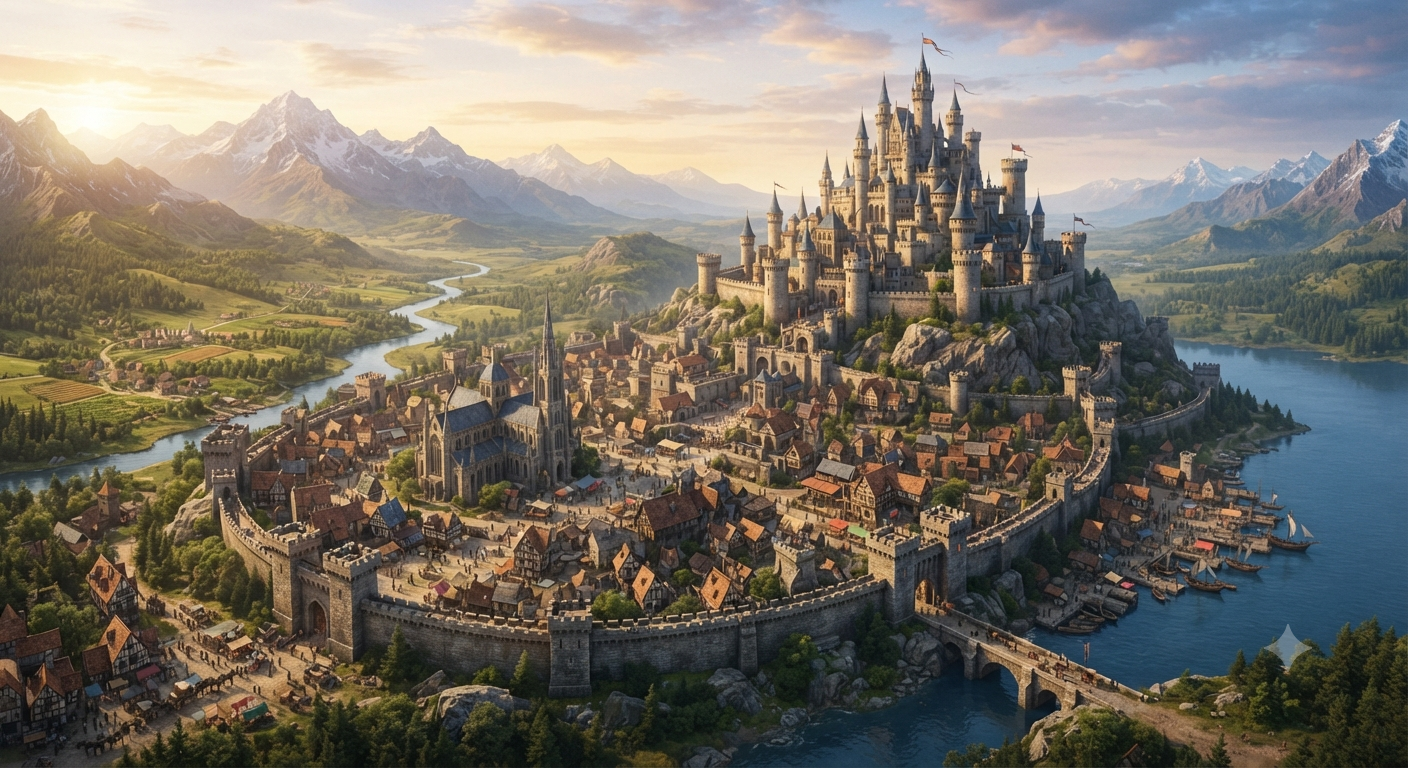
Kingdom is one of those deceptively simple words that changes meaning the moment its context changes. It can describe a country ruled by a monarch, a major category in biological classification, a spiritual realm, a sphere of influence, or the title of a film, television series, manga, or game.
That range is exactly why a one-line definition is rarely enough. To understand the term properly, you need to examine its political roots, scientific role, religious symbolism, figurative uses, and modern cultural associations.
What Does Kingdom Mean?
At its core, a kingdom is a realm, territory, community, or sphere governed by a central authority. In traditional political usage, that authority is a king or queen; Merriam-Webster defines the term primarily as a politically organized community or territorial unit with a monarchical form of government.
The word also extends beyond government. Dictionaries recognize religious meanings connected with divine rule, while biology uses it for a broad taxonomic rank below domain. The same word can therefore point to land, power, life, belief, or imagination.
The Origin of the Word Kingdom
The English term comes from Old English cyningdom, combining a word for “king” with the suffix -dom, which conveys a state, condition, authority, or jurisdiction. Its literal sense was close to the domain or authority of a king, although the meaning expanded over centuries.
That expansion matters. Modern speakers may use the word without referring to an actual monarch at all, as in “the animal world,” “a business empire,” or “the realm of imagination.”
Kingdom as a Form of Government
In political geography, a kingdom is generally a sovereign state or historical territory associated with monarchical rule. The monarch may hold extensive governing power, exercise limited constitutional duties, or serve mostly as a ceremonial head of state.
A crown alone does not explain how the system works. To evaluate any monarchy, look at the constitution, succession rules, legislature, courts, executive authority, and the practical limits placed on the sovereign.
Absolute Monarchy
An absolute monarchy concentrates major executive and governing authority in the monarch. Laws, institutions, religious traditions, elite agreements, or administrative structures may still constrain the ruler, but elected institutions do not exercise the same controlling role found in a parliamentary democracy.
“Absolute” should not be mistaken for “unlimited in every circumstance.” Even powerful rulers depend on bureaucracies, security institutions, economic systems, family alliances, religious legitimacy, and public cooperation. The standard contrast is with constitutional monarchy, where authority operates within an established legal framework.
Constitutional Monarchy
A constitutional monarchy separates the symbolic position of the crown from everyday political leadership. In the United Kingdom, for example, the monarch is head of state and remains politically impartial, while legislative power rests with an elected Parliament.
This arrangement can give a country continuity without placing routine government in royal hands. The monarch may perform formal duties, appoint a prime minister according to constitutional convention, host state occasions, recognize public service, and represent national identity.
Elective and Hereditary Monarchy
Most familiar royal systems use hereditary succession, meaning the crown passes according to rules tied to descent. Succession is not always a simple matter of the oldest child inheriting; statutes, religious requirements, gender rules, abdications, regencies, and constitutional amendments can affect the line.
Some monarchies are elective, with a ruler selected from an eligible group rather than inheriting automatically. This shows that monarchy is defined by the office and structure of sovereignty, not by one universal succession formula.
How a Kingdom Actually Functions
A functioning royal state is much more than a palace and a royal family. It requires institutions that turn authority into administration.
Core components usually include:
- The Crown: the legal or symbolic embodiment of monarchical authority
- The executive: ministers, advisers, agencies, and civil servants
- The legislature: a parliament, council, assembly, or royal lawmaking body
- The judiciary: courts that interpret and apply law
- Succession rules: procedures for transferring the throne
- Territorial administration: provinces, regions, municipalities, or local governors
- Public finance: taxation, budgets, royal expenditure, and state revenue
- Diplomacy and defense: institutions responsible for foreign relations and security
The balance between these elements determines whether royal power is active, constrained, shared, or mainly ceremonial. Two countries may both use royal titles while operating under very different constitutional realities.
Kingdom, Monarchy, Realm, Country, and Empire: What Is the Difference?
These terms overlap, but they are not interchangeable.
A monarchy is a form of government or head-of-state arrangement. A kingdom is the state, territory, or political community associated with a king or queen. A monarchy describes the system; the related realm describes where or over whom authority applies.
A country is a broader geographic and political term. It may be a monarchy, republic, federation, city-state, or another form of political organization.
A realm emphasizes jurisdiction, sovereignty, or a sphere of rule. It can refer to a monarch’s territory, but it also works figuratively, as in “the realm of science.”
An empire traditionally brings multiple territories, peoples, dependencies, or political units under a single dominant authority. A royal state may grow into an empire, exist inside one, lose imperial possessions, or remain territorially compact.
A Quick Comparison
| Term | Main focus | Requires a monarch? |
|---|---|---|
| Kingdom | State, realm, or sphere of rule | Usually in political usage |
| Monarchy | Government headed by a monarch | Yes |
| Country | Geographic or political territory | No |
| Realm | Jurisdiction or area of influence | No |
| Empire | Dominance over multiple territories or peoples | Not always |
| Republic | State without a hereditary monarch as sovereign | No |
The distinction is useful for history, civics, and search intent. Someone researching ancient royal states wants political history, while a student searching for biological classification is asking a scientific question.
How Kingdoms Developed Through History
Early royal states often emerged as communities centralized military leadership, administration, taxation, religious authority, land control, and dispute resolution. Evidence from ancient Mesopotamia shows kingship developing alongside government, bureaucracy, temples, armies, governors, judges, and tax collection.
The result was never one standard model. Some crowns governed compact territories directly, while others relied on nobles, tributary rulers, clan leaders, governors, priesthoods, or city administrations.
Medieval and early modern royal systems frequently involved negotiated power rather than simple one-person rule. Monarchs needed revenue and military support; elites wanted privileges, offices, land rights, or legal guarantees.
Over time, commercial growth, representative institutions, revolutions, colonial expansion, nationalism, mass literacy, industrialization, and constitutional reform changed the position of the crown. In the British case, royal executive power increasingly became subject to Parliament from the late seventeenth century onward, helping produce the modern constitutional model.
Why Some Royal Systems Survived
Royal institutions often survived by adapting. A crown that once directed government could become a constitutional symbol, diplomatic institution, ceremonial office, or source of continuity during political transitions; the British monarchy’s own account describes a long shift from executive power toward parliamentary constraint.
Survival does not prove universal popularity or political neutrality in every society. It usually reflects a specific mix of history, law, national identity, institutional flexibility, public opinion, and the perceived cost of replacing the system.
Kingdom in Biology
In biological taxonomy, a kingdom is a broad rank used to organize living organisms. The commonly taught hierarchy moves from domain through this rank to phylum, class, order, family, genus, and species.
This classification helps scientists communicate relationships and organize enormous biological diversity. A domestic dog, for example, belongs to domain Eukarya and Animalia before being classified through progressively narrower ranks.
The Five-Group and Six-Group Models
Many school systems teach either a five-group or six-group framework. Familiar categories include animals, plants, fungi, protists, and one or two prokaryotic groups, depending on whether bacteria and archaea are combined or separated.
These classroom models are useful, but they should not be treated as an unchanging map of nature. Genetic evidence, evolutionary relationships, cladistics, and database practices can reshape higher-level groupings.
Why Biological Classification Keeps Changing
Taxonomy is a scientific system, not a permanent list handed down unchanged. New DNA evidence may reveal that organisms grouped together by appearance do not share the evolutionary relationship researchers once assumed.
Modern databases also do not force every organism into a perfectly tidy sequence of traditional ranks. NCBI notes that standard levels are used where possible, while some entries remain unranked or use other structures.
That nuance creates real information gain for students: memorizing the hierarchy is helpful, but understanding phylogeny and common ancestry is more important than assuming every branch fits a rigid school chart.
Kingdom in Religion and Spiritual Thought
Religious language often uses the word to describe divine sovereignty rather than a bordered country. In Christianity, expressions such as the Kingdom of God or the reign of heaven can refer to divine rule, the fulfillment of God’s will, a spiritual reality, a future hope, or a combination of present and future meanings.
The emphasis is therefore not simply “a place in the sky.” Depending on the text and theological tradition, the concept may focus on authority, moral transformation, justice, salvation, community, judgment, or the restoration of creation.
Other faiths and mythologies also describe sacred realms, celestial courts, divine kingship, or ordered worlds. The English word may be used when translating those ideas, even when the original language carries a more specific cultural meaning.
When reading religious material, ask three questions:
- Does the passage describe a place, a reign, or both?
- Is the promise presented as present, future, symbolic, or literal?
- How does the surrounding tradition interpret divine authority?
Those questions prevent a political definition from being forced onto a spiritual text.
Figurative and Everyday Uses
The word has strong metaphorical power because it combines authority, territory, order, and belonging. A writer may describe a corporation as a commercial empire, a garden as a private realm, or the ocean as the natural domain of a particular species.
These expressions do not imply legal sovereignty. They signal dominance, specialization, control, scale, identity, or imaginative ownership.
Common figurative patterns include:
- Business empire: a large network of companies, assets, or influence
- Animal world: animals considered collectively or taxonomically
- Private realm: a space someone controls or treats as exclusively their own
- Fantasy realm: an invented political world in fiction or games
- Realm of ideas: a broad intellectual or creative field
Writers should use these phrases deliberately. The metaphor can sound grand and memorable, but it may also suggest hierarchy, exclusivity, or unchecked power.
Kingdom in Film, Television, Manga, and Games
The term is popular in entertainment because it instantly suggests conflict, territory, succession, warfare, loyalty, and high stakes. Yet a search for the title alone is highly ambiguous.
Netflix’s Korean series uses the name for a historical political thriller blended with a mysterious plague narrative, while the Japanese manga follows a fictionalized version of China’s Warring States era.
Other productions use the same title for family drama, legal drama, nature programming, action cinema, music, and gaming. The practical lesson is simple: add a year, platform, creator, country, character, or medium when searching.
For example:
- “Kingdom Korean series”
- “Kingdom manga reading order”
- “2014 MMA drama cast”
- “historical action film cast”
- “strategy game walkthrough”
- “biological classification definition”
This modifier strategy improves search accuracy and helps content creators avoid targeting a keyword whose intent is too broad to convert.
Why the Keyword Is Difficult for SEO
A single-word query creates an intent problem. Search engines must decide whether the user wants a dictionary definition, streaming page, historical explanation, scientific lesson, religious discussion, or branded property.
That means a generic article can rank poorly even when it is well written. The page must satisfy a clear audience while acknowledging other meanings early enough to reduce confusion.
A strong SEO approach should:
- State the primary interpretation in the title and introduction
- Use descriptive subheadings tied to distinct search intents
- Add relevant entities such as monarchy, taxonomy, domain, ruler, sovereignty, and biological classification
- Include comparison tables and examples
- Link to deeper cluster pages for politics, science, religion, and entertainment
- Use structured FAQ content without repeating the same definition
- Avoid pretending that one interpretation owns the entire query
For a general reference website, the broad disambiguation format used here is appropriate. For a niche site, a narrower page about biological classification or constitutional monarchies will usually match user intent more precisely.
How to Identify the Intended Meaning
Context usually resolves the ambiguity within seconds. Look for nearby words.
Terms such as king, queen, throne, crown, parliament, succession, territory, and sovereignty point toward political meaning. Words such as domain, phylum, species, organism, taxonomy, Animalia, and Plantae indicate biology.
References to God, heaven, divine rule, scripture, salvation, or prophecy indicate a religious use. Words such as episode, season, cast, manga, anime, film, Netflix, gameplay, or character signal entertainment.
When no context exists, do not guess too confidently. Define the broad concept first, then present the most likely interpretations.
Key Takeaways
- A kingdom can be a political state, biological rank, spiritual realm, figurative sphere, or entertainment title.
- Political examples range from active royal government to largely ceremonial constitutional monarchy.
- The term differs from monarchy, country, realm, empire, and republic.
- In biology, it sits below domain in the commonly taught hierarchy.
- Scientific classifications evolve as evidence and methods improve.
- Searchers should add a modifier to clarify whether they mean history, science, religion, or media.
- Content creators should optimize for a specific intent instead of relying on the single word alone.
Frequently Asked Questions
What Is the Simplest Definition of Kingdom?
The simplest definition is a realm or sphere under a central authority. In politics, it usually means a state ruled by a king or queen; in science and religion, the authority or organizing principle is different.
Is a Kingdom the Same as a Monarchy?
No. A monarchy is the governmental system or institution headed by a monarch, while a kingdom is the state or realm associated with that rule. The distinction is similar to the difference between a system of government and the territory governed under it.
What Are the Main Types of Kingdom Government?
The most useful distinction is between absolute and constitutional monarchy. An absolute ruler exercises extensive governing authority, while a constitutional monarch operates within legal and political limits, often leaving everyday government to elected leaders.
What Does Kingdom Mean in Biology?
It is a high-level taxonomic category below domain and above phylum in the commonly taught hierarchy. It groups organisms broadly, although modern evolutionary science may use clades and database-specific ranks that do not fit a perfectly rigid ladder.
Why Are So Many Shows, Films, and Games Called Kingdom?
The word immediately communicates power, territory, conflict, inheritance, and identity. Those themes fit historical drama, fantasy, warfare, family stories, political thrillers, and strategy games, making the title attractive but highly ambiguous in search results.
Final Takeaway
Kingdom is best understood as a flexible idea built around rule, order, territory, and belonging. Its exact meaning depends on whether the surrounding subject is politics, biology, religion, metaphor, or entertainment.
Your next step should be contextual: add a specific modifier when researching, and build a dedicated intent-focused page when publishing. That small decision turns a vague keyword into a useful question—and makes the answer far easier for both readers and search engines to understand.













Leave a Reply