
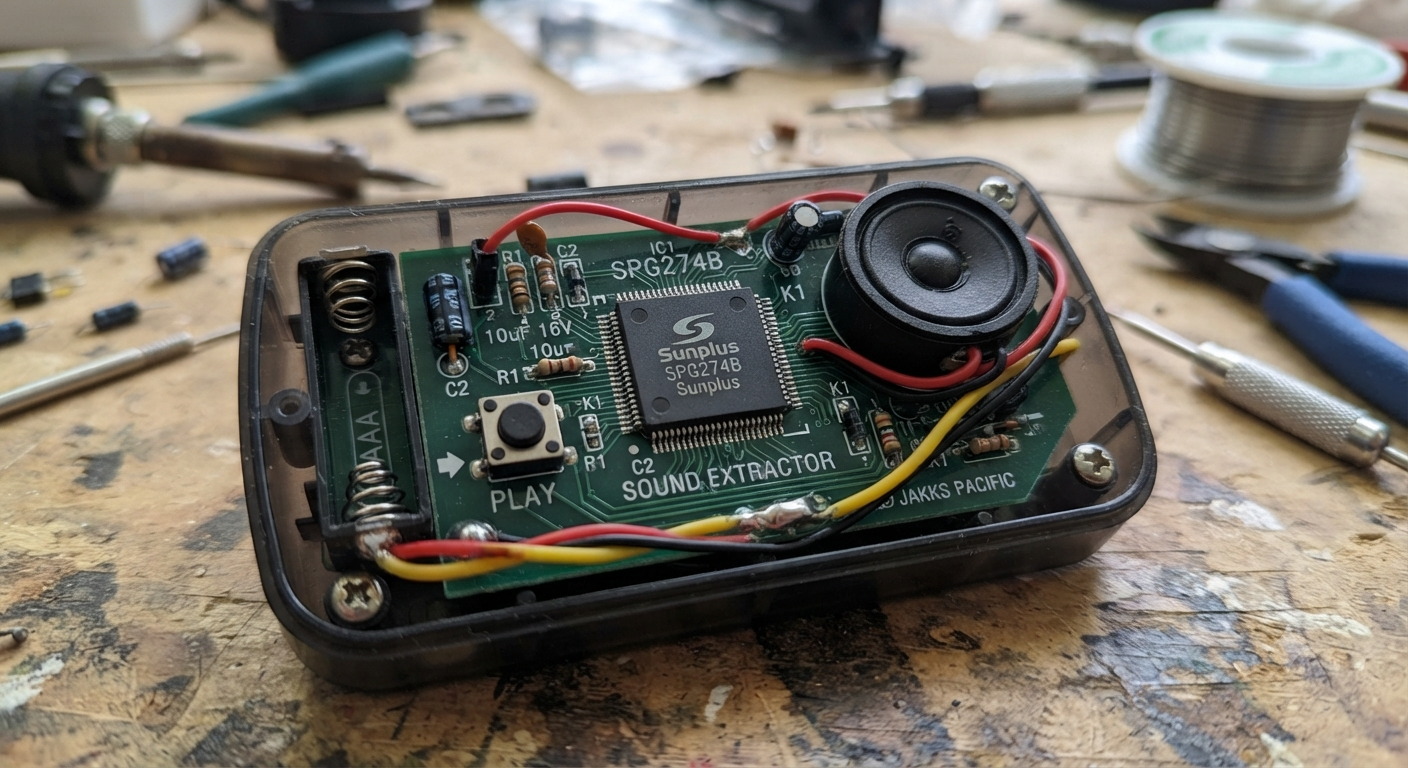
The phrase Jakks Pacific sound extractor Sunplus usually appears when collectors, preservationists, or reverse-engineering enthusiasts want to recover music, voices, instruments, and sound effects from JAKKS Pacific Plug It In & Play TV Games. It sounds like the name of an official utility, but that interpretation is misleading.
There is no widely documented commercial application released by JAKKS Pacific or Sunplus under that exact name. Instead, Jakks Pacific sound extractor Sunplus is best understood as a search term covering several community tools, ROM-analysis methods, emulator features, and game-specific Python scripts developed for Sunplus SPG2xx hardware.
That distinction matters. Anyone expecting a universal “open ROM, export WAV” program may be disappointed because JAKKS titles were created by multiple developers and do not all use one identical audio engine. Current community documentation explicitly describes non-V.Smile JAKKS extraction as work in progress and notes that different devices can behave very differently.
What Is Jakks Pacific Sound Extractor Sunplus?
In practical terms, Jakks Pacific sound extractor Sunplus refers to a workflow rather than a single standardized product. The workflow begins with a legally obtained ROM image from a device you own, identifies how the game stores sound data, separates samples or sequences, and converts the results into a playable format.
The “Sunplus” part refers to the system-on-chip family used in many direct-to-TV games. Early hardware research found that SPG2xx chips use the custom µ’nSP instruction set and were designed for devices such as plug-and-play consoles; the same research also connected the architecture to many JAKKS Pacific TV games.
A typical extraction project may involve:
- A dumped ROM image
- A hex editor or binary-analysis tool
- A game-specific extractor
- Python and supporting libraries
- An audio decoder such as vgmstream
- An emulator or built-in sound test for verification
- A digital audio editor for trimming and normalization
The central challenge is not simply copying data. It is discovering where the audio begins, how pointers are calculated, whether the content is raw PCM or compressed, and whether music is stored as complete recordings or reconstructed from instrument samples and note sequences.
Why Jakks Pacific Sound Extractor Sunplus Research Focuses on SPG2xx Hardware
JAKKS Pacific released numerous compact TV games that connected directly to a television and ran without a conventional console. A low-cost multimedia system-on-chip was a practical fit because it could combine CPU processing, graphics, input handling, and audio functions in a small consumer device.
Reverse-engineering work on the platform identified the SPG2xx line as a custom-architecture family built around µ’nSP. Researchers were able to dump ROMs, develop disassemblers, and create emulation support, which helped reveal that many apparently unrelated plug-and-play products shared a broader hardware foundation.
MAME now documents many JAKKS systems through its Sunplus-related drivers, and the project treats source code as hardware documentation intended to preserve vintage software history. That preservation goal makes MAME valuable for testing audio behavior, even when it is not a one-click Jakks Pacific sound extractor Sunplus utility.
How Audio Is Stored for Jakks Pacific Sound Extractor Sunplus Projects
The most useful community research suggests that audio storage can be divided into two broad categories: sample data and sequence data. Sample data contains digitized waveforms, while sequence data tells the sound engine which notes or instruments to play and when.
Unsigned 8-Bit PCM Instruments
The SPG2xx sound-engine research repository reports that instruments in many JAKKS Pacific plug-and-play titles use unsigned 8-bit PCM and are often stored near the end of the ROM. That is a strong starting clue, but it should not be treated as a guarantee for every title.
Unsigned 8-bit PCM is comparatively simple because every byte can represent one sample value. Even then, successful playback depends on identifying the correct offset, length, sample rate, loop points, and channel arrangement.
A raw region may sound like static when:
- The extraction begins a few bytes too early or late
- The assumed sample rate is wrong
- The data is not audio at all
- A pointer table has been mistaken for waveform data
- The bytes require conversion from unsigned to signed values
- The sample is intended to loop or be pitch-shifted by the engine
Music Sequences and Instrument Commands
Music may not exist as a finished WAV-like recording. Some titles store short instrument samples and a proprietary event stream that functions somewhat like MIDI, although the exact command layout is game-specific.
For The Batman, community documentation identifies a song table, channel counts, sequence offsets, note-and-duration pairs, program changes, and an end-of-track marker. It also states that stored pointers must be multiplied by two to obtain the real byte offsets.
That example explains why a generic Jakks Pacific sound extractor Sunplus can fail. A tool written for one title may depend on a hard-coded song-table address, a specific pointer rule, and a fixed number of songs or channels.
Proprietary or Partially Understood Codecs
Other Sunplus-based products use formats related to IMA ADPCM, Sunplus A1600, S720, and additional proprietary structures. The broader SPG2xx documentation distinguishes these codecs from the simpler PCM arrangements found in many JAKKS instruments and warns that codec and engine coverage is incomplete.
This means “no recognizable WAV header” does not prove that a ROM contains no audio. Embedded systems frequently store raw or custom-encoded data without standard desktop file headers.
Jakks Pacific Sound Extractor Sunplus: A Realistic Workflow
A reliable Jakks Pacific sound extractor Sunplus workflow should begin with identification, not conversion. Treat the ROM as an undocumented software image and build evidence step by step.
1. Identify the Exact Game and Revision
Write down the complete title, release year, controller style, region, board markings, ROM size, and any visible chip labels. Two devices with similar branding may contain different revisions or entirely different internal software.
Calculate cryptographic hashes for your dump and keep the original file read-only. A preserved master copy lets you confirm that later experiments did not alter the source.
2. Verify the ROM in an Emulator
Check whether the title is recognized by MAME and whether its sound is marked working, imperfect, or unsupported. Recent MAME work continues to add JAKKS plug-and-play systems, demonstrating that coverage remains active rather than historically frozen.
Emulation is useful because it gives you a behavioral reference. If music and effects play correctly in the emulator, you can compare extracted material against known in-game output.
3. Search for a Built-In Test Mode
Several JAKKS systems include boot-time test menus with ROM, color, sprite, or sound checks. Historical hardware research and current sound-engine notes both mention these diagnostic modes as useful aids for understanding the format.
A sound test can help you:
- Create a numbered inventory of effects
- Record when each sound is triggered
- Separate music from speech and gameplay effects
- Match table entries with audible output
- Detect unused or hidden sounds
Do not assume one button combination works on every device. Input mappings and test features can vary across games and revisions.
4. Inspect the ROM Structure
Open a working copy in a hex editor and look for repeated pointer patterns, large low-entropy or waveform-like regions, tables near the end of the ROM, and values that correlate with sounds in the test menu. Compare multiple nearby entries rather than guessing from one offset.
The Batman research is a good model: its extractor uses a known sequence-table start, reads little-endian values, multiplies stored offsets by two, follows channel pointers, and stops each extracted stream at a specific terminator.
5. Use the Most Specific Extractor Available
Choose a tool created for the exact title or sound engine whenever possible. The community repository currently includes game-specific material for titles such as The Batman and research notes for X-Men, rather than presenting one proven universal JAKKS exporter.
Before running any script:
- Read its source code
- Confirm the required Python version and libraries
- Check hard-coded offsets
- Create a separate output directory
- Scan downloads for malware
- Never run unknown code with administrator privileges
- Compare the expected ROM size with your own dump
The available Batman script, for example, is specifically coded around a sequence-table address, ten songs, channel counts, pointer multiplication, and an F000 termination value. That is evidence of a narrow tool, not a universal Jakks Pacific sound extractor Sunplus.
6. Convert Raw Output Carefully
Raw PCM needs parameters before it becomes a valid WAV. You may need to test sample rates, bit depth, signedness, mono or stereo layout, and endianness.
Sequence output requires a different path. It may need to be translated into MIDI-like events and paired with the correct extracted instrument bank before it resembles the original music.
The SPG2xx repository recommends vgmstream-compatible playback for some extracted Sunplus formats and notes that its scripts may use the Python Mido library for sequence conversion.
7. Validate Every Result
A file that opens is not necessarily correct. Compare timing, pitch, loop behavior, channel balance, and waveform shape against the original hardware or accurate emulation.
For archival work, retain:
- The untouched ROM hash
- The extractor version or commit
- Command-line settings
- Discovered offsets and pointer rules
- Original raw outputs
- Converted WAV or MIDI files
- Notes about uncertainty and failed attempts
This documentation turns an isolated sound rip into reproducible preservation research.
Tools Commonly Used With Jakks Pacific Sound Extractor Sunplus Research
There is no mandatory toolkit, but several categories repeatedly appear in successful Jakks Pacific sound extractor Sunplus projects.
MAME provides hardware documentation, emulation, debugging possibilities, and a reference for supported JAKKS systems. Its role is verification and preservation rather than automatic asset export.
Python scripts are useful for reading little-endian values, following pointers, splitting binary ranges, and converting event streams. Game-specific scripts may be short, but their hard-coded assumptions must match the exact ROM.
vgmstream can decode many game-audio formats and is often used through compatible players or command-line conversion tools. The SPG2xx research project recommends it for certain outputs, while also acknowledging incomplete support.
Hex editors and binary-analysis tools help locate tables, compare revisions, and test offset theories. A debugger or instrumented emulator can go further by tracing the code that writes audio registers or loads sample addresses.
Common Jakks Pacific Sound Extractor Sunplus Problems and Why Extraction Fails
The biggest mistake is assuming that all JAKKS Pacific games share one file format. The hardware family may be related, but software came from studios including Digital Eclipse, HotGen, Amaze Entertainment, Griptonite, Backbone, and others, and community documentation groups titles by developer for a reason.
Other frequent problems include:
- Wrong byte order: Values are interpreted as big-endian instead of little-endian.
- Word-addressed pointers: Stored addresses must be multiplied before seeking.
- Incorrect sample rate: Audio plays too fast, too slow, or at the wrong pitch.
- Sequence/sample confusion: A music command stream is opened as raw PCM.
- Revision mismatch: Hard-coded offsets point to unrelated data.
- Missing instrument bank: MIDI-like notes exist, but the timbres are absent.
- False file signatures: Random bytes resemble a known header.
- Incomplete emulator support: A playback failure is mistaken for missing source data.
- Zero-length output: The parser followed an invalid channel or pointer.
- Copyright issues: Extracted material is redistributed without permission.
A disciplined Jakks Pacific sound extractor Sunplus project tests one assumption at a time. When output becomes noise, return to the pointer table and data boundaries before trying dozens of random sample rates.
Legal and Ethical Rules for Jakks Pacific Sound Extractor Sunplus Work
ROM and audio extraction can raise copyright and anti-circumvention questions that vary by jurisdiction. The safest practical approach is to work from hardware and ROM images you personally own, keep extracted assets for research or preservation, and avoid distributing copyrighted game data, voice clips, music, or complete ROMs.
Open-source tools do not automatically make the underlying game content free to reuse. Commercial publication, soundtrack uploads, remixes, and asset packs may require permission from the relevant rights holders.
Preservation projects should also distinguish fact from inference. Label unknown codecs, uncertain sample rates, guessed loop points, and unverified table structures honestly.
How to Judge a Jakks Pacific Sound Extractor Sunplus Download
Because the keyword sounds like a software title, low-quality websites may present vague descriptions without providing verifiable code, documentation, supported-game lists, or reproducible examples. A trustworthy project should show exactly what it accepts, what it outputs, and which titles have been tested.
Use this checklist:
- Is the source code publicly inspectable?
- Does the tool name supported games and ROM revisions?
- Are offsets and pointer rules documented?
- Is there a commit history or issue tracker?
- Does it avoid bundling copyrighted ROMs?
- Can results be reproduced from a known hash?
- Are limitations stated clearly?
- Do reputable preservation communities reference it?
Be cautious when a page claims that Jakks Pacific sound extractor Sunplus is an official chip, a built-in consumer feature, or a universal audio application. The strongest available evidence instead points to a developing reverse-engineering ecosystem built around SPG2xx hardware and title-specific formats.
FAQ About Jakks Pacific Sound Extractor Sunplus
Is Jakks Pacific sound extractor Sunplus an official JAKKS program?
No widely documented official program uses that exact name. The phrase generally describes community efforts to extract audio from JAKKS Pacific games built on Sunplus SPG2xx hardware.
Available research consists of emulator drivers, format notes, experimental scripts, and title-specific extractors. The main SPG2xx sound-engine repository explicitly describes JAKKS extraction and format documentation as ongoing work.
Can one extractor rip sounds from every JAKKS Pacific TV game?
Probably not. Titles can use different engines, layouts, table addresses, pointer calculations, codecs, and sequence commands.
The Batman extractor demonstrates the problem clearly because it relies on a game-specific table offset and parsing rules. A script based on those assumptions is unlikely to work unchanged on another title.
What audio format does Jakks Pacific sound extractor Sunplus target?
Many documented JAKKS instruments use unsigned 8-bit PCM, often located near the end of a ROM. Music can also be stored as proprietary sequences that trigger instrument samples rather than as complete recordings.
Other Sunplus devices use ADPCM-like data or codecs such as A1600 and S720, so the correct answer depends on the exact game and sound engine.
Can MAME export JAKKS audio files automatically?
MAME is primarily an emulation and preservation framework, not a universal asset ripper. It can help confirm whether a ROM runs, reproduce sounds, expose diagnostic modes, and support technical debugging.
For clean asset extraction, you may still need a custom script, pointer analysis, or raw audio conversion. Recording emulator output is easier, but it is not the same as extracting original samples and sequences.
Why does my extracted audio sound like static?
The usual causes are a wrong offset, wrong length, incorrect signedness, incorrect sample rate, bad endianness, or an attempt to decode compressed or sequence data as raw PCM. A revision mismatch can also make a valid script read the wrong region.
Start by confirming the ROM hash and table location. Then inspect a small known sound, test documented parameters, and compare the result with a sound-test entry or emulator playback.
Conclusion
Jakks Pacific sound extractor Sunplus is a useful keyword, but it should not be mistaken for a polished official application. It describes a technical preservation problem involving Sunplus SPG2xx ROMs, raw samples, proprietary music sequences, game-specific pointer tables, and still-evolving community tools.
A careful Jakks Pacific sound extractor Sunplus project begins with an owned device and a verified ROM dump. Identify the exact title and revision, test it in MAME, locate any diagnostic sound menu, and use the most specific documented extractor available.
Most importantly, record every offset, hash, parameter, and uncertainty. That method will produce results that are safer, more accurate, and far more valuable than blindly running a supposed universal Jakks Pacific sound extractor Sunplus download.











Leave a Reply