
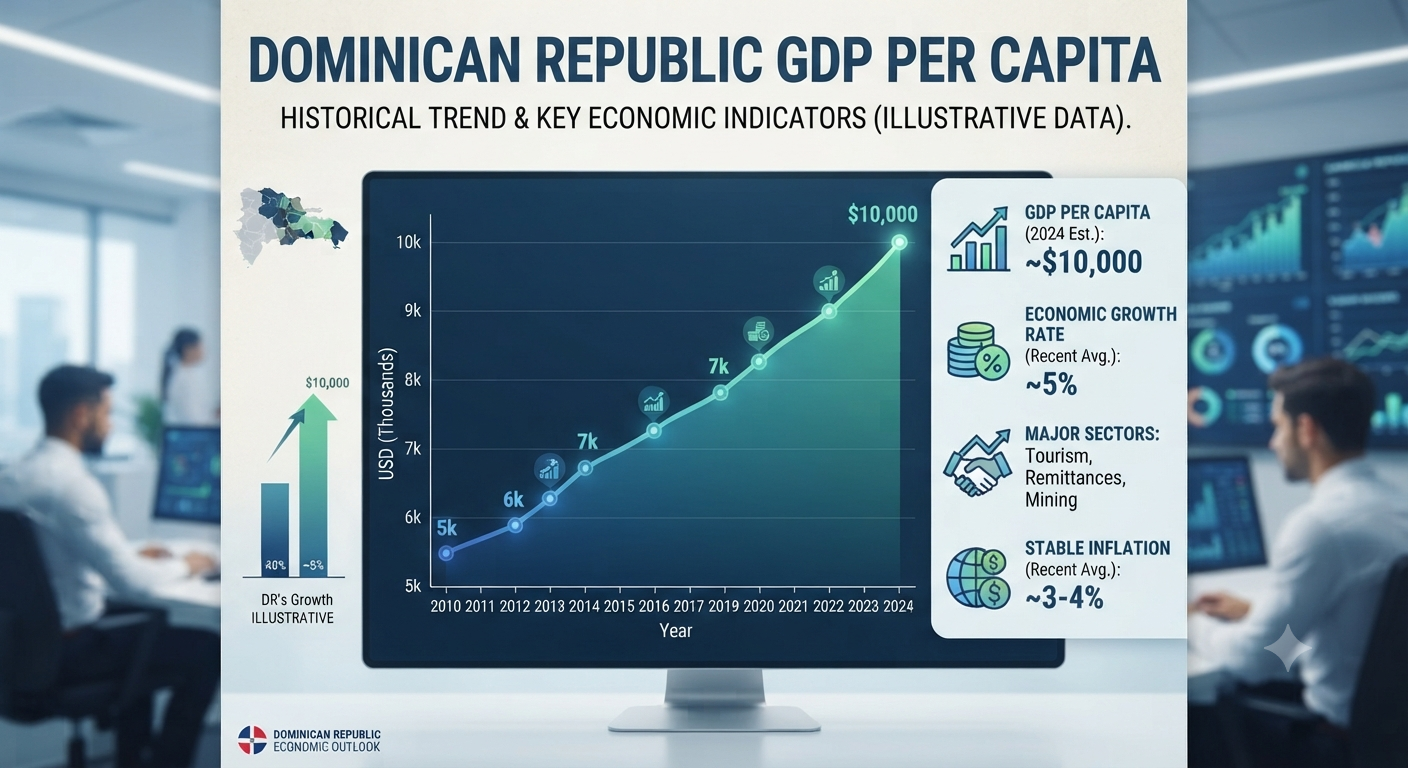
The Dominican Republic GDP per capita is approximately $11,059 in current U.S. dollars for 2025, according to the World Bank’s latest country data. That headline number is useful, but it does not tell the whole story. Depending on whether the calculation uses market exchange rates, purchasing power parity, constant prices or a different statistical release, the result can vary significantly.
For readers comparing income levels, investment conditions or living standards, the most important step is to identify which version of Dominican Republic GDP per capita is being used. Nominal GDP per capita is best for comparing the economy’s dollar value at current exchange rates, while purchasing power parity provides a better indication of how much goods and services local income may purchase inside the country.
Dominican Republic GDP Per Capita at a Glance
The latest Dominican Republic GDP per capita datasets present the following picture:
| Indicator | Latest figure | Interpretation |
|---|---|---|
| Nominal GDP per capita, World Bank | $11,059.2 in 2025 | Output per person converted at current market exchange rates |
| Nominal GDP per capita, IMF | $11,542 in 2024 | IMF estimate using its own data vintage and national accounts inputs |
| GDP per capita at PPP, World Bank | $27,541.7 in 2024 | Output per person adjusted for differences in domestic price levels |
| GDP per capita at PPP, IMF | $32,180 projected for 2026 | Forward-looking estimate in current international dollars |
| Total nominal GDP, World Bank | $127.41 billion in 2025 | Size of the entire economy at current U.S. dollar values |
| Real GDP growth, World Bank | 2.1% in 2025 | Inflation-adjusted annual expansion of total output |
The figures are not directly interchangeable. The World Bank’s current-dollar series places Dominican Republic GDP per capita just above $11,000 in 2025, while the IMF reports a higher 2024 estimate of $11,542.
Meanwhile, PPP-based measures are much larger because many locally purchased goods and services cost less than comparable items in high-income economies.
What Does GDP Per Capita Actually Measure?
The gross domestic product (GDP) per capita is a ratio that is calculated by dividing the gross domestic product (GDP) by the population of a country:
GDP per capita = Total GDP ÷ Population
In essence, the Dominican Republic GDP per capita shows the amount of goods and services produced by each member of the population on average. It does not indicate how much each person actually earns on average and is not equivalent to wages, household income, or disposable income.
This is not necessarily an issue when analyzing the growth of the Dominican Republic GDP per capita, as a country can have high overall economic growth while individuals who are employed experience significantly different income gains. The differences between the various categories reflect the impact that employment, personal wages, regional living costs, public services, and the overall income inequality of the nation have on the economy.
Nominal GDP per capita
The nominal GDP per capita for the Dominican Republic measures the amount of goods and services produced in the country at current prices. It is then converted to American dollars using currency exchange rates. It is useful for analyzing the Dominican Republic’s position in the international market, comparing GDP in American dollars, and evaluating the purchasing power of imports.
The problem with the nominal GDP per capita is that it can underestimate or distort the true value of the Dominican Republic’s economy. If the value of the Dominican Peso begins to decrease compared to the American Dollar, it will reduce the rate at which the nominal GDP per capita can increase. In turn, changes to the exchange rate can make the annual growth of GDP per capita appear higher or lower than they actually are.
GDP per capita at purchasing power parity
PPP-based Dominican Republic GDP per capita adjusts for differences in local price levels. The World Bank estimated Dominican GDP per person at about $27,542 in current international dollars in 2024, while the IMF projected approximately $32,180 for 2026.
These figures are better suited to broad living-standard comparisons, although they remain averages rather than measures of household welfare.
The wide gap between nominal and PPP values suggests that a dollar-equivalent income generally buys more domestically than it would in a higher-cost economy. It does not mean residents receive $27,000 or $32,000 in cash.
Real GDP per capita
Real Dominican Republic GDP per capita adjusts output for inflation. This version is especially useful when examining whether economic production per person is genuinely increasing over time rather than merely rising because prices are higher.
World Bank data reported constant-price GDP per person of about $9,287 in 2025, measured in 2010 U.S. dollars, up from approximately $9,168 in 2024. That indicates positive real output growth per resident, even though the pace was modest during 2025.
Why Different Sources Report Different Numbers
A common mistake is to treat one published number as the only correct value. In reality, Dominican Republic GDP per capita can differ across reputable databases for several legitimate reasons.
The most important are:
- Different publication dates: A newer release may incorporate revised GDP, exchange-rate or population data.
- National accounts revisions: Statistical authorities periodically update the base or reference year and expand sector coverage.
- Population estimates: GDP divided by 10.8 million people will differ from GDP divided by a later revised population estimate.
- Exchange-rate methodology: Annual averages, end-of-period rates and modeling assumptions produce different dollar values.
- Forecast versus historical data: A 2026 IMF number is a projection, while a 2025 World Bank number may be an estimated historical observation.
- Nominal versus PPP units: Current U.S. dollars and international dollars answer different questions.
The IMF’s 2025 review noted that the Dominican Republic had updated its national accounts reference year to 2018 and expanded the level of sector and product detail. Revisions of this type improve measurement but can also change historical and current GDP estimates.
For a credible report, always state the year, source, unit and methodology beside the number. Writing simply that the country’s GDP per person is “about $11,000” is acceptable for a quick overview, but serious analysis should identify whether the value is nominal, real or PPP-adjusted.
Historical Trend: How Fast Has Output Per Person Increased?
The long-term direction is clear. Dominican Republic GDP per capita has risen substantially since the start of the century, supported by sustained expansion in services, manufacturing, construction, tourism and trade.
World Bank-derived historical data place nominal GDP per person at roughly $2,894 in 2000 and about $5,479 in 2010. By 2025, the World Bank figure had reached $11,059, meaning the current-dollar value had almost quadrupled over 25 years and roughly doubled since 2010.
That increase should not be read as a fourfold improvement in real living standards. Part of the gain reflects inflation and currency movements.
Still, the country’s inflation-adjusted growth record has been strong. The World Bank reported that real GDP expanded by an average of 5.2% between 2005 and 2024.
The pandemic interrupted that trajectory. Real GDP contracted by 7.9% in 2020, then rebounded by 14.0% in 2021, followed by growth of 5.2% in 2022, 2.2% in 2023 and 5.0% in 2024, according to the IMF’s 2025 country report.
What Is Driving Dominican Republic GDP Per Capita Growth?
The economic base behind Dominican Republic GDP per capita is more diversified than a tourism-only description suggests. Tourism is crucial, but growth also depends on construction, commerce, manufacturing, free-trade zones, transportation, real estate, financial activity, mining and domestic consumption.
Tourism and hospitality
Tourism brings foreign currency into the economy, supports employment and stimulates demand for hotels, restaurants, transportation, entertainment, food production and construction. It also creates spillovers for small businesses and regional infrastructure.
The sector remains exposed to conditions in major visitor markets, particularly the United States. The IMF observed slower tourism growth during part of 2025 but also reported signs of renewed momentum in exports, tourism and credit later in the year.
Free-trade zones and manufacturing
Export-oriented free-trade zones produce medical devices, electrical products, tobacco goods, textiles and other manufactured items. They help diversify foreign-exchange earnings beyond tourism and connect the country to North American supply chains.
The IMF reported that free-trade-zone exports totaled $8.4 billion in 2024, with approximately $6.1 billion going to the United States. This close trade relationship creates opportunities from nearshoring, but it also exposes the economy to U.S. demand, trade policy and financial conditions.
Construction, commerce and services
Rebased national accounts confirm that services are the largest part of the economy. Construction, commerce, local manufacturing, real estate, hospitality, transportation and other services collectively account for a large share of output and employment.
These sectors influence Dominican Republic GDP per capita through job creation, investment, productivity and domestic demand. Construction is particularly important because it connects tourism projects, housing, public infrastructure and commercial development.
Remittances and household consumption
Money sent home by Dominicans abroad is not counted as domestic production simply because it enters the country. However, remittances can support consumption, housing, education, small-business investment and financial stability.
The World Bank expects resilient private consumption, supported by strong remittance inflows, to remain one of the economy’s medium-term growth drivers. The IMF likewise reported that exports and remittances helped narrow the current-account deficit in 2025.
Foreign direct investment
Foreign direct investment contributes capital, technology, construction activity and employment. The IMF estimated that the country’s current-account deficit would remain fully financed by FDI, an important sign of external funding resilience.
Investment quality matters as much as volume. Projects that raise worker skills, logistics capacity, energy reliability and technological adoption are more likely to generate lasting gains in productivity per person.
How Does the Dominican Republic Compare Regionally?
At approximately $11,059 in nominal terms, Dominican Republic GDP per capita places the country well above several lower-income economies in Central America and the Caribbean, but below the levels recorded by richer Latin American economies and high-income Caribbean territories.
PPP changes the comparison. The country’s 2026 IMF projection of roughly $32,180 per person is above the same IMF estimates for Mexico, Brazil, Colombia, Peru and Paraguay.
This reflects both the Dominican Republic’s growth record and its lower domestic price level, but it should not be treated as a direct ranking of wages or household wealth.
Regional comparisons should use a single source and year. Mixing the Dominican Republic’s 2026 PPP projection with another country’s 2024 nominal observation produces a misleading result.
Does a Higher Figure Mean Better Living Standards?
Usually, rising real output per person is a positive signal. It suggests that the economy is producing more goods and services relative to its population.
Over time, that can support better jobs, higher tax revenue, improved infrastructure and greater household consumption.
But Dominican Republic GDP per capita is not a complete measure of prosperity. It does not reveal who receives the gains, whether housing and food are affordable, how many workers are informal or whether public services are improving.
The country has achieved significant poverty reduction alongside growth. A 2025 World Bank document reported that between 2005 and 2024, poverty at the institution’s $8.30-per-day 2021 PPP line fell from 46.6% to 14.0%, while the Gini index declined from 50 to 39.
Even so, inequality, economic mobility and service quality remain important policy concerns.
For a fuller assessment, pair GDP per person with:
- Median household income
- Real wage growth
- Poverty and inequality rates
- Employment, unemployment and informality
- Housing, food and energy costs
- Education and healthcare outcomes
- Regional income differences
- Labor productivity
Risks That Could Slow Future Gains
Several factors could weaken the pace of Dominican Republic GDP per capita growth.
The country is highly exposed to hurricanes, flooding and other climate-related shocks. Tourism, agriculture and infrastructure are especially vulnerable, and the IMF estimates that agriculture and tourism together represent about one-quarter of GDP and nearly half of export receipts.
Electricity-sector losses and subsidies also create fiscal pressure. The IMF has repeatedly identified electricity reform, stronger public investment and better-targeted subsidies as priorities for raising medium-term growth and resilience.
Other risks include weaker U.S. demand, tighter global financial conditions, exchange-rate depreciation, slower private investment and delays in structural reforms.
Because the United States is the country’s main export market and home to a large Dominican diaspora, changes in U.S. employment, interest rates and consumption can affect exports, tourism and remittances.
Dominican Republic GDP Per Capita Outlook for 2026 and Beyond
The Dominican Republic GDP per capita outlook remains positive, although growth forecasts vary. The World Bank reported 2.1% growth in 2025 and projected expansion of 3.6% in 2026 and 4.4% in 2027.
The IMF’s late-2025 assessment was more optimistic, forecasting 4.5% growth in 2026 and a gradual return toward a long-term rate near 5%.
If real GDP grows faster than the population, real GDP per person should continue to rise. Nominal dollar gains will also depend on inflation and the peso-dollar exchange rate, which means Dominican Republic GDP per capita could move differently from real domestic living standards in any single year.
The strongest long-term path would combine macroeconomic stability with productivity improvements. Better electricity reliability, stronger education and technical training, efficient transport infrastructure, deeper financial markets and higher-value exports would make future gains more durable and broadly shared.
How to Use This Data Correctly
Readers, investors and researchers should follow a simple checklist:
- Choose the right metric. Use nominal data for market size and dollar comparisons, PPP for purchasing-power comparisons and constant-price data for long-term growth.
- Check the year. A historical observation and a forecast should never be presented as equivalent.
- Name the source. World Bank, IMF and Dominican central-bank figures can differ because their release schedules and methods differ.
- Avoid treating the average as income. GDP per person is economic output, not the typical worker’s salary.
- Add distributional indicators. Poverty, real wages, inequality and informality explain whether growth is reaching households.
This approach prevents the most common errors and makes any analysis of Dominican Republic GDP per capita more accurate, transparent and useful.
Frequently Asked Questions
What is the Dominican Republic GDP per capita in 2025?
The World Bank reports a 2025 nominal figure of approximately $11,059 per person in current U.S. dollars. This is an economy-wide average calculated from GDP and population, not the average salary earned by a Dominican resident.
What is the Dominican Republic GDP per capita at PPP?
The World Bank estimated about $27,542 in current international dollars for 2024. The IMF projected roughly $32,180 for 2026, but that figure is a forecast from a different database vintage.
PPP adjusts for local price differences and is generally more useful for broad living-standard comparisons.
Why is PPP GDP per capita much higher than nominal GDP per capita?
PPP accounts for the fact that many goods and services cost less in the Dominican Republic than in the United States and other high-income countries.
Nominal GDP uses market exchange rates, while PPP uses an estimated conversion rate designed to equalize purchasing power.
Is the Dominican Republic a rich or developing country?
The country is a fast-growing upper-middle-income economy rather than a high-income economy.
Its output per person is comparatively strong within parts of the Caribbean and Central America, but substantial gaps remain in wages, public services, productivity and household wealth compared with advanced economies.
Will Dominican Republic GDP per capita keep rising?
The most recent World Bank and IMF outlooks point to continued economic expansion in 2026 and 2027. Real output per person is likely to rise if GDP growth remains above population growth, but the nominal dollar figure will also be affected by inflation, exchange rates, statistical revisions and external shocks.
Conclusion
The latest Dominican Republic GDP per capita figure is about $11,059 in nominal current U.S. dollars for 2025, while PPP-based estimates place domestic purchasing power far higher. The economy has made substantial long-term progress, but a single average cannot explain wages, inequality, affordability or access to services.
For the most reliable analysis, use the latest World Bank or IMF release, label the year and measurement method, and compare the figure with real wage growth, poverty, inequality and employment data. That combination provides a far more accurate view of how economic expansion is translating into everyday prosperity.













Leave a Reply