
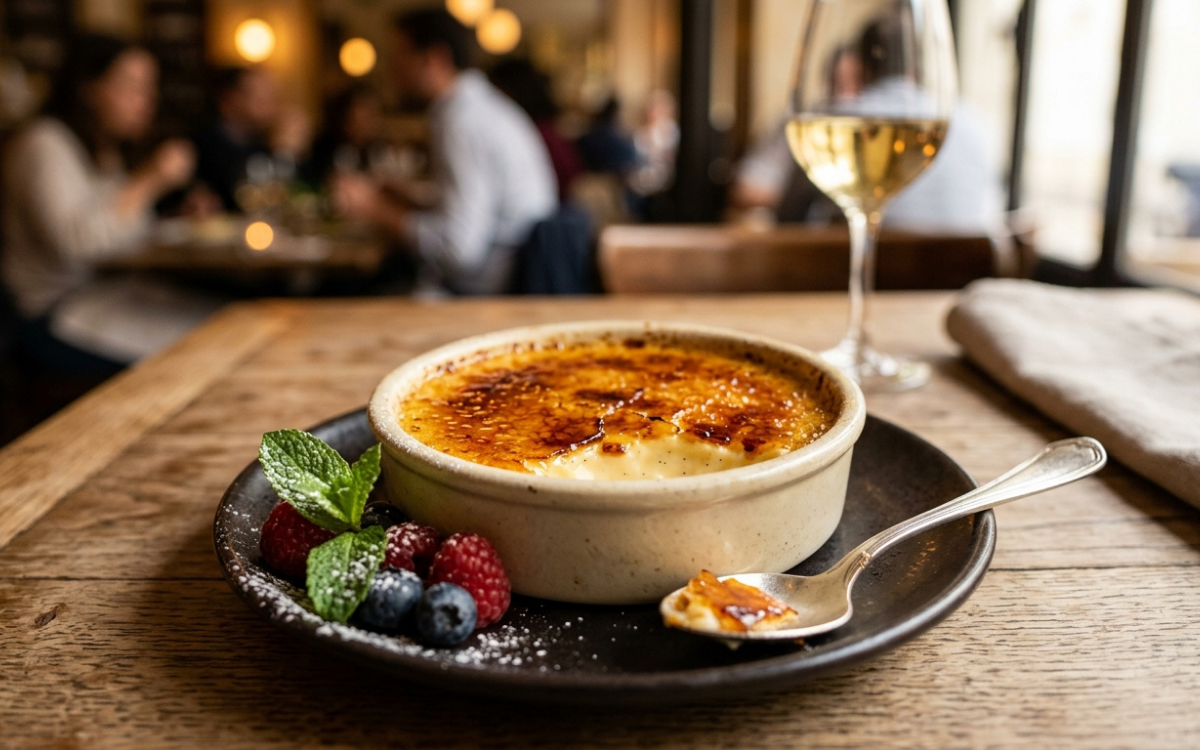
Cremebrulee.com is one of those domain names that instantly tells you what category it belongs to. It evokes the famous French-named custard dessert, the crack of caramelized sugar, vanilla custard, restaurant menus, baking tutorials, cookbooks, and premium food experiences. Yet anyone visiting the domain today will find something very different from a recipe hub: the live site is currently a domain-for-sale landing page, not an active culinary publication.
That distinction matters. The domain has a documented history connected to food and recipe content, but its present value is primarily that of a premium exact-match .com domain with culinary brand potential. For a buyer, publisher, chef, dessert company, cookware brand, or food-media entrepreneur, the real question is not simply “What is this website?” It is whether the name can be turned into a defensible, useful business asset.
What Is Cremebrulee.com Today?
As of August 29, 2026, Cremebrulee.com resolves to a sales page showing a $35,000 buy-now price and an option to make an offer. The page is listed through Spaceship and promotes buyer protection, transfer assistance, and multiple payment methods.
So, at present, the site is best understood as a premium domain name being marketed for acquisition. It is not currently publishing recipes, accepting restaurant reservations, selling desserts, or operating as a consumer food brand.
That may surprise people who discover older references to the site. Those references are important because they show the domain was historically associated with actual culinary material rather than being created recently as a speculative keyword asset.
A Domain With Real Web History
Third-party WHOIS data reports that Cremebrulee.com was created on November 7, 1997, placing its origin in the early commercial-web era. Age alone does not make a domain authoritative, but it does give researchers a longer history to audit for prior content, links, ownership changes, reputation, and potential brand associations.
Older web references indicate that the domain once hosted recipe-related material. A 2019 Writing Stack Exchange answer specifically pointed readers to an old recipe page on the domain as an example of concise, personality-driven recipe writing, while food discussions from years earlier referenced a crème brûlée recipe associated with the site.
There is another useful historical signal. Older link directories categorized the site among cooking and recipe resources, showing that other websites recognized it within the food-content ecosystem.
Why Cremebrulee.com Is More Than a Dessert Keyword
A strong domain is not valuable merely because it contains a popular phrase. It becomes valuable when language, memory, commercial intent, category identity, and brand expansion work together.
This domain performs well on several of those dimensions. “Crème brûlée” is a globally recognizable dish with a distinctive visual identity and premium association. The words naturally connect with restaurants, pastry, baking equipment, culinary education, recipes, gifting, hospitality, and gourmet products.
The .com extension strengthens that positioning because it remains a familiar commercial extension for users. For an English-language culinary brand, Cremebrulee.com is descriptive without feeling like a clumsy multi-word SEO domain stuffed with modifiers such as “best,” “easy,” or “recipe.”
The Accent Question: Crème Brûlée vs. Creme Brulee
The correct French spelling is crème brûlée, complete with diacritical marks. Domain names historically developed around ASCII characters, which is one reason unaccented spellings became common online.
For branding, the smart approach is simple: use Crème Brûlée in editorial typography where appropriate, while keeping the unaccented .com as the clean URL. That gives the brand linguistic polish without creating unnecessary friction for users typing the address.
The Historical Recipe Connection Adds Context
One of the more interesting threads around the domain is its connection to the broader popularity of crème brûlée recipes in the late 1990s and 2000s. Search results and archived references associate a classic recipe circulated from the site with Debbie Puente, author of Elegantly Easy Crème Brûlée & Other Custard Desserts.
Google Books identifies Puente’s cookbook as a 1998 cooking title containing 70 recipes, including dessert and savory variations. The Los Angeles Times also covered the book in March 1998, describing its connection to a Thousand Oaks author and a French restaurant whose lavender crème brûlée appeared in the book.
That does not mean a new owner automatically acquires rights to old recipes, book content, images, trademarks, or authorship. It means the domain has a traceable culinary footprint, which is considerably more meaningful than simply claiming that an aged domain “has history.”
A prospective buyer should treat the historical record as research material, not transferable intellectual property.
Is Cremebrulee.com Legit or a Scam?
The current website behaves like a domain-sale page, so it should be evaluated as a domain transaction, not as an online bakery or recipe subscription service. The live page clearly states that the name is for sale and identifies the transaction platform rather than pretending to operate a business that does not exist.
A third-party website-risk service has published a relatively positive automated assessment and reports no blacklist detection in its scan, but such trust scores should never replace transaction due diligence. Automated reputation tools can be useful signals; they are not legal guarantees.
Anyone considering the purchase should verify:
- Current ownership and registrar status
- Whether the seller is authorized to transfer the domain
- The exact purchase price and any marketplace commission
- Escrow or buyer-protection terms
- Transfer-lock timing and registrar requirements
- Trademark conflicts in intended product categories
- Historical backlink quality and spam exposure
- Past content through web archives
- Any manual actions or security problems after acquisition
For a five-figure purchase, a buyer should also preserve invoices, marketplace communications, escrow records, and transfer confirmation.
Cremebrulee.com and SEO: What the Domain Can — and Cannot — Do
It is tempting to assume Cremebrulee.com would automatically rank highly for “creme brulee” because the query appears in the domain. That is not how modern Google Search works.
Google explicitly says words in domain names are only one of many relevance factors, and its exact-match domain system is designed to prevent domains from receiving excessive ranking credit merely because they match a query.
That means the domain could be an excellent SEO asset, but only if the site built on it earns visibility through useful content, topical depth, relevant links, technical quality, brand demand, and trust. The domain is a head start in positioning, not a ranking entitlement.
Where the SEO Advantage Is Real
The genuine advantages are more subtle—and more durable.
First, the name has instant topical clarity. A user who sees the domain in a search result can immediately predict the site’s subject.
Second, the name is memorable. That can help branded search, word-of-mouth sharing, direct navigation, editorial citations, podcast mentions, social sharing, and offline marketing.
Third, it naturally supports a focused topical map. A publisher could build tightly connected content around custards, caramelization, pastry science, torches, ramekins, vanilla, water baths, restaurant techniques, flavor variations, troubleshooting, and dessert history.
Those are meaningful advantages. They simply require execution.
What Would Make Cremebrulee.com an E-E-A-T-Strong Food Brand?
Google’s current people-first guidance emphasizes Experience, Expertise, Authoritativeness, and Trustworthiness, while also clarifying that E-E-A-T is not a single standalone ranking factor. Google says trust is the most important component and encourages creators to make it clear who created content, how it was produced, and why it exists.
A serious relaunch should therefore avoid becoming a thin recipe farm. It should look like a publication run by people who actually cook, test, photograph, and explain crème brûlée.
Build First-Hand Experience Into Every Core Recipe
A credible recipe page should include more than ingredients and baking time. The strongest content would show test batches, ramekin dimensions, custard depth, oven temperature behavior, chilling time, torch distance, sugar thickness, and visual doneness cues.
Readers want to know what “set but still jiggly” actually looks like. They want to know why a custard curdled, why the top became watery after refrigeration, or why the caramel layer burned before melting evenly.
That is where the site could create real information gain.
Add Named Expertise
The site should use real author pages with credentials and relevant experience. A pastry chef, culinary educator, food scientist, experienced recipe developer, or trained baker can contribute different forms of expertise.
For technical pieces—such as egg coagulation, caramelization temperatures, dairy substitutions, or food safety—expert review can raise the quality substantially.
Document the Testing Method
A useful “How We Test Recipes” page could specify:
- Standard ramekin sizes used in testing
- Conventional versus convection oven settings
- Ingredient measurement methods by weight and volume
- Minimum test batches for flagship recipes
- Refrigeration and make-ahead testing
- Torch-versus-broiler comparison methods
- Photography and image-authenticity policies
- Correction and content-update procedures
That kind of transparency gives the publication something most generic recipe pages lack: a verifiable editorial process.
The Best Content Strategy for Cremebrulee.com
The strongest strategy would be to own the entire crème brûlée knowledge graph, not merely publish another version of the basic recipe.
A flagship “classic crème brûlée” guide should act as the central hub, supported by tightly connected clusters covering techniques, ingredients, equipment, variations, troubleshooting, and culinary history.
Core Content Hubs
A practical architecture could include:
- Classic Crème Brûlée: definitive tested recipe and technique
- Troubleshooting: runny custard, bubbles, graininess, curdling, burnt sugar
- Equipment: ramekins, culinary torches, baking pans, thermometers
- Technique: water baths, straining, chilling, torching, broiling
- Flavor Variations: coffee, chocolate, citrus, lavender, maple, coconut
- Dietary Adaptations: dairy-free or reduced-sugar experiments, clearly tested
- Restaurant Methods: batch production, holding, finishing, service timing
- Dessert Science: egg proteins, dairy fat, caramelization, moisture migration
- History and Culture: origins, naming, French culinary context
- Video Academy: short demonstrations targeting specific failure points
This structure gives the site multiple ways to satisfy search intent while keeping the publication tightly focused.
Build Content Around Problems, Not Just Keywords
Most recipe websites compete for variations of the same query: crème brûlée recipe, easy crème brûlée recipe, or best crème brûlée recipe.
A stronger editorial strategy would target the questions users ask after the recipe fails.
Examples include:
- Why is my crème brûlée watery?
- What temperature should crème brûlée reach?
- How deep should the custard be in a ramekin?
- Can crème brûlée be made without a torch?
- Why are there bubbles on top?
- How long should it cool before refrigeration?
- Can you caramelize the sugar hours before serving?
- Which sugar creates the thinnest glass-like crust?
- Why did the custard taste eggy?
- Can crème brûlée be frozen?
These topics create genuine information gain because they address real cooking decisions rather than merely rewriting ingredient lists from competing pages.
Commercial Models That Fit the Domain
The domain can support more than display advertising. In fact, a premium culinary name becomes more valuable when its revenue streams reinforce the subject rather than distract from it.
The business could monetize through affiliate commerce for torches, ramekins, vanilla, thermometers, bakeware, and cookbooks. Product recommendations should ideally be based on hands-on testing rather than rewritten manufacturer specifications.
Other viable models include a premium digital course, recipe e-book, branded bakeware, chef collaborations, sponsored culinary content with clear disclosures, or a specialty ingredient line. A newsletter built around “one technique, one variation, one chef insight” could also convert search traffic into a durable audience.
For an ambitious operator, the domain could even become a category media brand covering custards and brûléed desserts more broadly while retaining crème brûlée as its signature property.
What Is Cremebrulee.com Worth?
The live asking price is currently $35,000, but an asking price is not the same as independently verified market value. Domain pricing is negotiated and can be influenced by buyer motivation, seller expectations, comparable sales, commercial use cases, search demand, memorability, and the strategic value of the exact name.
The domain was also discussed in the professional domain-investing community ahead of a NameJet auction in December 2024, showing that investors had evaluated the asset before its current listing.
A rational buyer should value Cremebrulee.com based on business economics, not emotion. Ask: What could this name reduce in long-term branding costs, increase in recall, or enable in category ownership?
For a hobby blog, $35,000 may be difficult to justify. For a funded food brand, cookware company, premium dessert concept, publisher, or hospitality group with a credible monetization plan, the calculation can look very different.
The Hidden Cost: Building the Brand After Buying the Domain
The acquisition price is only the opening expense.
A commercially serious launch may also require investment in:
- Professional recipe development and testing
- Food styling and original photography
- Video production
- Culinary expert review
- Web design and development
- Structured data implementation
- Technical SEO
- Editorial management
- Digital PR and link acquisition
- Email marketing infrastructure
- Trademark and legal review
That means the economic question should not be “Can I afford the domain?” It should be “Can I afford to exploit the domain properly after I acquire it?”
Buyer Due Diligence Before Acquiring Cremebrulee.com
A premium domain should be audited like a digital asset, not purchased like a logo.
Before acquiring Cremebrulee.com, export historical backlink data from multiple SEO tools and look for unnatural anchor text, hacked pages, irrelevant foreign-language links, expired-domain networks, adult content, gambling references, or mass-generated spam. Then inspect archived snapshots to understand what users and search engines previously encountered.
Historical age and backlinks should not be assumed to equal usable SEO authority. A domain can accumulate valuable editorial mentions, irrelevant links, toxic associations, or a mixture of all three over decades.
Also run trademark searches in the jurisdictions and product classes relevant to the planned business. Owning a domain does not automatically grant trademark rights, and purchasing a descriptive domain does not eliminate possible conflicts with existing brands.
Finally, model the economics. Estimate acquisition cost, redesign, content production, expert review, photography, recipe testing, technical SEO, digital PR, and the runway required before organic traffic becomes commercially meaningful.
SEO Checks a Buyer Should Perform
Before paying a premium, evaluate:
- Historical indexed URLs
- Legacy backlinks and referring domains
- Anchor-text distribution
- Redirect history
- Previous ownership changes
- Malware or hacked-content history
- Spammy subdomains
- Google-index visibility
- Search-engine cache signals
- Old brand citations
- Competitor ownership of close variants
- Existing social-media handles
The objective is not to find a perfectly clean history. A domain dating back to 1997 will naturally leave a complicated footprint.
The objective is to understand exactly what is being purchased.
FAQ About Cremebrulee.com
Is Cremebrulee.com currently an active recipe website?
No. Cremebrulee.com currently resolves to a domain-for-sale page rather than an operating recipe publication. The live page displays a buy-now price and an offer mechanism, so visitors should not expect the historical recipe-site experience at present.
Historical references nevertheless indicate that food and recipe content appeared on the domain in earlier periods. That distinction between past use and current status is critical when researching the website.
How much does Cremebrulee.com cost?
The current live landing page lists Cremebrulee.com at $35,000 as of August 29, 2026. Domain prices can change, and marketplace listings may be updated at different times, so a buyer should always verify the live checkout terms before making a decision.
The advertised price should also be separated from appraised or realized value. An asking price represents what a seller wants; the eventual transaction value depends on negotiation and buyer demand.
Does Cremebrulee.com have SEO value because it is an exact-match domain?
It has branding and topical-relevance advantages, but exact-match wording does not guarantee rankings. Google states that domain words are only one relevance signal and that its exact-match domain system limits excessive ranking credit, so high-quality content and genuine authority remain essential.
Its strongest SEO advantages are therefore likely to come from memorability, topical clarity, natural brand mentions, focused site architecture, and the opportunity to build deep subject-matter authority.
Did Cremebrulee.com used to publish recipes?
Historical references strongly indicate that it did. Older cooking links, recipe discussions, and a 2019 writing example point to recipe content previously hosted on the domain, including a classic crème brûlée page.
Anyone buying the name should still independently examine web archives. Historical references prove prior usage; they do not automatically establish ownership of old text, photographs, recipes, or other intellectual property.
Who should consider buying Cremebrulee.com?
The best-fit buyer is someone with a clear commercial or editorial plan: a food publisher, pastry chef, dessert company, cookware brand, culinary school, restaurant group, specialty ingredient seller, or funded content business.
The domain makes the most sense when its memorability and category relevance can support a larger brand strategy rather than a single low-monetization recipe page. A buyer who can combine expert content, original recipe testing, video, commerce, and brand building has considerably more leverage than someone relying on exact-match SEO alone.
Final Verdict: What Should Happen Next?
Cremebrulee.com is compelling because it combines three attributes that rarely align so neatly: a memorable food term, a long web history, and the commercially familiar .com format. But the name itself is only the shell.
The next owner should not rebuild a generic recipe blog. The smarter move is to create the best-tested, most transparent, and most technically useful crème brûlée resource on the web, supported by identifiable authors, original photography, repeatable test methodology, expert input, and a content architecture designed around the problems home cooks and professionals actually face.
That means documenting failures as carefully as successes. Test different ramekins. Compare torch techniques. Measure custard temperatures. Photograph doneness stages. Explain why techniques work rather than simply telling readers what buttons to press.
That is genuine experience. It is also substantially harder for low-effort competitors to replicate.
If you are evaluating Cremebrulee.com as a buyer, start with a full domain-history, backlink, trademark, and commercial-model audit before negotiating. If you already own it, the opportunity is clear: turn a parked premium name into a focused culinary authority that earns trust one tested recipe, one solved problem, and one memorable brand interaction at a time.










Leave a Reply