
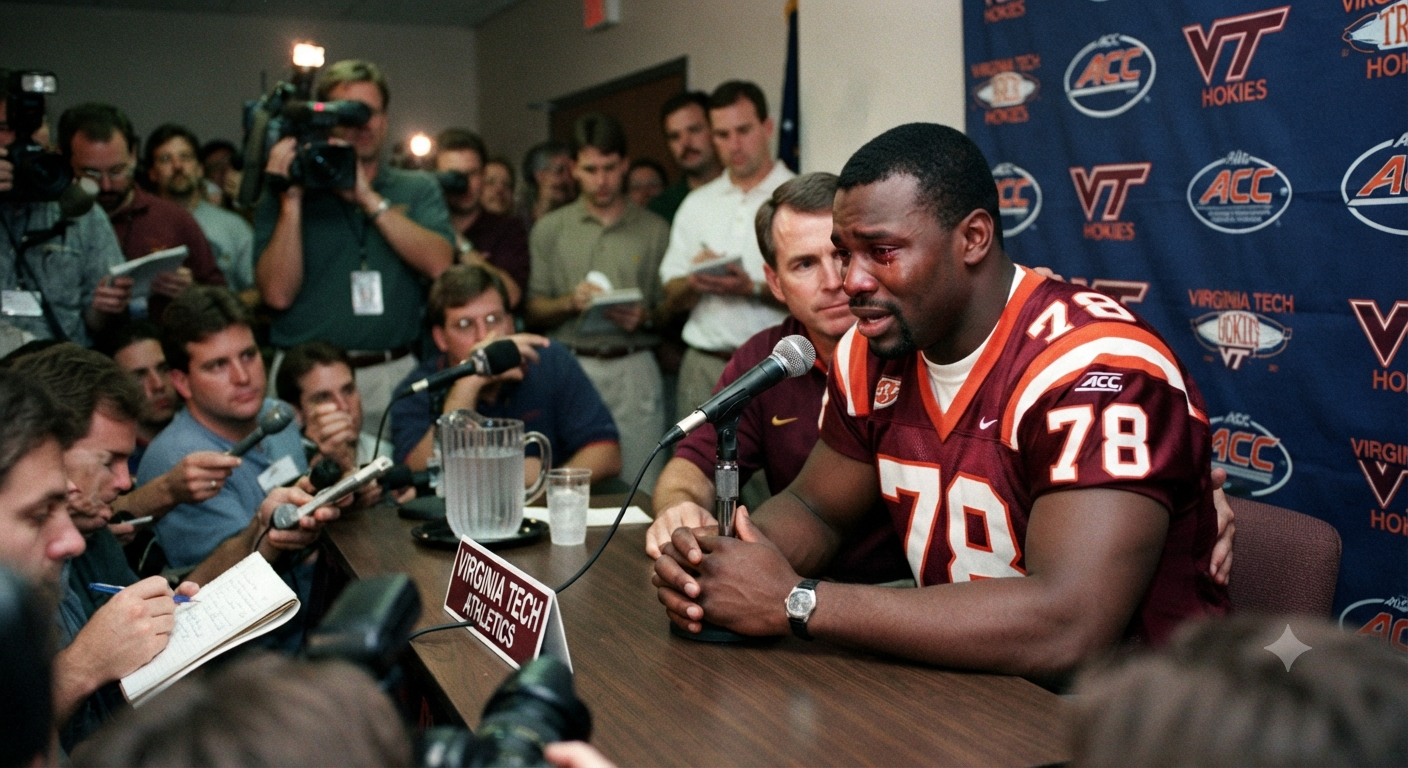
The Bruce Smith Virginia Tech confession has become a surprisingly popular search phrase, but the wording can create the wrong impression. Readers may expect a scandal, a hidden admission, or a dramatic revelation about the NFL Hall of Famer’s years with the Hokies. The available source material points to something much less sensational—and more interesting.
The phrase appears to trace back largely to a May 27, 2025 EssentiallySports headline describing an “emotional Virginia Tech confession.” Yet the remarks covered in that story were about Smith’s attachment to Virginia, why he chose Virginia Tech, and why he believes young athletes should think about where they want to build their lives and professional relationships. The related Triumph NIL video was titled around why Virginia athletes should stay in Virginia, not around an admission of misconduct.
That distinction matters. If you are searching for the Bruce Smith Virginia Tech confession, the most accurate answer is that there is no verified evidence in the cited 2025 material of Smith confessing to a crime, NCAA violation, secret scandal, or previously unknown wrongdoing.
Bruce Smith Virginia Tech Confession: The Short Answer
The Bruce Smith Virginia Tech confession was not a confession in the traditional sense. It was a reflective statement about home, loyalty, opportunity, and the long-term value of building roots in Virginia.
In coverage published on May 27, 2025, Smith explained that choosing Virginia Tech had felt simple because he believed there was “something special about Virginia.” He then encouraged current or prospective athletes to ask themselves practical questions about whether they planned to live, build relationships, and do business in the state.
His message culminated in a straightforward declaration: “This is my home. It will always be my home.” That is the emotional core of the story—and it is very different from the kind of confession implied by click-heavy search results.
Key Takeaways
- The 2025 remarks centered on Virginia, community, relationships, business, and long-term roots.
- The word “confession” appears to be headline framing rather than a description of an admission of wrongdoing.
- A Triumph NIL short published May 27, 2025 framed Smith’s comments as advice on why Virginia athletes should consider staying in Virginia.
- Smith does have a well-documented 1984 Virginia Tech eligibility controversy in his history, but that episode was a legal and NCAA dispute—not the substance of the 2025 “confession” headline.
Where the Bruce Smith Virginia Tech Confession Story Came From
To understand the Bruce Smith Virginia Tech confession, it helps to follow the source trail rather than rely on recycled summaries.
On May 27, 2025, EssentiallySports published a story headlined “Bills Legend Bruce Smith Makes Emotional Virginia Tech Confession, A Year After First Citizen Honor.” The article discussed Smith’s return to Virginia, his real-estate work, his bond with Virginia Tech, and remarks shared with young Hokies.
On the same date, Triumph NIL published a short video titled “Hokie LEGEND Bruce Smith on why VA athletes should stay in Virginia.” That title provides a clearer description of the underlying message than the word “confession” does.
This is a useful example of how search language evolves. One publisher chooses a dramatic headline; other sites target the phrase; readers begin searching the exact wording; and suddenly the phrase looks like the name of a specific scandal even when the original source does not support that interpretation.
For anyone researching the Bruce Smith Virginia Tech confession, this source trail is crucial. It shows why relying on a later SEO article instead of the earliest available reporting can dramatically change the perceived meaning of an event.
What Did Bruce Smith Actually Say?
The most important part of the Bruce Smith Virginia Tech confession story is the content of Smith’s remarks.
According to the May 2025 report, Smith said his decision to attend Virginia Tech was rooted in his belief that Virginia was special and that Virginia Tech was the right place for him. He then shifted from nostalgia to practical advice, telling athletes to think about where they expect to live, who they want to build relationships with, and where they may eventually do business.
That is not scandal language. It is network-and-community language.
Smith’s point becomes especially meaningful when viewed against his post-football life. He returned to Virginia and became involved in development and business ventures in the region, reinforcing the idea that college connections can extend far beyond a player’s eligibility or professional sports career. Coverage of his 2024 Norfolk First Citizen recognition likewise emphasized his decision to return and invest locally.
Why Smith’s Message Resonates With College Athletes
The Bruce Smith Virginia Tech confession can be read as a piece of career advice disguised as a hometown reflection.
College athletes now make decisions in an environment shaped by transfers, NIL opportunities, personal branding, professional ambitions, and increasingly complex career pathways. Smith’s message cuts through that complexity with a simple question: Where do you want your relationships to compound over time?
A school is not only a place to compete. It can become a long-term professional network, a market for future business, a community of alumni, and a geographic base for life after sports.
That is the real “confession,” if the word must be used at all: Smith still sees Virginia as home.
Why the Word “Confession” Is Potentially Misleading
Searchers encountering the Bruce Smith Virginia Tech confession phrase may assume several things: that Smith admitted cheating, revealed hidden NCAA misconduct, confessed to a crime, or disclosed a secret from his playing days.
The verified 2025 source does not establish any of those claims. It presents an emotional homecoming-style message about Virginia Tech and Virginia.
This distinction is especially important because multiple low-authority pages now appear in search results with increasingly elaborate versions of the story. Some describe supposed mental-health revelations, specific event locations, detailed admissions, or timelines that are not present in the original May 2025 coverage.
Those additions should not be treated as established facts unless independently verified by primary video, a transcript, Virginia Tech, Smith himself, or reputable reporting. Repetition across websites does not transform an unsupported assertion into evidence.
For readers, the best rule is simple: separate the headline from the evidence.
For publishers covering the Bruce Smith Virginia Tech confession, that distinction is equally important. A fact-checked article can satisfy the same search intent without repeating unverified allegations simply because competitors have already published them.
Is the Bruce Smith Virginia Tech Confession Connected to the 1984 NCAA Controversy?
This is where the story becomes more complicated.
Bruce Smith really was at the center of a major eligibility dispute during his final season at Virginia Tech. In December 1984, immediately before the Independence Bowl against Air Force, his postseason eligibility became the subject of lawsuits and emergency court rulings.
Virginia Tech archival reporting says the underlying recruiting violations included a load of firewood provided to Smith’s family and extra rides to Virginia Tech football games while he was being recruited. The NCAA had ruled Smith ineligible for bowl participation, while Smith challenged that restriction in court.
Smith ultimately obtained legal relief that allowed him to play in the Independence Bowl. A later Roanoke Times retrospective preserved in Virginia Tech’s scholarly archive identifies the Louisiana case and notes that his lawsuit was dismissed shortly after the game.
The Crucial Distinction
The Bruce Smith Virginia Tech confession discussed in 2025 coverage is not presented as an admission about the 1984 case.
The 1984 episode was already public, heavily reported, litigated in court, and discussed for decades. It was not a newly revealed secret. Virginia Tech’s own retrospective described the controversy in detail in 2010, long before the 2025 headline appeared.
That means articles that merge the 2025 emotional remarks with the 1984 NCAA dispute risk creating a false narrative: a modern confession about an old scandal. The available evidence supports two separate stories.
One is a documented eligibility and legal battle from 1984.
The other is a 2025 message about Virginia, relationships, opportunity, and home.
Bruce Smith’s Virginia Tech Legacy Explains Why the Remarks Matter
The Bruce Smith Virginia Tech confession attracts attention partly because Smith is not an ordinary alumnus. He is one of the most accomplished football players ever associated with the school.
Smith played at Virginia Tech from 1981 through 1984. The National Football Foundation credits him with 46 career sacks, 71 tackles for loss, 22 sacks as a junior, consensus All-America honors as a senior, and the 1984 Outland Trophy. He entered the College Football Hall of Fame in 2006.
The Buffalo Bills selected him first overall in the 1985 NFL Draft. He later finished his 19-season professional career with 200 sacks, still recognized by the Pro Football Hall of Fame as the NFL career record, along with 11 Pro Bowl selections and 13 seasons of at least 10 sacks.
Virginia Tech also retired Smith’s No. 78. The university’s athletics department records his 46 sacks as a school record and notes his 22-sack 1983 season and Outland Trophy.
So when Smith tells young Virginia athletes to think beyond the next season, his advice carries unusual weight. He can speak from both sides of the athlete lifecycle: local recruit and college star on one end, Hall of Famer and businessman on the other.
The First Citizen Honor Adds Important Context
The phrase Bruce Smith Virginia Tech confession also appears alongside references to Smith’s recognition as Norfolk’s First Citizen.
Smith was named Norfolk’s First Citizen in 2024. Coverage highlighted not only his football fame but also his return to the region and his involvement in community and development efforts. Norfolk Mayor Kenny Alexander described Smith’s interest in local opportunities and community impact.
That context helps explain why the 2025 comments focused so strongly on staying in Virginia. The message was not merely sentimental.
It reflected the arc of Smith’s own life: grow up in Norfolk, star at Virginia Tech, build an elite NFL career, then return to Virginia with business and civic interests.
In that sense, the speech was less about looking backward than about showing athletes what a long-term local network can become.
A Bigger Lesson About NIL, Recruiting and Life After Football
There is another layer to the Bruce Smith Virginia Tech confession that deserves more attention than the sensational headline: Smith was effectively talking about the economics of relationships.
Modern recruiting conversations often revolve around immediate variables—playing time, coaching staff, facilities, conference exposure, NIL compensation, and the possibility of reaching the NFL. Those considerations are legitimate, but they are not the entire value of a college decision.
Relationships may continue paying dividends decades after the final snap.
An athlete who builds credibility with alumni, local businesses, university supporters, former teammates, civic leaders, and regional organizations can create a network that remains useful after professional sports. Smith’s own transition from football superstar to Virginia-based businessman gives his advice an unusually concrete backdrop.
This does not mean athletes should automatically remain in their home states or choose schools solely because of geography. It means long-term network value deserves a place beside short-term athletic opportunity when evaluating a college decision.
That is a much richer takeaway than the word “confession” suggests.
How to Verify Claims About the Bruce Smith Virginia Tech Confession
Because the Bruce Smith Virginia Tech confession keyword now produces a mixture of reporting, SEO pages, summaries, and speculative retellings, readers should verify unusually dramatic claims before repeating them.
Use a simple source hierarchy:
- Start with the original video. Triumph NIL’s May 27, 2025 short is the closest available source to the remarks themselves.
- Check the early report using the “confession” wording. The EssentiallySports article shows what the headline actually referred to.
- Use institutional records for career facts. Virginia Tech Athletics, the National Football Foundation, and the Pro Football Hall of Fame provide authoritative biographical and statistical context.
- Use archival reporting for the 1984 dispute. Contemporary UPI coverage and Virginia Tech-hosted archives document the eligibility battle.
- Treat unsupported specifics cautiously. If a page introduces a date, venue, confession, diagnosis, quote, or event not found in primary or reputable sources, do not assume repetition makes it true.
That last point is the biggest information-quality lesson here. Search visibility is not the same thing as evidence.
What the Bruce Smith Virginia Tech Confession Really Tells Us
The most accurate interpretation of the Bruce Smith Virginia Tech confession is not that a football legend finally admitted to hidden wrongdoing.
It is that Bruce Smith publicly reaffirmed a long-standing connection to Virginia and encouraged younger athletes to think about the life they want to build after college sports. His questions about living, relationships, and business point toward a broader idea: athletic recruiting decisions can have consequences far beyond wins, playing time, or draft position.
That message fits his biography. Smith used Virginia Tech as a launching point for a historic professional career, then maintained strong ties to the state after football.
And because his name is attached to a genuine 1984 NCAA eligibility controversy, the word “confession” can easily cause readers to connect dots that the 2025 source never connects.
FAQ About the Bruce Smith Virginia Tech Confession
What was the Bruce Smith Virginia Tech confession?
The Bruce Smith Virginia Tech confession refers to 2025 coverage of Smith speaking about why he chose Virginia Tech and why he believes athletes from Virginia should consider building their lives, relationships, and business networks in the state.
The source does not show him confessing to criminal conduct or newly revealed NCAA wrongdoing.
Did Bruce Smith confess to cheating at Virginia Tech?
No verified source reviewed for this article shows Smith making such a confession in the 2025 remarks.
There was a real NCAA eligibility controversy during his senior season, but it involved recruiting violations and a legal battle over whether he could play in the 1984 Independence Bowl. The dispute was public at the time and has been documented for decades.
What happened to Bruce Smith at Virginia Tech in 1984?
Smith was ruled ineligible for postseason play in connection with recruiting violations involving benefits provided during his recruitment. He challenged the restriction through court action and ultimately played against Air Force in the Independence Bowl.
The episode generated national attention because the legal fight unfolded immediately before the game. It should not, however, be confused with Smith’s 2025 comments.
Why did Bruce Smith choose Virginia Tech?
In the 2025 remarks, Smith described his choice as straightforward: he believed Virginia was special and Virginia Tech was the place for him.
He used his own experience to encourage athletes to consider where they want to live and build lasting relationships after their playing careers.
What is Bruce Smith’s connection to Virginia Tech today?
Smith remains one of Virginia Tech football’s defining alumni. He won the Outland Trophy, finished his college career with 46 sacks, became the No. 1 pick in the 1985 NFL Draft, and later set the NFL career sack record at 200.
His 2025 comments also demonstrate that his connection is more than historical. He continues to identify strongly with Virginia and Virginia Tech, framing the state as a place where athletes can build relationships and opportunities that survive long after their playing careers end.
Conclusion: Read the Source Before Repeating the Headline
The Bruce Smith Virginia Tech confession is a strong example of why readers should investigate viral wording instead of accepting it literally. The evidence supports an emotional statement about home, opportunity, relationships, and Virginia—not a newly disclosed scandal.
If you are researching this topic, start with the May 27, 2025 Triumph NIL video and the EssentiallySports report that popularized the “confession” framing. Then use Virginia Tech, Hall of Fame records, and archival reporting to separate Smith’s 2025 remarks from the very real but much older 1984 eligibility dispute.
That approach gives readers something far more valuable than another sensational retelling: a verifiable account of what Bruce Smith actually said, what happened historically, and what the evidence does—and does not—support.
. Readers may expect a scandal, a hidden admission, or a dramatic revelation about the NFL Hall of Famer’s years with the Hokies. The available source material points to something much less sensational—and more interesting.
The phrase appears to trace back largely to a May 27, 2025 EssentiallySports headline describing an “emotional Virginia Tech confession.” Yet the remarks covered in that story were about Smith’s attachment to Virginia, why he chose Virginia Tech, and why he believes young athletes should think about where they want to build their lives and professional relationships. The related Triumph NIL video was titled around why Virginia athletes should stay in Virginia, not around an admission of misconduct.
That distinction matters. If you are searching for the Bruce Smith Virginia Tech confession, the most accurate answer is that there is no verified evidence in the cited 2025 material of Smith confessing to a crime, NCAA violation, secret scandal, or previously unknown wrongdoing.
Bruce Smith Virginia Tech Confession: The Short Answer
The Bruce Smith Virginia Tech confession was not a confession in the traditional sense. It was a reflective statement about home, loyalty, opportunity, and the long-term value of building roots in Virginia.
In coverage published on May 27, 2025, Smith explained that choosing Virginia Tech had felt simple because he believed there was “something special about Virginia.” He then encouraged current or prospective athletes to ask themselves practical questions about whether they planned to live, build relationships, and do business in the state.
His message culminated in a straightforward declaration: “This is my home. It will always be my home.” That is the emotional core of the story—and it is very different from the kind of confession implied by click-heavy search results.
Key Takeaways
- The 2025 remarks centered on Virginia, community, relationships, business, and long-term roots.
- The word “confession” appears to be headline framing rather than a description of an admission of wrongdoing.
- A Triumph NIL short published May 27, 2025 framed Smith’s comments as advice on why Virginia athletes should consider staying in Virginia.
- Smith does have a well-documented 1984 Virginia Tech eligibility controversy in his history, but that episode was a legal and NCAA dispute—not the substance of the 2025 “confession” headline.
Where the Bruce Smith Virginia Tech Confession Story Came From
To understand the Bruce Smith Virginia Tech confession, it helps to follow the source trail rather than rely on recycled summaries.
On May 27, 2025, EssentiallySports published a story headlined “Bills Legend Bruce Smith Makes Emotional Virginia Tech Confession, A Year After First Citizen Honor.” The article discussed Smith’s return to Virginia, his real-estate work, his bond with Virginia Tech, and remarks shared with young Hokies.
On the same date, Triumph NIL published a short video titled “Hokie LEGEND Bruce Smith on why VA athletes should stay in Virginia.” That title provides a clearer description of the underlying message than the word “confession” does.
This is a useful example of how search language evolves. One publisher chooses a dramatic headline; other sites target the phrase; readers begin searching the exact wording; and suddenly the phrase looks like the name of a specific scandal even when the original source does not support that interpretation.
For anyone researching the Bruce Smith Virginia Tech confession, this source trail is crucial. It shows why relying on a later SEO article instead of the earliest available reporting can dramatically change the perceived meaning of an event.
What Did Bruce Smith Actually Say?
The most important part of the Bruce Smith Virginia Tech confession story is the content of Smith’s remarks.
According to the May 2025 report, Smith said his decision to attend Virginia Tech was rooted in his belief that Virginia was special and that Virginia Tech was the right place for him. He then shifted from nostalgia to practical advice, telling athletes to think about where they expect to live, who they want to build relationships with, and where they may eventually do business.
That is not scandal language. It is network-and-community language.
Smith’s point becomes especially meaningful when viewed against his post-football life. He returned to Virginia and became involved in development and business ventures in the region, reinforcing the idea that college connections can extend far beyond a player’s eligibility or professional sports career. Coverage of his 2024 Norfolk First Citizen recognition likewise emphasized his decision to return and invest locally.
Why Smith’s Message Resonates With College Athletes
The Bruce Smith Virginia Tech confession can be read as a piece of career advice disguised as a hometown reflection.
College athletes now make decisions in an environment shaped by transfers, NIL opportunities, personal branding, professional ambitions, and increasingly complex career pathways. Smith’s message cuts through that complexity with a simple question: Where do you want your relationships to compound over time?
A school is not only a place to compete. It can become a long-term professional network, a market for future business, a community of alumni, and a geographic base for life after sports.
That is the real “confession,” if the word must be used at all: Smith still sees Virginia as home.
Why the Word “Confession” Is Potentially Misleading
Searchers encountering the Bruce Smith Virginia Tech confession phrase may assume several things: that Smith admitted cheating, revealed hidden NCAA misconduct, confessed to a crime, or disclosed a secret from his playing days.
The verified 2025 source does not establish any of those claims. It presents an emotional homecoming-style message about Virginia Tech and Virginia.
This distinction is especially important because multiple low-authority pages now appear in search results with increasingly elaborate versions of the story. Some describe supposed mental-health revelations, specific event locations, detailed admissions, or timelines that are not present in the original May 2025 coverage.
Those additions should not be treated as established facts unless independently verified by primary video, a transcript, Virginia Tech, Smith himself, or reputable reporting. Repetition across websites does not transform an unsupported assertion into evidence.
For readers, the best rule is simple: separate the headline from the evidence.
For publishers covering the Bruce Smith Virginia Tech confession, that distinction is equally important. A fact-checked article can satisfy the same search intent without repeating unverified allegations simply because competitors have already published them.
Is the Bruce Smith Virginia Tech Confession Connected to the 1984 NCAA Controversy?
This is where the story becomes more complicated.
Bruce Smith really was at the center of a major eligibility dispute during his final season at Virginia Tech. In December 1984, immediately before the Independence Bowl against Air Force, his postseason eligibility became the subject of lawsuits and emergency court rulings.
Virginia Tech archival reporting says the underlying recruiting violations included a load of firewood provided to Smith’s family and extra rides to Virginia Tech football games while he was being recruited. The NCAA had ruled Smith ineligible for bowl participation, while Smith challenged that restriction in court.
Smith ultimately obtained legal relief that allowed him to play in the Independence Bowl. A later Roanoke Times retrospective preserved in Virginia Tech’s scholarly archive identifies the Louisiana case and notes that his lawsuit was dismissed shortly after the game.
The Crucial Distinction
The Bruce Smith Virginia Tech confession discussed in 2025 coverage is not presented as an admission about the 1984 case.
The 1984 episode was already public, heavily reported, litigated in court, and discussed for decades. It was not a newly revealed secret. Virginia Tech’s own retrospective described the controversy in detail in 2010, long before the 2025 headline appeared.
That means articles that merge the 2025 emotional remarks with the 1984 NCAA dispute risk creating a false narrative: a modern confession about an old scandal. The available evidence supports two separate stories.
One is a documented eligibility and legal battle from 1984.
The other is a 2025 message about Virginia, relationships, opportunity, and home.
Bruce Smith’s Virginia Tech Legacy Explains Why the Remarks Matter
The Bruce Smith Virginia Tech confession attracts attention partly because Smith is not an ordinary alumnus. He is one of the most accomplished football players ever associated with the school.
Smith played at Virginia Tech from 1981 through 1984. The National Football Foundation credits him with 46 career sacks, 71 tackles for loss, 22 sacks as a junior, consensus All-America honors as a senior, and the 1984 Outland Trophy. He entered the College Football Hall of Fame in 2006.
The Buffalo Bills selected him first overall in the 1985 NFL Draft. He later finished his 19-season professional career with 200 sacks, still recognized by the Pro Football Hall of Fame as the NFL career record, along with 11 Pro Bowl selections and 13 seasons of at least 10 sacks.
Virginia Tech also retired Smith’s No. 78. The university’s athletics department records his 46 sacks as a school record and notes his 22-sack 1983 season and Outland Trophy.
So when Smith tells young Virginia athletes to think beyond the next season, his advice carries unusual weight. He can speak from both sides of the athlete lifecycle: local recruit and college star on one end, Hall of Famer and businessman on the other.
The First Citizen Honor Adds Important Context
The phrase Bruce Smith Virginia Tech confession also appears alongside references to Smith’s recognition as Norfolk’s First Citizen.
Smith was named Norfolk’s First Citizen in 2024. Coverage highlighted not only his football fame but also his return to the region and his involvement in community and development efforts. Norfolk Mayor Kenny Alexander described Smith’s interest in local opportunities and community impact.
That context helps explain why the 2025 comments focused so strongly on staying in Virginia. The message was not merely sentimental.
It reflected the arc of Smith’s own life: grow up in Norfolk, star at Virginia Tech, build an elite NFL career, then return to Virginia with business and civic interests.
In that sense, the speech was less about looking backward than about showing athletes what a long-term local network can become.
A Bigger Lesson About NIL, Recruiting and Life After Football
There is another layer to the Bruce Smith Virginia Tech confession that deserves more attention than the sensational headline: Smith was effectively talking about the economics of relationships.
Modern recruiting conversations often revolve around immediate variables—playing time, coaching staff, facilities, conference exposure, NIL compensation, and the possibility of reaching the NFL. Those considerations are legitimate, but they are not the entire value of a college decision.
Relationships may continue paying dividends decades after the final snap.
An athlete who builds credibility with alumni, local businesses, university supporters, former teammates, civic leaders, and regional organizations can create a network that remains useful after professional sports. Smith’s own transition from football superstar to Virginia-based businessman gives his advice an unusually concrete backdrop.
This does not mean athletes should automatically remain in their home states or choose schools solely because of geography. It means long-term network value deserves a place beside short-term athletic opportunity when evaluating a college decision.
That is a much richer takeaway than the word “confession” suggests.
How to Verify Claims About the Bruce Smith Virginia Tech Confession
Because the Bruce Smith Virginia Tech confession keyword now produces a mixture of reporting, SEO pages, summaries, and speculative retellings, readers should verify unusually dramatic claims before repeating them.
Use a simple source hierarchy:
- Start with the original video. Triumph NIL’s May 27, 2025 short is the closest available source to the remarks themselves.
- Check the early report using the “confession” wording. The EssentiallySports article shows what the headline actually referred to.
- Use institutional records for career facts. Virginia Tech Athletics, the National Football Foundation, and the Pro Football Hall of Fame provide authoritative biographical and statistical context.
- Use archival reporting for the 1984 dispute. Contemporary UPI coverage and Virginia Tech-hosted archives document the eligibility battle.
- Treat unsupported specifics cautiously. If a page introduces a date, venue, confession, diagnosis, quote, or event not found in primary or reputable sources, do not assume repetition makes it true.
That last point is the biggest information-quality lesson here. Search visibility is not the same thing as evidence.
What the Bruce Smith Virginia Tech Confession Really Tells Us
The most accurate interpretation of the Bruce Smith Virginia Tech confession is not that a football legend finally admitted to hidden wrongdoing.
It is that Bruce Smith publicly reaffirmed a long-standing connection to Virginia and encouraged younger athletes to think about the life they want to build after college sports. His questions about living, relationships, and business point toward a broader idea: athletic recruiting decisions can have consequences far beyond wins, playing time, or draft position.
That message fits his biography. Smith used Virginia Tech as a launching point for a historic professional career, then maintained strong ties to the state after football.
And because his name is attached to a genuine 1984 NCAA eligibility controversy, the word “confession” can easily cause readers to connect dots that the 2025 source never connects.
FAQ About the Bruce Smith Virginia Tech Confession
What was the Bruce Smith Virginia Tech confession?
The Bruce Smith Virginia Tech confession refers to 2025 coverage of Smith speaking about why he chose Virginia Tech and why he believes athletes from Virginia should consider building their lives, relationships, and business networks in the state.
The source does not show him confessing to criminal conduct or newly revealed NCAA wrongdoing.
Did Bruce Smith confess to cheating at Virginia Tech?
No verified source reviewed for this article shows Smith making such a confession in the 2025 remarks.
There was a real NCAA eligibility controversy during his senior season, but it involved recruiting violations and a legal battle over whether he could play in the 1984 Independence Bowl. The dispute was public at the time and has been documented for decades.
What happened to Bruce Smith at Virginia Tech in 1984?
Smith was ruled ineligible for postseason play in connection with recruiting violations involving benefits provided during his recruitment. He challenged the restriction through court action and ultimately played against Air Force in the Independence Bowl.
The episode generated national attention because the legal fight unfolded immediately before the game. It should not, however, be confused with Smith’s 2025 comments.
Why did Bruce Smith choose Virginia Tech?
In the 2025 remarks, Smith described his choice as straightforward: he believed Virginia was special and Virginia Tech was the place for him.
He used his own experience to encourage athletes to consider where they want to live and build lasting relationships after their playing careers.
What is Bruce Smith’s connection to Virginia Tech today?
Smith remains one of Virginia Tech football’s defining alumni. He won the Outland Trophy, finished his college career with 46 sacks, became the No. 1 pick in the 1985 NFL Draft, and later set the NFL career sack record at 200.
His 2025 comments also demonstrate that his connection is more than historical. He continues to identify strongly with Virginia and Virginia Tech, framing the state as a place where athletes can build relationships and opportunities that survive long after their playing careers end.
Conclusion: Read the Source Before Repeating the Headline
The Bruce Smith Virginia Tech confession is a strong example of why readers should investigate viral wording instead of accepting it literally. The evidence supports an emotional statement about home, opportunity, relationships, and Virginia—not a newly disclosed scandal.
If you are researching this topic, start with the May 27, 2025 Triumph NIL video and the EssentiallySports report that popularized the “confession” framing. Then use Virginia Tech, Hall of Fame records, and archival reporting to separate Smith’s 2025 remarks from the very real but much older 1984 eligibility dispute.
That approach gives readers something far more valuable than another sensational retelling: a verifiable account of what Bruce Smith actually said, what happened historically, and what the evidence does—and does not—support.















Leave a Reply