
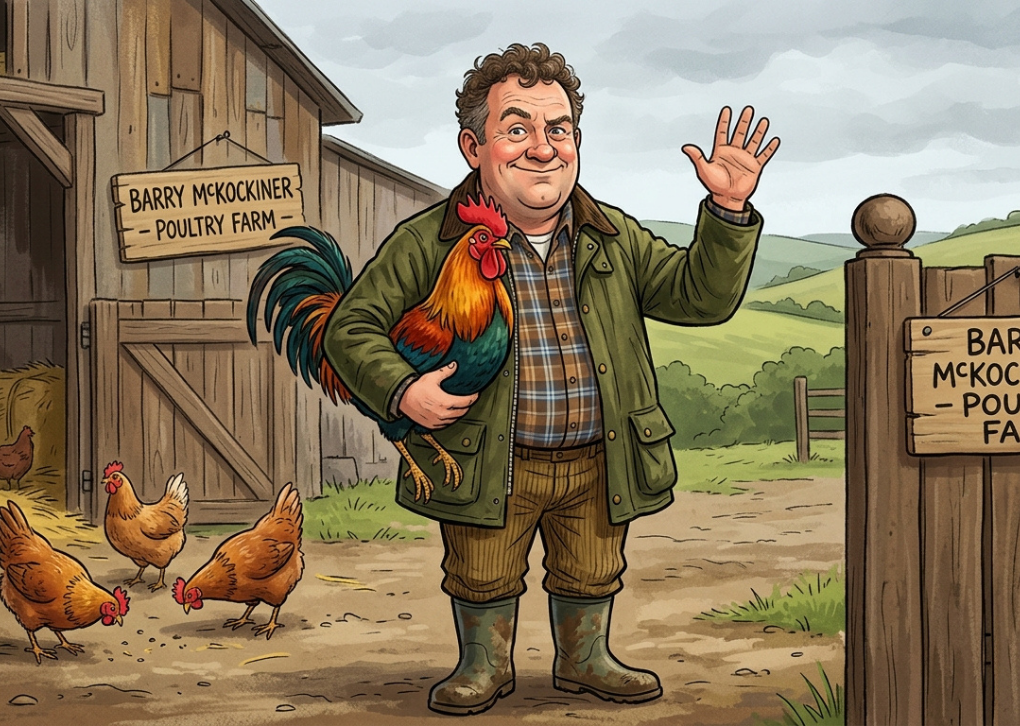
Barry McCockiner is not a conventional sports journalist, athlete, or public figure. The name belongs to a pseudonymous internet persona built around sports satire, deliberately outrageous hot takes, fake breaking-news posts, and a style of trolling that has repeatedly exposed how quickly unverified claims can move through the sports-media ecosystem. What began as a joke account evolved into a recognizable content brand spanning Twitter/X, YouTube, podcasts, and guest appearances.
That distinction matters because searches for the name often produce a messy mix of memes, recycled biographies, parody profiles, and unsupported claims about the creator’s real identity. The most useful way to understand the phenomenon is to separate the fictional character from the real content operation behind it, then examine the documented incidents that made the account famous.
Who Is Barry McCockiner?
Barry McCockiner is the online alias of a sports-focused comedian and content creator best known for parody reporting and deliberately inflammatory sports commentary. Coverage from Forbes, Sporting News, PolitiFact, and sports-media publications has described the account as a parody or satirical prankster rather than a legitimate reporter. That distinction is essential: many of the “reports” attached to the persona were designed to be absurd, not to function as actual journalism.
The creator has historically kept much of his private identity outside the center of the brand. That makes confident claims about his legal name, birthplace, education, age, net worth, or family life difficult to verify and, in many cases, irresponsible to repeat.
A credible profile should therefore focus on the public persona, documented media appearances, and measurable platform activity instead of filling gaps with speculation.
Is Barry McCockiner a Real Name?
No reliable source establishes Barry McCockiner as the creator’s legal name. It functions as a gag name and pseudonym, in the tradition of phonetic joke names that sound superficially plausible until spoken aloud.
The joke itself predates the sports account. References to the name existed online before the creator became prominent, which is another reason not to treat every profile, meme, recruiting page, or joke entry using the name as evidence about the same person. The sports personality turned an already recognizable gag-name format into a durable media identity.
How Barry McCockiner Became Famous
The persona’s early growth came from an unusually effective formula: mimic the visual conventions of trusted sports reporters, post a fabricated scoop at exactly the moment fans are hungry for breaking news, and make the claim just plausible enough—or just outrageous enough—to spread.
On fast-moving sports Twitter, where users often react before opening a source, that formula could travel remarkably far.
A 2020 interview on the Talking Buffalo podcast described years of audience building, repeated Twitter suspensions, and a deliberate balance between humor and substantive football and basketball opinions. The same interview highlighted the creator’s expansion into a podcast and YouTube, showing that the project had already moved beyond one-off trolling into a broader content operation.
The Skip Bayless “Man Boobs” Incident
The best-known example arrived in June 2019. During reports of tension between Houston Rockets stars Chris Paul and James Harden, the account posted a fabricated story claiming Paul had mocked Harden’s “man boobs,” causing Harden to leave practice in tears.
Skip Bayless then referenced the claim on FS1’s Undisputed as though it were legitimate information. Sporting News and Complex documented the mistake, turning what might have been a disposable troll tweet into a widely cited example of a mainstream sports personality getting fooled by parody reporting.
The episode mattered for more than the laugh. It exposed a structural weakness in real-time sports commentary: once a claim looks like insider reporting and fits an existing storyline, speed can overpower source verification.
Barry McCockiner later uploaded a YouTube video about Bayless falling for the post, describing himself in the video description as an internet troll.
The Fake Tom Brady Quote That Reached Major Outlets
Barry McCockiner also became associated with a fabricated Tom Brady quotation after Brady’s 2020 interview with Howard Stern. The false quote portrayed Brady as offering explicit political praise that he had not actually given during the interview.
Forbes traced the quote back to the parody account and noted that media figures and outlets had been fooled by the fabricated material. The incident showed how misinformation can jump from a joke account into apparently legitimate coverage when writers rely on screenshots, reposts, or secondhand citations instead of checking primary audio or transcripts.
That episode is particularly revealing because the fabricated quotation contradicted the broader context of Brady’s actual remarks. Verification would not have required sophisticated investigative work; it primarily required going back to the original interview.
The Tim Tebow and Aaron Hernandez Hoax
In 2021, another fabricated quote claimed Tim Tebow chose No. 85 with the Jacksonville Jaguars to honor former New England Patriots tight end Aaron Hernandez. The post attributed a shocking statement to Tebow that he never made.
PolitiFact investigated the rumor, found no credible evidence for it, traced the claim to the Barry McCockiner account, and rated it false. This is a useful case study because the joke moved beyond sports banter into fact-checking territory, illustrating how parody can lose its original context once screenshots circulate independently.
Barry McCockiner and the Evolution From Twitter Troll to Creator
A key part of the story is platform migration. Twitter supplied the viral distribution mechanism, but repeated suspensions made it an unstable home base.
In a 2021 Talking Buffalo appearance, the creator discussed another permanent suspension after building an account beyond 100,000 followers and said the setback pushed more attention toward YouTube, where the audience was then around 58,000 subscribers.
That shift proved important. Instead of depending entirely on disposable social accounts, the brand developed long-form videos that could be searched, recommended, monetized, and revisited months or years later.
It is a familiar creator-economy pattern: use a high-velocity social platform for discovery, then move loyal viewers toward a platform with stronger content durability.
YouTube Growth and Current Reach
The official YouTube channel was created in September 2018. As of August 2026, third-party analytics services place it at roughly 238,000 subscribers, more than 57.5 million total views, and more than 380 uploaded videos. Social Blade’s recent snapshot lists 238,000 subscribers, about 57.6 million views, and 383 videos.
Those figures are more useful than speculative “net worth” estimates because they are tied to observable channel performance. They also show that the creator’s relevance did not depend solely on a brief 2019 Twitter moment; the channel continued accumulating views and uploads years after the most famous trolling incidents.
One of the channel’s strongest historical performers, according to vidIQ, is a video built around putting an asterisk on every Super Bowl champion, which surpassed one million views. That title captures the core editorial formula: recognizable sports history, provocative ranking logic, and a comedic premise engineered to invite disagreement.
What Kind of Content Does Barry McCockiner Make?
The content sits at the intersection of sports comedy, fan culture, parody journalism, and genuine analysis. Football and basketball dominate, but the presentation often relies on exaggerated certainty, intentionally hostile player comparisons, recurring grudges, and jokes that reward viewers who already understand sports-media conventions.
Several recurring themes define the brand:
- NFL commentary: quarterback debates, Super Bowl narratives, team reactions, rankings, and criticism of conventional football wisdom.
- NBA arguments: LeBron James versus Michael Jordan, Stephen Curry legacy debates, Kevin Durant criticism, and reactions to league storylines.
- Tom Brady satire: arguably the persona’s most recognizable running bit, centered on portraying Brady as overrated or system-dependent.
- Fake breaking news: impersonation-style parody posts that mimic the cadence and presentation of insiders.
- Meta-commentary on sports media: jokes that work because audiences understand how reporters, debate shows, and fan accounts behave online.
- Long-form creator content: YouTube videos and podcast episodes that allow more developed arguments than a single viral post.
The Class Act Podcast extended that voice into audio. Podcast directories document close to 100 episodes beginning in October 2018, with topics spanning the NFL, NBA, politics, movie discussion, and guest interviews. Listings show the feed’s final releases in late 2021, making it an important but apparently dormant part of the creator’s public content history.
Why the Barry McCockiner Persona Works
The obvious answer is shock value, but that explanation is incomplete. The character works because it understands the grammar of sports internet culture: absolutist rankings, instant reactions, insider language, fan tribalism, legacy arguments, and the constant pressure to have the fastest take.
There is also a layered joke. Casual readers may see an outrageous claim; regular followers often understand that the exaggeration itself is the performance.
That gap between literal reading and audience awareness creates the conditions for both viral comedy and accidental misinformation.
The persona also benefits from consistency. Tom Brady criticism, pro-LeBron arguments, anti-Warriors or anti-Curry rhetoric, and repeated “class act” style jokes function almost like recurring characters in a sitcom.
They give returning followers familiar cues while leaving enough room to react to whatever is happening in sports that week.
Why People Keep Falling for the Fake Reports
The success of Barry McCockiner reveals more about online information behavior than it does about any individual reporter who gets fooled. Sports news is unusually vulnerable to fabricated scoops because trades, injuries, locker-room conflicts, signings, and anonymous-source reports often emerge first as extremely short social posts.
There is no requirement for a legitimate breaking-news post to look elaborate. Often it is simply a reporter’s avatar, name, one or two sentences, and a few thousand instant reposts.
A fake account therefore needs only several ingredients to appear credible for a few seconds: a familiar avatar, reporter-like display name, confident language, a believable timestamp, and a claim that fits what fans already suspect. On a phone screen—especially in a cropped screenshot—handles and parody labels are easy to miss.
This effect becomes stronger when confirmation bias enters the picture. Someone who already believes two teammates dislike each other, or that a particular athlete would say something controversial, has less psychological friction to overcome before accepting a fake claim.
The practical lesson is simple. Before repeating a “breaking” story, check the exact account handle, open the original post, confirm whether established reporters are independently reporting it, and look for a primary source.
Those few seconds of verification are precisely what viral parody exploits when people skip them.
Is Barry McCockiner Satire or Misinformation?
It can function as both, depending on context. Satire is the creator’s evident mode, and multiple documented descriptions identify the account as parody. Yet a satirical post can become misinformation once it is stripped of its original account context and presented elsewhere as factual.
That distinction is crucial.
It does not mean every joke should be evaluated as a newsroom dispatch. It does mean readers, aggregators, broadcasters, influencers, and publishers carry responsibility when they rebroadcast claims.
The Skip Bayless, Brady, and Tebow examples all demonstrate roughly the same chain reaction: a joke leaves its native context, a trusted intermediary treats it seriously, and a larger audience encounters the falsehood without the original comedic frame.
This distinction is especially important for SEO publishers. Articles that repeat fake quotes without labeling them clearly can unintentionally resurrect old hoaxes in Google results, featured snippets, AI summaries, and social previews.
A high-quality profile should identify famous fabrications as fabrications at the point of mention—not several paragraphs later.
Barry McCockiner on X: Handles, Suspensions and Identity Confusion
The creator’s Twitter history is unusually difficult to summarize because the brand has operated through changing handles and repeated account suspensions. Historical interviews reference handles including @MegaracismHater and @SportsTalkBarry, while the current public-facing account is associated with @BarryOnHere.
The changing usernames were not merely cosmetic. They became part of the account’s history because followers repeatedly had to locate new incarnations after previous accounts disappeared.
X search data captured in 2026 showed the @BarryOnHere account with more than 200,000 followers. That continuity matters because copycats and unrelated users sometimes adopt the same gag name, making the account handle and cross-platform links more useful than the display name alone when verifying whether a post comes from the established creator.
How to Tell the Real Barry McCockiner Brand From Copycats
Start with cross-platform consistency. The established YouTube presence uses the @BarryOnHere handle, and the X profile links toward that same YouTube identity. That linkage provides substantially stronger evidence than a random social profile simply carrying the same display name.
Be especially skeptical of accounts that suddenly appear during major NFL trades, NBA free agency, the draft, or another breaking-news cycle. Impersonation is most effective when users are already refreshing their feeds for updates.
Avoid treating unsourced biography pages as authoritative as well. If a page claims to know an exact birth date, legal name, salary, relationship status, or net worth but provides no primary interview, platform record, or reputable reporting, that information should be considered unverified.
This is one area where many search results fail basic E-E-A-T standards.
The Barry McCockiner Podcast Era
The Class Act Podcast launched in October 2018 and gave the creator considerably more room than Twitter for sports arguments, interviews, cultural commentary, and character-driven humor. Listen Notes catalogs the show as an explicit U.S. sports podcast and records 98 episodes, while other directories list 99 depending on how entries are counted.
Its early episodes already contained the ingredients that would define the wider brand: NFL discussion, NBA arguments, deliberate self-aggrandizement, absurd recurring jokes, and conversations with other internet personalities.
The podcast is also valuable evidence when researching the persona because it provides a much richer picture than isolated troll tweets. Interviews and long-form audio demonstrate that there is substantive sports knowledge behind the deliberately unserious presentation.
That mixture is central to the appeal. The joke works better when the person making it understands the subject well enough to know precisely which sports-media nerve to hit.
Barry McCockiner, Tom Brady and the Art of the Running Bit
Few topics are as closely associated with the character as Tom Brady. Podcast descriptions repeatedly reference trademark anti-Brady rants, including arguments that Brady is overrated and exaggerated criticism of his career.
For unfamiliar viewers, taking every statement literally misses part of the performance. The persona exaggerates the kind of legacy warfare common to sports debate culture, where championship rings, supporting casts, coaching systems, statistics, era differences, and individual accomplishments can be weaponized indefinitely.
Tom Brady works particularly well as a target because his résumé is so accomplished. The greater the mainstream consensus around his greatness, the more extreme an opposing argument can become—and the more engagement it can produce.
The same mechanism helps explain recurring opinions surrounding LeBron James, Michael Jordan, Stephen Curry, and Kevin Durant. These are not random athletes. They sit at the center of sports arguments with unusually strong fan identities, which means even a deliberately absurd take can generate thousands of serious replies.
The Bigger Legacy: Sports Satire as a Media-Literacy Stress Test
Barry McCockiner belongs to a broader lineage of sports parody accounts that exploit the visual sameness of social-media news. The humor depends on imitation, but the lasting significance comes from what happens when imitation defeats verification.
The account’s most famous incidents predate many of today’s concerns about synthetic media, AI-generated images, fabricated screenshots, voice cloning, and industrial-scale low-quality content. Yet the underlying lesson is even more relevant now: credibility cannot be judged from tone or appearance alone.
A screenshot that “looks like ESPN,” a post formatted like an insider scoop, or a quote repeated by a large account still needs provenance.
Barry McCockiner demonstrates another uncomfortable reality about digital publishing: misinformation does not always win because the fake is exceptionally sophisticated. Sometimes it wins because the surrounding information system is moving too quickly.
Journalists want to publish first. Television panels need material immediately. Fan accounts compete for engagement. Algorithms reward posts that create emotional reactions.
Parody can exploit all four incentives simultaneously.
That is the real information gain behind the story. Barry McCockiner is not merely a crude joke name or a troll who embarrassed famous broadcasters. The persona became an accidental case study in source authentication, attention economics, platform incentives, parasocial sports fandom, and the tension between speed and certainty in online media.
Frequently Asked Questions About Barry McCockiner
Is Barry McCockiner a real person?
A real creator operates the accounts and appears in media, but Barry McCockiner is a pseudonymous persona rather than a verified legal identity. Reliable coverage focuses primarily on the creator’s public work, satire, interviews, and sports commentary.
Readers should be cautious with biography websites claiming an exact real name, age, birthday, family history, or other personal details without credible sourcing. The existence of a real creator does not make every biographical claim attached to the pseudonym true.
What is Barry McCockiner famous for?
He is best known for sports satire, provocative NFL and NBA opinions, parody insider posts, and fake reports that occasionally fooled prominent media personalities. The 2019 Skip Bayless incident involving a fabricated Chris Paul–James Harden story remains the clearest mainstream example.
His reputation later expanded through YouTube videos, podcasting, and recurring sports takes. The longevity of those platforms separates the brand from a typical one-joke troll account.
What happened between Barry McCockiner and Skip Bayless?
A parody post falsely claimed Chris Paul mocked James Harden’s chest and caused Harden to leave practice in tears. Bayless repeated the claim on television while discussing reported tension between the Rockets stars.
Sports outlets subsequently documented that the source was a troll account rather than legitimate reporting. The creator also published a YouTube video celebrating the incident.
Does Barry McCockiner still make content?
Yes. Third-party channel tracking in August 2026 showed the YouTube channel at about 238,000 subscribers, roughly 57.6 million lifetime views, and 383 videos, indicating activity well beyond the account’s original Twitter-fame period.
The @BarryOnHere identity also remained visible on X in 2026 with a following above 200,000 in captured search data. Exact social metrics fluctuate, so current platform pages should always be checked when precise counts matter.
Why does Barry McCockiner hate Tom Brady?
The anti-Brady stance is one of the persona’s longest-running comedic and argumentative motifs. Barry mckockiner Podcast appearances have explicitly highlighted “trademark” Brady rants and the recurring position that Brady is overrated, suggesting the argument functions as both a sports opinion and a deliberately exaggerated component of the character.
It also makes excellent engagement bait. Few NFL subjects provoke stronger reactions than questioning the legacy of a seven-time Super Bowl champion, so the recurring argument naturally creates debate among fans.
Final Take: How to Read Barry McCockiner Content
Barry McCockiner is best understood as a sports-satire creator who turned trolling into a durable cross-platform brand. The entertainment comes from exaggerated takes, sports tribalism, recurring character bits, and media mimicry; the caution comes from how easily those jokes can be detached from their original source and mistaken for reporting.
The creator’s history also provides an unexpectedly useful lesson for journalists, fans, bloggers, and SEO publishers. Authority is not established by a familiar avatar. A viral screenshot is not a primary source. Repetition does not transform a fabricated quotation into a genuine one.
If you encounter a shocking quote, trade rumor, locker-room story, or “insider” scoop tied to the account, enjoy the joke—but verify before sharing. Check the handle, locate the original post, compare it with trusted reporting, and look for independent or primary-source confirmation.
That habit is useful far beyond sports Twitter. And it may be the most important legacy the Barry McCockiner phenomenon has produced.













Leave a Reply