
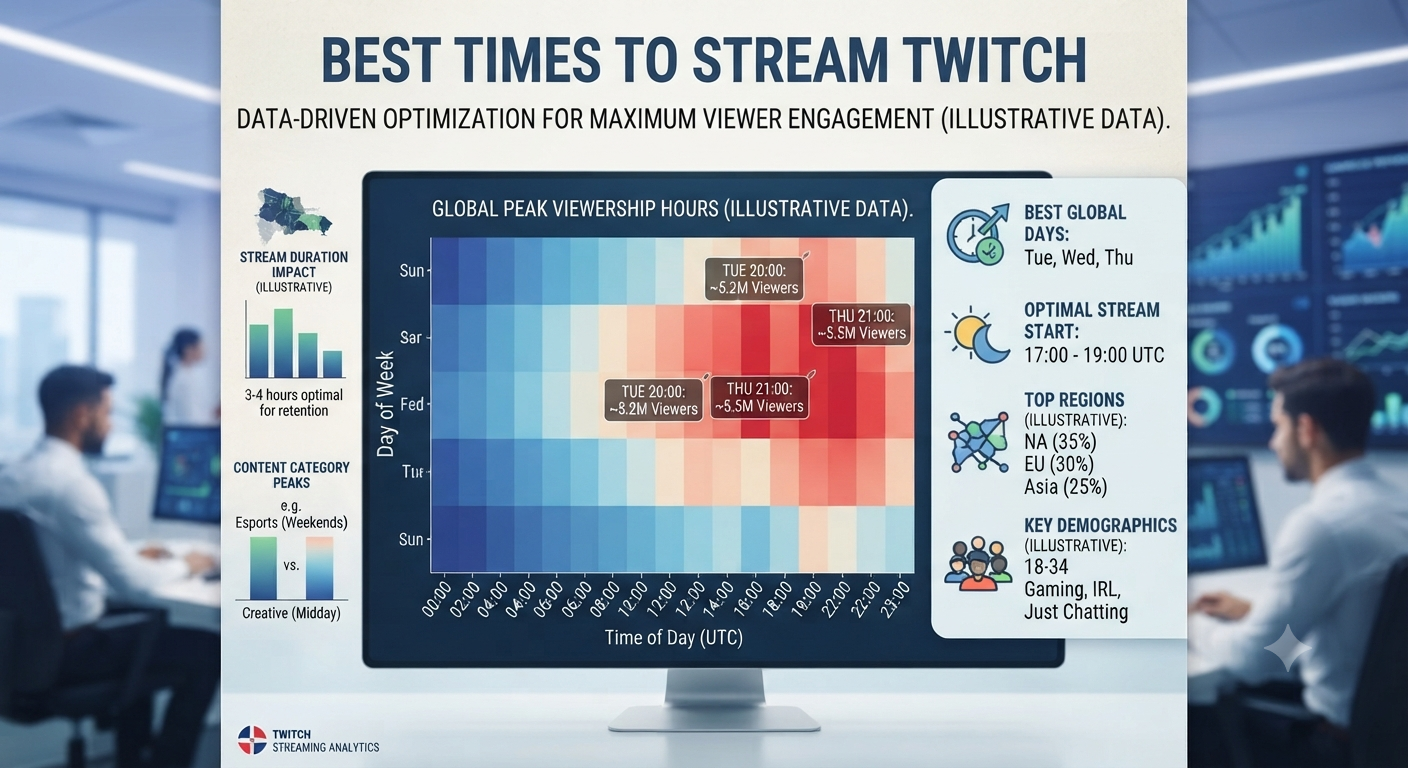
The best times to stream Twitch are not simply the hours with the most viewers. The real opportunity appears when enough of your target audience is online, fewer competing channels are live, and your content matches what those viewers want at that moment.
For many English-language creators, a strong starting point is weekday afternoons from 3:00 p.m. to 7:00 p.m. UTC for a better viewer-to-channel balance, followed by 7:00 p.m. to 11:00 p.m. in the audience’s local time for maximum demand. These are testing windows, not universal guarantees, because category, language, region, channel size, and major live events can completely change the result.
Quick Answer: What Are the Best Times to Stream Twitch?
Before you have enough personal channel analytics, use the following time slots as practical starting points:
- Small or new channels: Weekdays from 3:00 p.m. to 7:00 p.m. UTC, when global activity is healthy but North American evening competition has not fully peaked.
- North American audiences: Test 11:00 a.m. to 3:00 p.m. Eastern Time for discoverability and 6:00 p.m. to 10:00 p.m. Eastern Time for greater audience potential.
- European audiences: Test 1:00 p.m. to 5:00 p.m. local time for lower competition and 6:00 p.m. to 10:00 p.m. for prime-time demand.
- Asian audiences: Test 11:00 a.m. to 3:00 p.m. local time for a quieter category page and 7:00 p.m. to 11:00 p.m. for peak local viewing.
- Weekend streams: Start one or two hours earlier than your weekday slot because viewers often have more flexible daytime schedules.
- Established communities: Prioritize the hours when returning viewers consistently appear, even when those hours are not platform-wide peaks.
The best times to stream Twitch depend on whether your goal is discovery, average concurrent viewers, subscriptions, chat activity, or serving an existing community. Use these windows to identify the best times to stream Twitch through controlled testing, not as permanent rules.
A channel trying to attract its first 10 regular viewers should not copy the schedule of a creator who already brings thousands of followers online through notifications and social media.
Why Peak Viewership Is Not the Same as Opportunity
The Twitch platform is quite popular; thus, there are many streamers who want to become successful on it. According to the information provided by SullyGnome, there were 2 million viewers on average in the last 30 days (July 13, 2026). There were also 81,600 channels on average, and the ratio between viewers and channels was 24.2 on average.
Meanwhile, according to TwitchTracker’s rolling stats, there were 2.02 million viewers and 89,300 channels on average during the last seven days. The Twitch platform experiences a rapid growth of popularity; therefore, this value changes quite often.
These numbers may be confusing since they suggest that each channel, on average, has only 24 viewers. However, it would be a mistake to believe that every channel earns approximately the same amount of views. Moreover, channels with higher concurrent viewership values tend to take more space on the category pages. If a new streamer launches its channel within a highly competitive category during peak hours, it may experience lower views than expected.
The most concurrent hours for Twitch channels are usually late in the afternoon or evening. This way, a streamer may maximize the number of viewers by going live at 3 pm instead of 8 pm. However, it is worth noting that a channel’s popularity may not be very high overall. On average, the number of concurrent viewers at 8 pm is almost 3 times higher than at 3 pm. However, in this case, the streamer at 3 pm will still have more viewers than the one at 8 pm.
The Three Variables That Determine Your Best Streaming Time
1. Audience availability
Start with the people you want to reach. Students, office workers, night-shift employees, parents, international gamers, and casual weekend viewers follow different routines.
A creator targeting American professionals may perform best after working hours. An English-speaking streamer based in Europe might gain more visibility by overlapping European evenings with North American afternoons.
The best times to stream Twitch are ultimately audience times, not streamer times. Your physical location matters less than the time zone, language, and daily habits of the people you want watching.
2. Competition in your category
Compare average viewers, live channels, and the distribution of viewers among the top channels. A category with 20,000 viewers and 2,000 live channels may offer less realistic exposure than one with 5,000 viewers and only 100 active channels.
Twitch’s Research Analytics includes a Time to Stream panel showing average viewers per channel, average viewers, and average channels live across different hours and days. That makes the Creator Dashboard a better scheduling source than a generic worldwide timetable.
Do not evaluate the entire Twitch platform when you stream in one specific category. Study the supply and demand inside the game, language, tag group, or content niche where your broadcast will actually appear.
3. Your returning-viewer behavior
Your Stream Summary and Channel Analytics reveal how individual broadcasts perform and where viewers discover your channel. Twitch provides both per-stream analysis and broader channel-level metrics inside the Creator Dashboard.
Once you have four to eight comparable broadcasts, your own data should outrank general scheduling advice. The best times to stream Twitch for your channel are the slots that repeatedly improve average concurrent viewers, returning viewers, chat participation, follows, and watch time.
Best Times to Stream Twitch by Region
The table below should be treated as a starting hypothesis. All times are shown in the target audience’s local time.
| Target audience | Discovery window | Peak-demand window | Best use |
|---|---|---|---|
| North America | 11 a.m.–3 p.m. | 6 p.m.–10 p.m. | Early slot for growth tests; evening for established communities |
| United Kingdom | 1 p.m.–5 p.m. | 6 p.m.–10 p.m. | Afternoon for lower competition; evening for broader reach |
| Continental Europe | 1 p.m.–5 p.m. | 7 p.m.–11 p.m. | Match local after-work and gaming habits |
| South Asia | 12 p.m.–4 p.m. | 7 p.m.–11 p.m. | Midday testing or evening community building |
| East and Southeast Asia | 11 a.m.–3 p.m. | 7 p.m.–11 p.m. | Adjust for language-specific category activity |
| Global English audience | 3 p.m.–7 p.m. UTC | 7 p.m.–11 p.m. UTC | Useful overlap between Europe and North America |
When comparing regions, remember that the best times to stream Twitch should be defined by the audience you want, not the country where your equipment is located. A global English-language channel should not try to cover every time zone in one exhausting broadcast.
It is usually smarter to select one primary market, one secondary overlap market, and a schedule you can maintain consistently.
The best times to stream Twitch may also shift by one hour when daylight-saving rules change in the United States or Europe. Keep your published schedule tied to one named time zone, such as Eastern Time or UTC, and display conversions for international viewers.
Best Days of the Week to Stream on Twitch
The day matters because school, work, social plans, esports events, and creator competition reshape demand. Your best times to stream Twitch can therefore differ between weekdays and weekends even when the content stays identical.
Monday and Tuesday: strong testing days
Early-week streams are useful for controlled experiments because entertainment calendars may be less crowded than Friday or Saturday. Test new games, formats, titles, tags, and start times during these sessions.
For many small creators, the best times to stream Twitch on Monday or Tuesday are late afternoon and early evening. You can catch viewers entering their leisure window without competing through the entire prime-time peak.
These days are also useful for educational streams, ranked progression, recurring challenges, or content that benefits from a predictable weekly structure.
Wednesday and Thursday: reliable community-building days
Midweek routines are often predictable. Viewers know when they finish work or school, while creators can establish recurring programs such as community games, tutorials, interviews, co-working sessions, or talk shows.
Use the same starting time for at least three or four weeks before judging its effectiveness. Consistency gives followers a chance to form a viewing habit and makes performance data easier to compare.
Wednesday and Thursday can also serve as strong anchor days for channels that publish clips or short-form content earlier in the week.
Friday: high demand, high distraction
Friday evening can bring more available viewers, but it also competes with social plans, game launches, special broadcasts, esports events, and major creators. The best times to stream Twitch on Friday may be earlier than expected, especially for smaller gaming channels.
Consider starting in the late afternoon and carrying your existing audience into the evening. That gives the broadcast time to build momentum before competition reaches its highest level.
Event-driven, collaborative, or highly social content can still perform well later on Friday. The stream needs a clear hook, however, rather than looking like an ordinary session with no special reason to watch.
Saturday and Sunday: start earlier
Weekends create longer viewing windows, making midday and afternoon streams more viable. These periods are particularly useful for long-form challenges, speedruns, creative work, co-working, tournaments, and community events.
The best times to stream Twitch on weekends often begin one to three hours before the normal weekday slot. Starting earlier gives your channel time to attract viewers before evening competition intensifies.
Sunday evening can also work well for relaxed or community-focused content, although streams that run too late may lose viewers preparing for Monday.
How Category Choice Changes the Best Time
Category-level supply and demand can matter more than the platform-wide peak. To find the best times to stream Twitch, study the exact game or content category you plan to enter.
Competitive games
Categories such as major shooters, MOBAs, sports games, and battle royales can attract enormous audiences. They can also contain thousands of live channels competing for placement.
A small competitive-gaming channel should test shoulder hours, specific modes, regional servers, educational commentary, challenge runs, or rank-focused positioning. The best times to stream Twitch become more favorable when the content provides a clear reason to click.
Simply broadcasting standard gameplay during the busiest hour may leave the channel buried beneath established streamers.
Just Chatting and talk content
Conversation-led content depends heavily on personality, community habits, topical relevance, and audience participation. Evening hours can produce stronger chat activity, but established creators dominate much of the category.
Use precise stream titles, relevant tags, clips, social content, and collaborations to create discovery paths outside the main category ranking.
Twitch’s mobile Discovery Feed can surface a personalized mix of clips and live streams. A complete growth strategy should therefore include strong content packaging rather than relying on timing alone.
Creative, coding, music, and co-working
Creative and productivity categories can perform well during daytime working hours because viewers may watch while studying, designing, coding, or completing office tasks. Longer, calmer streams can also reach people across multiple time zones.
For these creators, the best times to stream Twitch may be mornings or afternoons rather than conventional gaming prime time. Measure average watch time, returning viewers, active chatters, and follow conversions—not only peak concurrent viewers.
A productive daytime audience may be smaller but more loyal than a large group of evening viewers who leave after only a few minutes.
New releases and esports events
A major game release can create sudden demand, but it also floods the category with competitors. Streaming at the exact launch minute is not automatically the best decision unless you already have an audience, early access, specialist knowledge, or a distinctive concept.
Major tournaments can either pull viewers away from your channel or create raid and audience-transfer opportunities.
A 2026 longitudinal study of affiliated livestream channels found that overlapping broadcasts were associated with lower raw per-stream audiences. It also found that detected viewer-transfer events had a median efficiency of approximately 50%, while hour-of-day effects explained part of the apparent competition penalty.
The practical lesson is clear: study the schedules of directly competing creators, but also identify channels that could send viewers through collaborations, raids, or coordinated programming.
A Four-Week Test to Find Your Personal Best Time
Generic recommendations should expire as soon as you have enough channel data. Use this experiment to identify the best times to stream Twitch for your actual audience.
Week 1: establish a baseline
Stream twice at your normal time using the same category, similar duration, and a comparable content format. Record the following metrics:
- Average concurrent viewers
- Peak concurrent viewers
- Unique viewers
- Returning viewers
- Follows per hour
- Active chatters per hour
- Average watch time
- Traffic and discovery sources
Avoid comparing a major special event with an ordinary gaming session. The broadcasts should be similar enough for timing to remain the main variable.
Week 2: test an earlier slot
Move the starting time two to three hours earlier while keeping the same days and content format. Do not simultaneously change your category, stream length, title strategy, promotional campaign, and on-screen format.
The purpose is isolation. You want to learn whether the schedule—not an entirely different content package—changed performance.
Document unusual circumstances such as raids, game updates, platform outages, holidays, or major competing broadcasts.
Week 3: test a later slot
Move the starting time two to three hours later than the original baseline. Preserve the category, duration, and stream concept as closely as possible.
Watch for a common pattern: more total impressions but weaker conversion because more channels are competing. This can reveal why peak demand does not always represent the best times to stream Twitch for a smaller creator.
Also monitor your own energy. A statistically attractive time slot is not sustainable when you are consistently tired or distracted during it.
Week 4: repeat the winner
Repeat the strongest time slot at least twice. One successful broadcast can be caused by a raid, news story, game update, holiday, viral clip, or unusually strong topic.
Select the winning schedule only when it performs consistently across several sessions. Then maintain that timetable for at least one month before introducing another major timing change.
Use an Opportunity Score to Find the Best Times to Stream Twitch
Create a simple score for each day and time:
Opportunity Score = Average category viewers ÷ Live channels in the category
A higher result suggests that more potential viewers are available for each competing channel. It does not guarantee discovery, but it provides a more useful starting point than total viewership alone.
Adjust the number with three practical considerations:
- Audience fit: Are your target viewers awake, available, and interested?
- Content fit: Does your format match what people seek during that time block?
- Retention fit: Do viewers stay, chat, follow, subscribe, and return?
Suppose one slot has 10,000 viewers and 1,000 live channels. Its basic opportunity score is 10 viewers per channel.
Another slot may have only 6,000 viewers but 300 active channels, producing a score of 20 viewers per channel. The quieter period may offer twice the theoretical visibility despite having fewer total viewers.
A lower opportunity score can still win when your returning community consistently attends. The best times to stream Twitch should maximize sustainable channel outcomes rather than a single impressive peak.
Sample Twitch Schedules for Different Channel Sizes
A usable schedule must fit your channel stage and production capacity. The best times to stream Twitch are worthless if the timetable causes burnout or leaves no time for clips, planning, networking, and promotion.
Beginner: two streams per week
A simple beginner schedule could look like this:
- Tuesday: 3:00 p.m. to 6:00 p.m. UTC
- Saturday: 2:00 p.m. to 6:00 p.m. UTC
This provides one controlled weekday session and one longer weekend window. It is sustainable enough to leave time for editing clips, improving production, researching categories, and promoting the next broadcast.
Two focused weekly streams are generally more useful than seven inconsistent broadcasts with no clear content direction.
Growing channel: three streams per week
A developing channel can separate its schedule by purpose:
- Monday: Early discovery slot
- Wednesday: Established community slot
- Saturday: Longer event or collaboration stream
For a growing channel, the best times to stream Twitch should include both discovery and retention goals. Do not force every broadcast to serve exactly the same purpose.
Use one stream to test new viewers, another to serve returning community members, and a third for memorable content that can generate clips.
Established channel: four or five streams per week
Use audience analytics to anchor two or three core prime-time shows. Add one experimental time slot and one collaboration, tournament, or community event slot.
Larger channels can tolerate crowded hours because followers, notifications, social promotion, subscriptions, and raids reduce their dependence on category-page visibility.
Twitch also lets creators display a streaming schedule on their channel page, helping viewers understand when future broadcasts are planned.
Common Scheduling Mistakes That Limit Growth
Even creators who research the best times to stream Twitch can sabotage the result by changing too many variables or choosing an unsustainable routine.
Avoid these common mistakes:
- Copying a famous streamer: Their audience follows them across time slots; yours may not.
- Changing times every stream: Viewers cannot form a routine, and your analytics become difficult to compare.
- Only chasing low competition: A nearly empty category may also have almost no demand.
- Ignoring language: English, Spanish, French, German, Arabic, Japanese, and other audiences peak at different local hours.
- Streaming for too long: Extra hours can reduce energy and average performance without meaningfully improving discovery.
- Competing with predictable events: Esports finals, game showcases, launches, and major creator broadcasts can reshape an entire category.
- Judging performance by peak viewers: A raid can inflate the peak without improving retention or returning viewership.
- Ignoring seasonal behavior: School holidays, public holidays, summer schedules, and major releases can temporarily distort results.
- Choosing an unsustainable time: A theoretically perfect slot is useless when you cannot appear consistently.
The best times to stream Twitch will not rescue weak positioning, poor audio, confusing titles, inconsistent content, or a broadcast with no clear audience promise. Timing multiplies a good stream; it rarely fixes a poor one.
Frequently Asked Questions
What time is Twitch most active?
Twitch activity generally rises as major regional audiences enter their afternoon and evening leisure hours, but the platform operates globally. Current tracking services show millions of average concurrent viewers and tens of thousands of average live channels, so meaningful activity remains present throughout the day.
For growth, do not ask only when Twitch is busiest. Ask when your target category has the strongest combination of viewers, manageable competition, and audience relevance.
Is it better to stream Twitch in the morning or at night?
Morning streams often face less competition and can reach viewers in other regions. Night streams usually provide greater demand from your local audience but place your channel against more competing creators.
The best times to stream Twitch depend on whether you currently need discoverability or maximum attendance from an established community.
Test both periods under comparable conditions. A morning slot with 30% fewer viewers but dramatically fewer competing channels may be more valuable for a new streamer.
How long should a Twitch stream be?
For many developing channels, two to four focused hours is a practical testing range. It is long enough to collect useful performance data without turning every session into an endurance stream.
Choose a duration you can sustain while maintaining energy, conversation, and content quality. Compare broadcasts of similar length when evaluating different time slots.
Longer streams can work for tournaments, challenges, speedruns, creative projects, or established communities, but duration should serve the content rather than compensate for weak discovery.
Should I stream at the same time every day?
You do not need to broadcast every day, but recurring starting times make it easier for viewers to remember your schedule. Consistency also improves the quality of your experiments because fewer variables change between sessions.
Two or three reliable weekly streams are usually more useful than seven unpredictable ones. The best times to stream Twitch only become valuable when viewers know when to return.
Publish your schedule clearly and announce significant changes before they happen whenever possible.
How do I find the best Twitch streaming time for my channel?
Open Twitch’s Creator Dashboard and review Research Analytics, Channel Analytics, and individual Stream Summaries. Compare average viewers, channels live, discovery sources, returning viewers, follows, watch time, and chat activity across several similar broadcasts.
Test one earlier slot and one later slot against your normal baseline for four weeks. Your winning schedule is the one that improves repeatable engagement—not merely the broadcast with the highest one-time peak.
Final Verdict: Build a Schedule Around Opportunity, Not Hype
The best times to stream Twitch are the hours when your audience is available, your category is not impossibly crowded, and you can deliver your strongest content consistently. Start with late-afternoon shoulder hours for discovery, use local evenings for peak community attendance, and begin weekend streams earlier.
Your next step is simple. Choose one baseline slot, one earlier slot, and one later slot.
Run the four-week test and compare average viewers, returning viewers, follows per hour, watch time, traffic sources, and chat participation. Publish the winning schedule and follow it long enough for viewers to build a habit around your channel.












Leave a Reply