
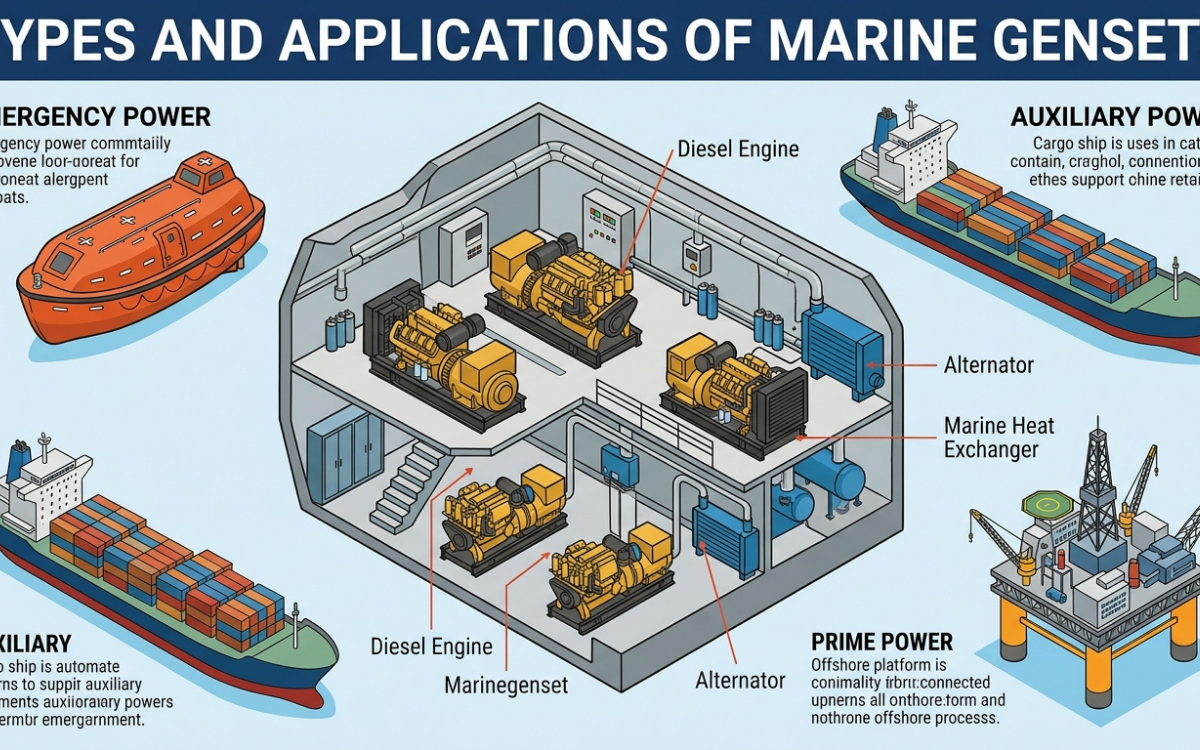
Marinegensets.com sits at the intersection of a deceptively simple need and a complicated engineering decision: producing dependable electrical power at sea. A marine generator is not just a smaller land-based genset placed inside a boat. It has to operate in a hot, vibrating, corrosive environment while supporting loads that may include air-conditioning compressors, refrigeration, pumps, navigation electronics, galley equipment, battery chargers, communications systems, and safety-critical auxiliaries.
That is why the useful way to approach Marinegensets.com is not to ask, “Which generator has the biggest kW number?” The better questions are: What loads must run together? What happens when the largest motor starts? Which voltage and frequency does the vessel require? How will the unit be cooled and exhausted? Can it be serviced in place? And does the engine meet the emissions rules that apply to the vessel and its trading area?
This guide answers those questions in a buyer-first way.
What Marinegensets.com Readers Should Understand Before Comparing Gensets
A marine generator set combines a prime mover—usually a diesel engine—with an alternator, controls, cooling equipment, starting equipment, protection systems, and an electrical output section. Its job is to convert fuel energy into stable onboard AC power.
The key word is stable. A generator that technically produces enough peak power can still be a poor fit if voltage dips badly when a compressor starts, if it spends most of its life lightly loaded, if cooling-water routing is wrong, or if routine service points become inaccessible after installation.
ISO 8528-1 defines classifications for application, rating, and performance of reciprocating-engine-driven AC generating sets and explicitly covers land and marine use. That matters because “kW” alone does not describe duty, transient performance, or the conditions under which a rating is valid.
For anyone researching through Marinegensets.com, the first rule is therefore simple: compare complete operating requirements, not brochure headline numbers.
Marinegensets.com Guide to Correct Generator Sizing
Sizing is where many purchasing mistakes begin. Boat length can provide a rough reference, but it cannot determine generator capacity because two vessels of the same length may have radically different electrical systems.
Fischer Panda’s current guidance makes the same point: generator sizing should be evaluated as part of the vessel’s overall electrical design, based on the actual equipment and comfort systems installed.
Start With a Real Load Schedule
Create a list of every AC load the genset may be expected to carry. Record its running wattage, starting requirement, and whether it is likely to operate at the same time as other major loads.
Typical loads include:
- Air-conditioning and chilled-water compressors
- Watermakers and pressure pumps
- Refrigeration and freezers
- Battery chargers and inverter-chargers
- Electric galley appliances
- Lighting and hotel loads
- Navigation, radar, and communication equipment
- Hydraulic power packs, pumps, or winches on commercial vessels
- Workshop or deck machinery
Do not simply add every nameplate rating and buy the next size up. That can lead to chronic oversizing. Instead, build realistic operating scenarios: overnight hotel load, cooking period, marina departure, full HVAC demand, cargo operation, or emergency-support mode.
Marinegensets.com research should focus on the highest credible simultaneous load, then test whether the generator can absorb the starting surge of the largest motor without unacceptable voltage or frequency deviation.
Understand kW, kVA, and Power Factor
Real power is measured in kilowatts (kW). Apparent power is measured in kilovolt-amperes (kVA). The relationship is:
kW = kVA × power factor
If a generator is rated at 10 kVA at a 0.8 power factor, that corresponds to 8 kW of real power under that rating basis. Never assume every manufacturer uses the same power factor or rating convention; verify the data sheet.
This distinction becomes important when comparing alternators, motor-heavy loads, and commercial installations. Marinegensets.com users should treat kW and kVA as related but not interchangeable values.
Account for Motor Starting Surge
Compressors, pumps, and other motors may draw substantially more current during startup than during steady operation. A genset that handles the running load can still stumble when a large compressor engages.
That is why experienced sizing looks at transient response, not only steady-state capacity. Sequence-starting major loads, using soft starters or variable-frequency drives where appropriate, and designing load-shedding logic can sometimes produce a better system than simply buying a much larger generator.
Why Oversizing Can Be as Costly as Undersizing: A Marinegensets.com Priority
Undersizing is obvious: breakers trip, voltage sags, appliances misbehave, and the generator remains overloaded. Oversizing is quieter—and often more expensive over the life of the vessel.
A lightly loaded diesel can spend long periods away from its intended operating window. Depending on engine design and duty cycle, that can contribute to inefficient combustion, deposits, poor fuel economy per useful kWh, and maintenance problems.
The better Marinegensets.com buying principle is right-size for the real duty cycle, then preserve sensible reserve capacity. On larger vessels, two smaller machines with intelligent load sharing may sometimes offer better redundancy and load matching than one oversized unit, although the economics and complexity must be evaluated vessel by vessel.
A useful comparison should therefore include:
- Typical daytime load
- Typical overnight load
- Maximum simultaneous load
- Largest single starting load
- Minimum expected sustained load
- Required redundancy
- Hours per year
- Harbor versus offshore operating profile
That load profile is more valuable than a boat-length chart.
Marinegensets.com on 50 Hz vs 60 Hz: A Small Specification With Big Consequences
One of the easiest mistakes is ordering the correct power rating with the wrong electrical frequency. Many marine generators are offered in both 50 Hz and 60 Hz configurations.
For a typical four-pole synchronous generator, 50 Hz operation corresponds to 1,500 rpm and 60 Hz to 1,800 rpm. Caterpillar, for example, lists 50/60 Hz configurations and those respective engine speeds for its C7.1 marine generator set.
Marinegensets.com buyers should match the genset to the vessel’s distribution system and connected equipment. Confirm voltage, phase, frequency, grounding arrangement, shore-power interface, and switchboard compatibility before purchase—not after the unit is onboard.
Marinegensets.com Installation Checklist: What the Spec Sheet Does Not Tell You
A generator can be electrically perfect and mechanically wrong for the engine room. Installation constraints frequently decide whether a project becomes clean and reliable or turns into a costly refit.
Measure Service Clearance, Not Just Generator Dimensions
Length, width, and height are only the starting point. The installer needs room to remove filters, service the seawater pump, change belts, access the heat exchanger, inspect electrical connections, service the exhaust elbow, and lift major components if a future overhaul is required.
Ask a more practical question: Can a technician perform the 500-hour service without dismantling half the engine room?
Caterpillar’s current marine generator specifications illustrate how much installation detail can matter: cooling configuration, starting voltage, exhaust arrangements, service intervals, and physical dimensions all vary by model and configuration.
Treat Cooling as a System
Marine diesel gensets commonly use heat-exchanger or keel-cooling arrangements. Raw-water systems introduce strainers, pumps, hoses, anti-siphon considerations, seacocks, heat exchangers, and discharge routing into the reliability equation.
Saltwater is unforgiving. Corrosion control, hose quality, accessible strainers, proper winterization where relevant, and inspection of sacrificial components can matter as much as the engine itself.
Marinegensets.com comparisons should therefore identify the cooling architecture, not just say “water cooled.”
Exhaust and Carbon Monoxide Safety Are Non-Negotiable
Generator exhaust design is a life-safety issue on recreational vessels. The U.S. Coast Guard advises operators to maintain fresh-air circulation, run exhaust blowers whenever the generator is operating, know where generator exhaust outlets are located, and install and maintain carbon-monoxide alarms inside the boat.
That makes exhaust routing, wet-exhaust components, back-pressure limits, ventilation, and outlet location engineering issues—not accessories. Installation should follow the genset manufacturer’s manual, applicable vessel standards, and qualified marine electrical/mechanical practice.
Marinegensets.com Fuel-Efficiency Rule: Compare kWh Produced, Not Liters Per Hour Alone
A generator consuming fewer liters per hour is not necessarily more efficient if it is also producing much less useful electrical output. A better metric is fuel consumed per useful kWh at realistic load points.
When using Marinegensets.com to compare options, request fuel-consumption data across several load levels rather than a single best-case number. Then map those points against the vessel’s expected duty cycle.
This is where “cheap to buy” and “cheap to own” separate. Lifecycle cost can include:
- Initial genset price
- Installation labor and vessel modifications
- Fuel consumption over expected annual hours
- Oil, filters, impellers, belts, coolant, and anodes
- Planned service labor
- Major-overhaul cost
- Spare-parts availability
- Downtime and logistics
- Resale implications
On a working vessel, one day of lost operation may cost more than the price difference between two generator brands.
Marinegensets.com and Emissions Compliance: A Procurement Variable
Marine generator selection increasingly intersects with environmental regulation. In the United States, EPA regulations apply to compression-ignition marine engines under 40 CFR Part 1042, with standards covering marine diesel engines installed across a wide range of vessel types.
Internationally, MARPOL Annex VI governs air pollution from ships. The Mediterranean Sea became a sulphur Emission Control Area on May 1, 2025, with a 0.10% fuel-sulphur limit in the ECA compared with the 0.50% global limit outside SOx ECAs.
Modern commercial gensets may therefore be offered with different certification packages. Caterpillar, for example, lists configurations meeting IMO II, IMO III, U.S. EPA Tier 3, EU Stage V, and other requirements, depending on model and aftertreatment configuration.
For Marinegensets.com users, the buying question is not “Is this engine low-emission?” It is “Which exact certificate applies to this engine rating, vessel category, build date, flag, and operating area?”
The 2026 Regulatory Picture: What Buyers Should Watch
The IMO’s 2023 greenhouse-gas strategy aims for international shipping to reach net-zero GHG emissions by or around 2050, with indicative checkpoints of at least 20% reduction by 2030 and at least 70% by 2040, both relative to 2008.
The proposed IMO Net-Zero Framework was approved in April 2025 but had not yet become legally binding as of August 2026. At MEPC 84, the IMO established further working sessions ahead of MEPC 85, scheduled for November 30 to December 3, 2026, with the extraordinary session potentially resuming on December 4.
Why does that matter to Marinegensets.com readers? Because a generator purchased today may remain in service for years. Fuel compatibility, emissions architecture, hybrid integration, monitoring capability, and upgrade pathways may influence lifecycle value even when the current rule does not directly apply to a particular vessel.
Diesel, Hybrid, or Battery-Assisted? Avoid False Either-Or Thinking
Battery systems are changing onboard energy architecture, but they do not make generator sizing irrelevant. In many hybrid arrangements, the battery bank handles short peaks or silent low-load periods while the genset operates in a more favorable load band.
That can be powerful when the vessel has highly variable demand. It can also add weight, capital cost, thermal-management requirements, battery-management complexity, and integration work.
Marinegensets.com comparisons should evaluate the whole power ecosystem: genset + inverter/charger + battery bank + shore power + renewable inputs + energy-management logic. The best architecture is the one that fits the vessel’s actual duty cycle, not the one with the most fashionable component list.
Maintenance Strategy: Reliability Is Designed Before the First Oil Change
Preventive maintenance starts with installation. If filters are inaccessible, the seawater strainer is buried, or the sound enclosure cannot be opened properly, maintenance gets deferred.
A strong Marinegensets.com evaluation should look beyond nominal service intervals and ask whether parts, diagnostic support, documentation, and trained technicians are available where the vessel operates.
Build a maintenance plan around:
- Engine oil and filter intervals
- Fuel-filter inspection and replacement
- Cooling-system service
- Raw-water pump and impeller inspection
- Heat-exchanger cleaning
- Belt and hose condition
- Battery and starting-system health
- Exhaust-system inspection
- Alternator cleanliness and electrical connections
- Alarm, shutdown, and sensor testing
- Load-bank or operational load verification where appropriate
Hour-based maintenance is only part of the picture. Calendar age, salt exposure, long layups, fuel quality, and operating temperature can be equally important.
A Better Marinegensets.com Buyer Scorecard
Instead of ranking generators by brand recognition alone, score every candidate against the same engineering and ownership criteria. This creates an apples-to-apples comparison and exposes hidden trade-offs.
| Decision Factor | What to Verify |
|---|---|
| Electrical output | kW, kVA, voltage, phase, 50/60 Hz |
| Load acceptance | Starting surge and transient response |
| Duty rating | Prime, continuous, standby, or manufacturer-specific rating |
| Physical fit | Dimensions, weight, service clearance, removal path |
| Cooling | Heat exchanger, keel cooling, raw-water requirements |
| Exhaust | Wet/dry layout, back pressure, outlet routing |
| Noise/vibration | Enclosure, mounts, measured sound data where available |
| Compliance | EPA, IMO, class, flag-state, regional requirements |
| Serviceability | Filter, impeller, belt, heat-exchanger access |
| Ownership cost | Fuel, service parts, labor, overhaul, downtime |
| Support | Dealer network, parts lead time, diagnostic capability |
| Integration | Controls, remote monitoring, parallel operation, hybrid readiness |
This is the kind of framework that turns Marinegensets.com research into a defensible purchasing decision.
Red Flags When Buying a Marine Generator
A credible supplier or installer should be able to answer detailed technical questions. Be cautious when the recommendation is based only on boat length, when the quotation omits configuration details, or when certification is described vaguely.
Watch for these red flags:
- No written load calculation
- No confirmation of voltage, frequency, or phase
- “Marine” labeling without clear cooling and corrosion-protection details
- No engine or alternator model numbers
- No emissions certificate information where required
- No dimensional drawing
- No sound-shield or ventilation data
- No installation-manual review
- No stated warranty terms
- Unclear parts origin or long-term availability
- No plan for commissioning and load testing
Marinegensets.com users should regard documentation quality as a proxy for supplier quality. If basic technical data is difficult to obtain before the sale, support rarely becomes easier after commissioning.
Frequently Asked Questions About Marinegensets.com and Marine Gensets
1. What size marine generator do I need?
Start with a load schedule, not vessel length. Add the equipment that will realistically run at the same time, identify the largest motor-starting requirement, confirm voltage/frequency/phase, then select a generator with adequate transient capability and sensible reserve.
Oversizing should be avoided just as deliberately as undersizing. The goal is a generator that operates efficiently across normal loads while retaining enough capacity to handle realistic peaks.
2. Is a marine generator different from a standard portable or land generator?
Yes. A proper marine installation must account for corrosion, vibration, cooling-water systems, exhaust routing, ventilation, electrical protection, confined-space serviceability, and vessel-specific safety requirements.
The engine, alternator, enclosure, mounts, cooling system, and controls need to work as an integrated marine package. Simply installing a conventional portable generator aboard a vessel does not turn it into a properly engineered marine genset.
3. Should I choose a 50 Hz or 60 Hz marine genset?
Match the generator to the vessel’s electrical distribution system and connected equipment. Many regions and vessels use 50 Hz, while others use 60 Hz; some yachts are designed around specific shore-power and onboard standards.
Do not change frequency assumptions casually because motors, transformers, chargers, HVAC equipment, and other loads may be frequency-sensitive. Voltage and phase must also be checked at the same time.
4. How often should a marine diesel generator be serviced?
Follow the exact manufacturer schedule for the model and operating conditions. Service intervals vary, and some components are time-sensitive even when operating hours are low.
A reliable plan also includes routine pre-start checks, cooling-system inspection, raw-water components, fuel quality, battery health, exhaust condition, alarms, and periodic verification under meaningful load.
5. What should I verify before buying through Marinegensets.com or any marine generator supplier?
Ask for the complete model and rating, kW/kVA output, voltage, phase, frequency, duty classification, dimensional drawing, wet/dry weight, cooling configuration, exhaust requirements, fuel-consumption curve, emissions certification, warranty, included accessories, lead time, shipping terms, service-parts availability, and commissioning responsibility.
Then have the proposed installation checked against your vessel’s actual electrical and mechanical layout. That final verification can prevent expensive compatibility, installation, and performance problems later.
Conclusion: Use Marinegensets.com as the Start of an Engineering Decision
The smartest generator purchase is rarely the largest unit, the cheapest quote, or the most familiar badge. It is the system that can carry the vessel’s real loads, start the hardest equipment cleanly, fit the machinery space, run efficiently across the duty cycle, meet applicable emissions requirements, and remain serviceable years after installation.
Use Marinegensets.com as a research starting point, but do not stop at headline ratings or surface-level specifications. Create a load schedule, verify 50/60 Hz and voltage, model motor-starting demand, audit the installation space, compare lifecycle fuel and service costs, confirm emissions certificates, and get the final configuration reviewed by a qualified marine electrician or engineer before ordering.
That process takes more work up front. It also sharply reduces the risk of buying the wrong generator for a vessel that has to depend on it offshore.














Leave a Reply