
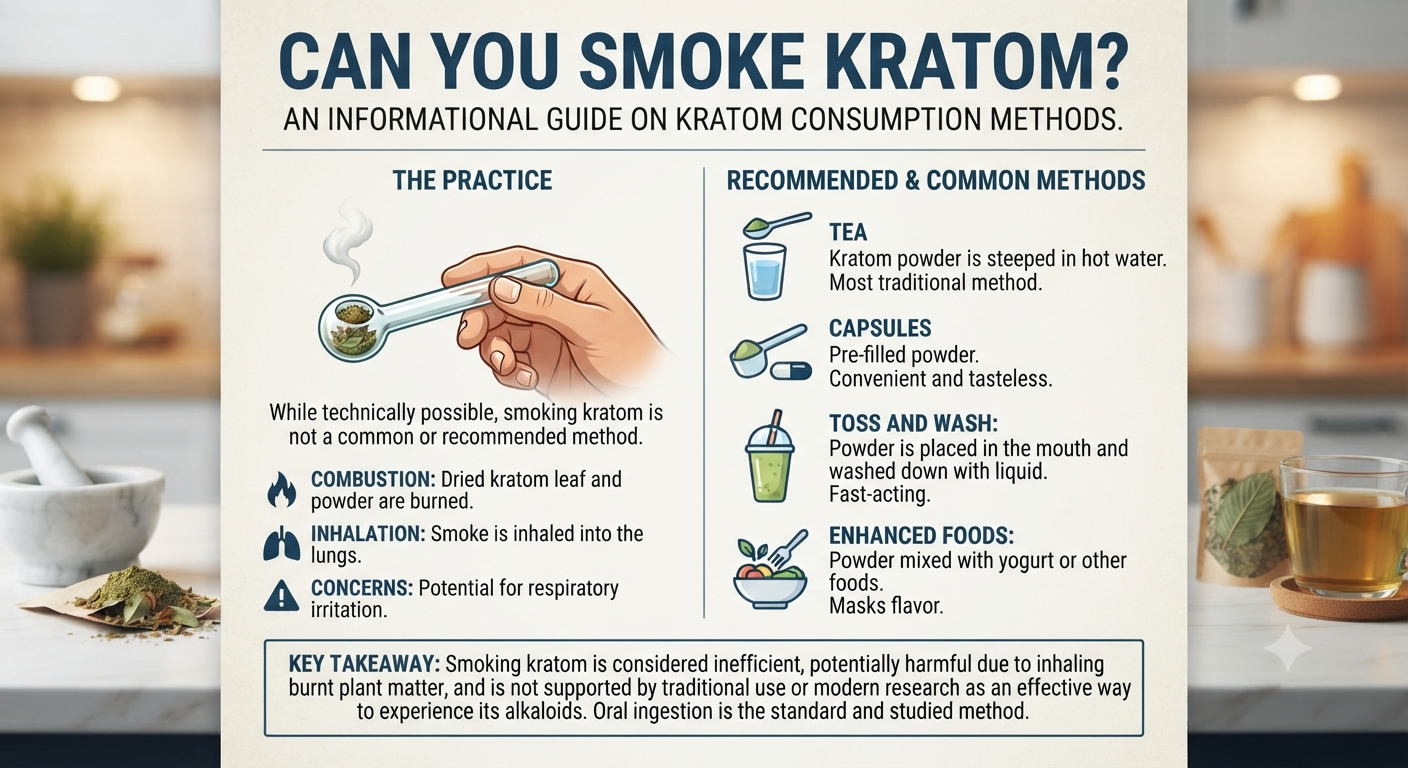
Can you smoke kratom? Technically, dried kratom leaf or powder can be burned, but that does not make inhaling the smoke safe, effective, or medically supported. Research on kratom has focused overwhelmingly on oral use, and a 2025 review of acute adverse events concluded that the effects of inhaling kratom products remain unknown and are not recommended.
The practical answer is therefore no—you should not smoke kratom. Searches for can you smoke kratom often overlook the difference between something being physically combustible and being safe to inhale.
There is no established inhaled dose, no reliable evidence that combustion delivers kratom’s active alkaloids predictably, and no clinical evidence showing that smoking offers benefits over researched routes of exposure. Burning plant material also produces smoke and fine particles that can irritate the airways and reach deep into the lungs.
Medical note: This article provides general health information, not personal medical advice. Anyone experiencing trouble breathing, collapse, seizures, severe confusion, chest pain, or inability to wake after kratom exposure should seek emergency help immediately.
Quick Answer: Can You Smoke Kratom Safely?
Can you smoke kratom safely? Current evidence does not support that claim. Inhalation has not been adequately studied, kratom products vary widely in composition, and smoke exposure creates risks that are separate from kratom’s pharmacological effects.
The main reasons to avoid smoking it are straightforward:
- No validated inhaled dosage: Product labels do not provide a medically established smoking dose.
- Unpredictable alkaloid delivery: Heat may alter or destroy plant alkaloids, making exposure difficult to estimate.
- Lung irritation: Smoke from burning plant material contains gases and fine particles that can trigger coughing, wheezing, and breathing problems.
- Systemic effects may still occur: If active compounds are absorbed, they may cause nausea, dizziness, sedation, rapid heart rate, confusion, dependence, or more serious effects.
- Contaminants may also be inhaled: Commercial kratom products have faced concerns involving microorganisms, heavy metals, and inconsistent composition.
What Is Kratom and How Does It Affect the Body?
“Kratom comes from the leaves of a tropical tree, Mitragyna speciosa, native to Southeast Asia. Alkaloids in the leaves, including mitragynine and 7-hydroxymitragynine (7-OH), bind to opioid receptors and other sites in the brain. The complex pharmacology of kratom may account for its multiple effects–stimulant-like effects at lower doses and opioid- or sedative-like effects at higher doses.
It is most often used as an herbal tea, but can be found in leaf form, capsules, powder, and extract. NIDA notes that administration of whole-plant products is almost always oral. This is significant because most of the preceding information comes from either pharmacology, surveys, or case reports of adverse events related to oral administration. Less is known about the effects of inhaling kratom.
The specific effects of kratom depend on the product and the dosage, as well as individual factors such as physiology and tolerance, and the presence of other drugs. Users report feeling alert or energetic, or sleepy or even dissociated. However, these results do not mean that kratom is safe or effective for the treatment of pain, anxiety, depression, or opioid addiction. The FDA confirms that there are no approved prescription or over-the-counter drugs containing kratom in the United States.”
Can You Smoke Kratom Powder?
Can you smoke kratom powder? A person may be able to ignite it, but powder is especially poorly suited to inhalation. Fine particles can become airborne before combustion, irritate the throat and lungs, and create an uneven burn that makes the amount inhaled impossible to judge.
This is not simply a question of whether the material catches fire. The important question is whether smoking produces a predictable concentration of active compounds without creating harmful combustion products.
No clinical evidence currently answers that question in a reassuring way.
A laboratory study found that the stability of mitragynine and several related alkaloids changes with temperature and pH, even within a tested range of 4°C to 80°C. That study did not examine smoking or combustion, so it cannot tell us exactly what happens when kratom burns.
It does, however, show why assumptions about heat preserving the plant’s original chemical profile are unreliable. Combustion temperatures are substantially higher than those examined in that study, and no validated research has established which alkaloids survive or reach the bloodstream through smoke.
Does Smoking Kratom Make It Work Faster?
People asking can you smoke kratom often assume inhalation will create a faster onset. That assumption comes from experiences with other inhaled substances, but it has not been established for kratom leaf or powder.
There are no accepted human studies defining the:
- Inhaled bioavailability of kratom alkaloids
- Time required for effects to begin
- Peak blood concentration after smoking
- Duration of smoked kratom’s effects
- Relationship between inhaled quantity and toxicity
Without those data, claims that kratom “hits faster” when smoked remain anecdotal. A perceived reaction could reflect expectations, smoke irritation, reduced oxygen intake, contaminants, another substance, or an unknown product composition rather than a predictable kratom effect.
A 2025 review identified a surviving case in which a person reported smoking an unspecified kratom product. However, the product, dose, and co-exposures were unclear.
The researchers explicitly stated that the effects of inhaled kratom are unknown and that inhalation is not recommended.
Why Smoking Kratom May Be More Harmful Than It Seems
1. Combustion creates a separate respiratory hazard
When plant material burns, it produces a mixture of gases and particles. The CDC describes smoke from burning trees and plants as containing fine particles that can cause coughing, wheezing, chest discomfort, and difficulty breathing.
The EPA notes that some microscopic particles can penetrate deep into the lungs and may even enter the bloodstream. Exposure to fine-particle pollution has been associated with irritated airways, aggravated asthma, reduced lung function, abnormal heart rhythms, and other respiratory or cardiovascular effects.
That does not mean kratom smoke is chemically identical to wildfire, cigarette, or wood smoke. It means that inhaling combusted botanical material introduces a recognized category of respiratory exposure before kratom-specific toxicity is even considered.
People who may be particularly vulnerable include those with:
- Asthma
- Chronic obstructive pulmonary disease
- Heart disease
- Existing respiratory infections
- Pregnancy
- A history of severe smoke sensitivity
Fine-particle exposure can produce airway inflammation, bronchial hyperreactivity, coughing, wheezing, reduced pulmonary function, and emergency-department visits among susceptible individuals.
2. The absorbed dose is impossible to estimate reliably
When someone asks can you smoke kratom for a stronger effect, the biggest overlooked problem is dose uncertainty. Kratom products can differ in alkaloid concentration, extract strength, contamination, age, storage conditions, and labeling accuracy.
Combustion adds another layer of variability.
Some compounds may be degraded by heat. Some may transfer into smoke, while others may remain in the burned residue. Without controlled inhalation studies, users cannot know how much reached the lungs, how much entered the bloodstream, or how rapidly the blood concentration changed.
This uncertainty can encourage repeated use when the expected effect does not appear immediately. Repeated exposure may increase the risk of:
- Nausea and vomiting
- Dizziness or impaired coordination
- Agitation or anxiety
- Excessive drowsiness
- Confusion
- Rapid heart rate
- Seizures
- More serious toxicity
A dose that appears weak because combustion destroyed part of the plant material may still produce an unpredictable systemic exposure. Trying to compensate by repeatedly inhaling more smoke can substantially increase respiratory irritation.
3. Kratom can interact with other substances
CDC poison-center data published in 2026 found that severe outcomes were more common in cases involving kratom and other substances. Alcohol, opioids, benzodiazepines, stimulants, and antidepressants may increase risk through combined effects on the central nervous system or through metabolic interactions that change drug exposure.
Combining kratom with substances that cause sedation is particularly concerning because extreme drowsiness can make it harder to recognize a medical emergency. Potentially dangerous combinations include kratom with:
- Alcohol
- Prescription opioids
- Heroin or fentanyl
- Benzodiazepines
- Sleep medications
- Sedating antihistamines
- Gabapentinoids
- Other central nervous system depressants
Combining kratom with stimulants may add cardiovascular stress, agitation, or rapid heart rate. Certain antidepressants and other psychiatric medications may create unpredictable neurologic or metabolic interactions.
The safest approach is not to combine kratom with prescription drugs, alcohol, illicit drugs, or other psychoactive supplements without discussing the risks with a qualified clinician or pharmacist.
4. Dependence and withdrawal can develop
The answer to can you smoke kratom without getting addicted is uncertain, but changing the route does not remove dependence risk. NIDA and the FDA recognize reports of tolerance, physical dependence, withdrawal, and kratom-related substance use disorder.
A person may be developing problematic use when they:
- Need increasingly larger amounts
- Use kratom more frequently than planned
- Feel unable to reduce or stop
- Continue despite physical or emotional problems
- Spend significant time obtaining or using it
- Experience symptoms after missing a dose
- Begin changing products or routes to intensify the effects
A faster or more ritualized delivery method can reinforce repeated behavior with some substances, although this has not been specifically quantified for smoked kratom.
Anyone using kratom daily, feeling unable to cut down, or experiencing withdrawal symptoms should seek medical support rather than experimenting with smoking, vaping, extracts, or concentrated 7-OH products.
5. Product contamination does not disappear when burned
Kratom products are not FDA-approved medications with standardized manufacturing, dosing, and quality-control requirements. FDA actions have identified microbial contamination in certain commercial products, including potentially harmful bacteria.
FDA researchers have also investigated elemental contaminants in commercial kratom products, including substances such as lead and nickel.
Burning a contaminated product is not a reliable purification method. Depending on the contaminant and temperature, heating could:
- Destroy part of the contaminant
- Leave it concentrated in residue
- Release it into inhaled particles
- Produce different breakdown products
- Fail to eliminate it at all
Because this has not been tested across commercial products, there is no credible basis for treating combustion as a safety step.
Can You Smoke Kratom Extract or 7-OH Products?
Can you smoke kratom extract? This is even more unpredictable than smoking plain leaf because extracts may contain higher alkaloid concentrations, added ingredients, residual solvents, flavorings, or undisclosed components.
A product marketed as “kratom extract” may not resemble traditional leaf in either potency or risk. Extract labels may use ratios, proprietary blends, or total-alkaloid claims that do not clearly communicate how much mitragynine or 7-OH the user will receive.
Concentrated 7-OH products deserve separate attention. The FDA has warned that products containing added or enhanced levels of 7-hydroxymitragynine can cause serious harm and have not been approved for any medical use.
Naturally occurring kratom leaf contains only trace amounts of 7-OH. Commercial tablets, gummies, shots, or extracts with enhanced 7-OH levels may have a substantially different risk profile.
On July 1, 2026, the DEA announced its intent to temporarily schedule certain 7-OH substances above a specified threshold. The agency’s announcement highlights the distinction between concentrated 7-OH products and ordinary natural kratom leaf.
Do not assume that a product bought from a vape shop, smoke shop, gas station, or website is formulated for inhalation simply because of where it is sold. Packaging, flavoring, or marketing language cannot substitute for toxicology testing and regulatory approval.
Can You Vape Kratom Instead of Smoking It?
Can you smoke kratom by vaping it? Vaping avoids an open flame, but it does not solve the central problems. There is still no established safe inhaled dose, standardized formulation, or reliable evidence that heating kratom liquid or extract produces a predictable aerosol.
Vape devices expose ingredients to heat, potentially altering the original chemical mixture. Oils, solvents, flavorings, contaminants, and concentrated alkaloids may behave differently when aerosolized.
A product intended for oral use should never be assumed safe for the lungs.
For readers comparing vaping with the question can you smoke kratom, the absence of visible smoke does not equal the absence of risk. The CDC emphasizes that vaping aerosol is not harmless water vapor and can contain potentially harmful substances.
That CDC guidance concerns e-cigarettes rather than kratom-specific devices, but the broader lesson remains relevant: an inhaled aerosol requires its own toxicological evaluation. Oral safety data cannot establish inhalation safety.
Until inhaled kratom formulations undergo appropriate pharmaceutical and respiratory testing, vaping should not be presented as a safe alternative.
What Are the Signs of a Bad Reaction?
Someone wondering can you smoke kratom should know the warning signs before experimenting. Kratom-related poison-center reports include gastrointestinal, neurologic, and cardiovascular effects.
Frequently reported symptoms include:
- Nausea
- Vomiting
- Drowsiness or lethargy
- Dizziness
- Agitation
- Rapid heart rate
Seizures, tremors, high blood pressure, severe sedation, liver injury, and breathing problems have also been reported.
Seek urgent medical help for:
- Trouble breathing or severe wheezing
- Blue, gray, or unusually pale lips
- Collapse or fainting
- Inability to wake the person
- A seizure
- Extreme agitation or severe confusion
- Chest pain
- A very fast or irregular heartbeat
- Repeated vomiting combined with marked drowsiness
- Suspected exposure to an unknown extract or 7-OH product
- Any serious reaction after combining kratom with another substance
Possible signs of liver injury can include yellow skin or eyes, dark urine, unusually pale stool, intense itching, severe fatigue, or upper-abdominal pain. These symptoms warrant prompt medical assessment.
In the United States, Poison Control is available at 1-800-222-1222. If the person collapses, experiences a seizure, cannot breathe normally, or cannot be awakened, call 911 immediately.
People outside the United States should contact their local poison-information service or emergency number.
What Should You Do Instead of Smoking Kratom?
The safest answer to can you smoke kratom is to avoid inhaling it and speak with a healthcare professional about the reason you were considering it. In practice, can you smoke kratom is the wrong safety question; the better question is what evidence-based option addresses the underlying need.
When the goal is pain relief
Ask a medical professional about evidence-based pain treatments and whether evaluation by a pain specialist, physiotherapist, or another relevant clinician is appropriate.
Persistent pain may involve nerve injury, inflammation, joint damage, migraine, muscle dysfunction, or another condition requiring specific treatment. Masking symptoms with an unpredictable inhaled product can delay diagnosis.
When the goal is opioid withdrawal
Smoked kratom is not an established treatment for opioid withdrawal or opioid use disorder. FDA-approved medications such as buprenorphine, methadone, and naltrexone have evidence-based clinical protocols for treating opioid use disorder.
Medical treatment can help reduce withdrawal symptoms, cravings, relapse risk, and overdose danger. Anyone experiencing opioid withdrawal should contact an addiction-medicine provider, emergency department, primary-care professional, or licensed treatment service.
When the goal is more energy
Persistent fatigue may be associated with sleep deprivation, anemia, thyroid disorders, nutritional deficiencies, medication effects, depression, infection, or other medical conditions.
Using smoked kratom may temporarily mask fatigue while introducing additional cardiovascular, respiratory, and dependence risks.
When the goal is anxiety, mood, or sleep
A healthcare professional can assess whether anxiety, insomnia, depression, medication side effects, substance use, or an underlying health condition is contributing to the symptoms.
Replacing an uncertain oral product with an even less studied inhaled route is not a meaningful harm-reduction strategy.
When someone already uses kratom regularly
Be honest with a clinician about:
- The exact product or brand
- Whether it is leaf, powder, extract, or 7-OH
- Frequency of use
- Approximate amount used
- Duration of use
- Other medications or substances
- Previous attempts to stop
- Withdrawal symptoms
Individualized medical guidance is preferable to improvising a taper, switching routes, or replacing leaf with increasingly concentrated products.
Is Kratom Legal?
The legal answer is separate from the health answer. As of July 13, 2026, natural kratom leaf itself is not federally controlled under the U.S. Controlled Substances Act, but state and local restrictions may apply.
The FDA has not approved kratom for any medical use and continues to warn consumers about serious adverse events, including seizures, liver toxicity, and substance use disorder.
Concentrated 7-OH products face a rapidly changing regulatory environment. Because laws differ by location and can change, consumers should verify current state and local rules rather than relying on a retailer’s claim that a product is legal.
Legal availability does not prove safety, purity, effectiveness, or suitability for inhalation.
Frequently Asked Questions
1. Can you smoke kratom leaves?
Can you smoke kratom leaves? They can physically burn, but inhaling the resulting smoke is not supported by clinical evidence and is not recommended.
Burning leaves produces respiratory irritants, while the amount of mitragynine or other alkaloids delivered to the bloodstream remains unknown. The inability to estimate the absorbed dose also increases the risk of repeated exposure.
2. Can you smoke kratom and feel its effects?
There is no reliable scientific evidence defining the effects, onset, or potency of smoked kratom. Anecdotal accounts cannot establish whether a perceived reaction comes from kratom alkaloids, smoke inhalation, contaminants, expectations, or another substance used at the same time.
Even when an effect is felt, that does not demonstrate safety. Adverse reactions can occur alongside or shortly after the desired effects.
3. Can you smoke kratom with cannabis or tobacco?
Combining substances increases uncertainty and may compound sedation, dizziness, anxiety, impaired judgment, rapid heart rate, or respiratory irritation.
Tobacco and cannabis smoke also expose the lungs to combustion products. Combining either substance with kratom does not make kratom safer, more effective, or easier to dose.
4. Can you smoke kratom if oral kratom causes nausea?
Changing to inhalation is not a safe workaround for nausea. Nausea may indicate a dose-related adverse effect, sensitivity, contamination, or interaction with another substance.
Smoking adds lung exposure without providing a medically established dose. Stop experimenting and seek advice from a clinician or poison-information service if nausea is severe, persistent, or accompanied by marked drowsiness, confusion, chest symptoms, or repeated vomiting.
5. Can you smoke kratom during opioid withdrawal?
Smoked kratom is not an evidence-based treatment for opioid withdrawal. It has no validated inhaled dose, no established withdrawal protocol, and no clinical evidence showing that smoking it safely controls symptoms.
Anyone at risk of opioid withdrawal should seek medical care. Approved medications and supervised treatment can reduce symptoms, support recovery, and lower overdose risk.
Conclusion: Should You Smoke Kratom?
So, can you smoke kratom? Although kratom leaf or powder can be burned, there is no established safe method, reliable dose, proven benefit, or reassuring body of inhalation research.
The route adds smoke exposure to an already unpredictable product. It may also increase the danger of contamination, interactions, repeated dosing, dependence, and delayed treatment.
The most responsible next step is simple: do not smoke or vape kratom.
If you are considering it for pain, withdrawal, mood, energy, anxiety, or sleep, tell a qualified healthcare professional what you are trying to achieve and ask for an evidence-based option. If exposure has already occurred and symptoms are developing, contact Poison Control or emergency services rather than waiting for the reaction to pass.













Leave a Reply