
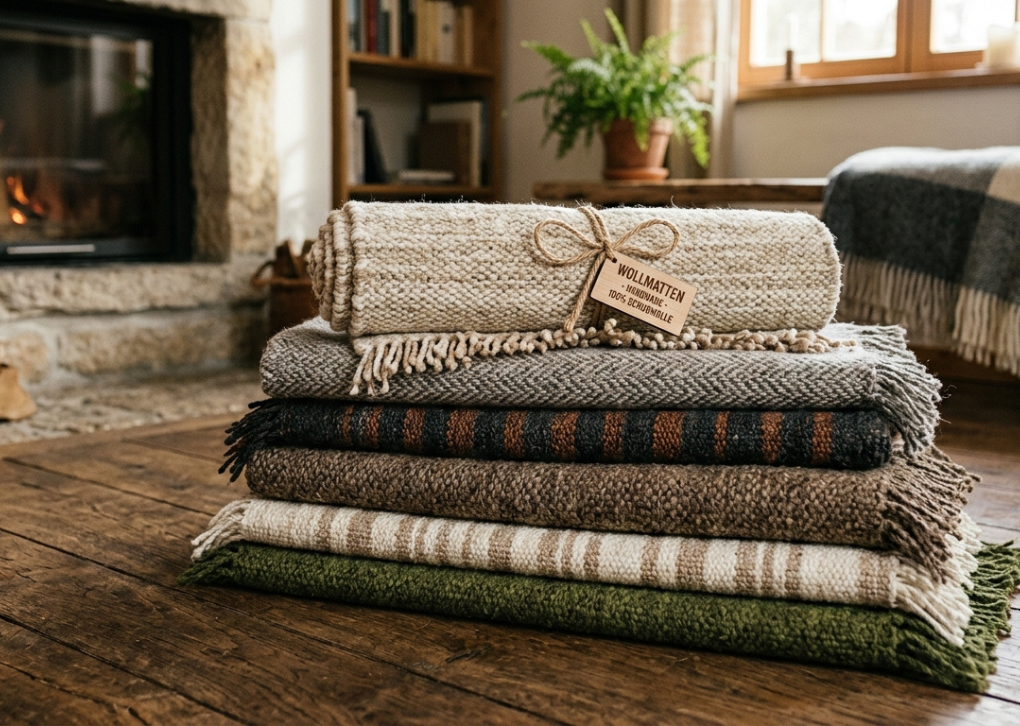
Wollmatten bring something difficult for synthetic floor coverings to imitate: natural texture, springy comfort, visual warmth and a material story you can actually understand. But buying well takes more than choosing a color you like. The best wool mat for a quiet bedroom is not necessarily the right one for a busy entryway, a home with pets, or a floor with underfloor heating.
The useful question is not simply, “Is wool good?” It is which wool, built in which way, for which room, with which backing and care routine. Once you evaluate those variables, Wollmatten become much easier to compare—and you are less likely to pay premium prices for a product that does not suit your home.
What Are Wollmatten?
The German word Wollmatten literally refers to wool mats. In home-interior shopping, the term can cover compact wool rugs, felted floor mats, woven runners and other small-to-medium floor coverings made wholly or partly from wool.
That broad definition matters. A dense felt mat behaves differently from a hand-knotted rug; a flatweave handles doors and dining chairs differently from a plush tufted pile. Even two products labeled “100% wool” can vary dramatically in weight, softness, resilience, shedding and cleanability.
For buyers, the material label is therefore only the starting point. Construction is just as important as fiber content.
Why Wool Works So Well Underfoot
Wool fibers have a naturally crimped, spring-like structure. That helps them recover after compression, which is one reason quality Wollmatten can stay visually full even when walked on regularly. Woolmark describes this recovery behavior as a result of wool’s complex spiral-like molecular and fiber structure.
Wool is also hygroscopic: its internal structure can absorb moisture vapor while the fiber surface remains comparatively water-repellent. The International Wool Textile Organisation reports that wool can absorb substantial moisture relative to its own weight, which helps explain why it feels comfortable across changing indoor conditions.
Warmth without the “plastic” feel
The air trapped within and between wool fibers contributes to thermal insulation. That makes a wool mat pleasant on tile, stone, concrete or timber floors, especially in cooler seasons.
The same insulation can be a disadvantage when Wollmatten sit over radiant floor heating. A thick pile plus dense underlay may slow heat transfer, so buyers should check the product’s thermal-resistance or TOG information rather than assuming every wool rug is suitable.
Natural resilience and soil resistance
Wool has an outer protective structure that helps dry soil remain near the surface long enough to be removed through normal maintenance. That does not make a wool mat stain-proof, but it gives properly maintained wool useful everyday performance.
Woolmark also highlights wool’s resilience, stain resistance and comparatively low static generation in interior applications. The practical takeaway is simple: maintenance still matters, but Wollmatten made from appropriate carpet-grade wool are well suited to repeated domestic use.
Fire behavior is another genuine strength
Wool is naturally difficult to ignite and, unlike many thermoplastic synthetic fibers, it does not melt or drip when exposed to heat. IWTO attributes that behavior partly to wool’s naturally high nitrogen and moisture content.
That does not make a mat “fireproof.” It does mean wool has inherently favorable flame behavior, which is one reason the fiber is widely used in furnishing textiles.
The Most Important Choice: How Wollmatten Are Made
Fiber gets the attention. Construction determines much of the performance.
Before comparing patterns, look at the product description for terms such as felted, flatwoven, hand-knotted, hand-tufted, loop pile, cut pile and machine woven.
Felted Wollmatten
Felt is created by matting fibers into a dense structure rather than building a conventional pile. Felted Wollmatten are usually firm, low-profile and practical where door clearance matters.
They also tend to give interiors a clean, architectural look. Dense felt can insulate strongly, though, so suitability over heated floors should be verified from the manufacturer’s technical data.
Flatwoven Wollmatten
Flatwoven Wollmatten have little or no upright pile. They slide more easily under dining chairs, fit beneath doors and are generally easier to vacuum than deep-pile designs.
They are a strong choice for dining rooms, studies, hallways and minimalist interiors. Because there is less plush pile, they usually feel firmer underfoot.
Hand-knotted wool rugs
In a hand-knotted construction, yarn is individually knotted around warp threads. The technique can support intricate patterns and high density, but craftsmanship varies widely.
Do not judge quality by the phrase “hand-knotted” alone. Ask about knot density, yarn quality, foundation material, edge finishing and whether the seller offers repair or aftercare.
Hand-tufted designs
Hand-tufted rugs are made by pushing yarn through a backing with a tufting tool, then securing the pile from behind. They can provide a luxurious surface at a lower price than many hand-knotted rugs.
The backing system is important. Some tufted products use adhesive or latex layers, so buyers sensitive to odor, emissions or underfloor-heating restrictions should examine the complete construction rather than focusing only on the wool face fiber.
How to Choose Wollmatten Room by Room
The fastest way to buy the wrong mat is to choose by appearance first. Start with traffic, moisture, furniture movement and cleaning demands.
| Room or Area | Best Practical Direction | What to Avoid |
|---|---|---|
| Entryway | Dense low pile or flatweave, darker pattern | Delicate shag, pale plush pile |
| Living room | Medium pile, resilient weave, quality rug pad | Undersized mats that “float” between furniture |
| Bedroom | Softer cut pile or plush weave | Very coarse texture beside bare feet |
| Dining room | Low pile, flatweave, generous dimensions | Deep pile that catches chair legs |
| Hallway | Dense runner with anti-slip system | Loose lightweight mat without grip |
| Child’s room | Easy-clean, low-to-medium pile, verified dyes/finishes | Hard-to-clean shag or unstable backing |
| Home office | Dense low pile under rolling chairs | High pile under casters |
For a living room, the mat should visually connect the furniture rather than sit like an island. In many layouts, at least the front legs of the sofa and chairs should rest on the rug.
For dining areas, allow enough border so chairs remain on the mat when pulled back. This reduces catching, curling and awkward transitions between the mat and hard flooring.
Wool Type: Does Merino Always Mean Better?
Not necessarily. Finer is not automatically better for a floor covering.
Merino is known for fine, soft fibers and makes sense when tactile softness is a priority. But rugs and mats also benefit from stronger, more robust wool types that tolerate repeated abrasion and compression.
New Zealand wool is frequently used for carpet and rug applications because stronger wool grades can work well in durable interiors. Other regional wools can perform equally well when the yarn specification, construction and finishing are appropriate.
Also read labels carefully when sellers use words such as “wool blend,” “wool-rich,” “recycled wool,” “alpaca” or “cashmere.” Those descriptions can represent very different fiber compositions and price structures.
A premium-sounding animal fiber does not automatically produce a better floor mat. What matters is whether the fiber characteristics suit the construction and intended use.
Pile Height, Density and Weight: Three Specs Buyers Overlook
Pile height tells you how tall the visible fiber surface is. Density tells you how closely fibers or tufts are packed. Weight gives another clue about how much material is present, although it should never be read in isolation.
A high pile can feel luxurious but trap more debris and interfere with doors, chair legs or robot vacuums. A short, dense pile often performs better in busy zones because there is less fiber movement under traffic.
With Wollmatten, density often matters more than dramatic fluffiness when longevity is the goal. Press the pile with your fingers: a well-built mat should feel substantial rather than thin and easily parted.
A product specification that gives pile height but says nothing about total weight, construction or backing tells only part of the story.
Backing and Rug Pads Matter More Than Most Buyers Realize
The underside of a mat affects slip resistance, airflow, floor compatibility, odor, cleaning and heat transfer. Never assume that “100% wool” means the entire product is wool; the visible face fiber may be wool while the foundation, adhesive or backing uses other materials.
Under Wollmatten on hard flooring, a compatible rug pad can improve grip and reduce movement. It can also reduce localized wear caused by constant sliding.
Choose the pad for the floor finish. Some rubberized or adhesive-backed materials can interact poorly with delicate flooring, and some thick pads are unsuitable over underfloor heating.
A pad should therefore be selected as part of the flooring system—not added as an afterthought.
Wollmatten and Underfloor Heating: Check the Data, Not the Marketing
This is one of the biggest areas where generic buying advice fails. Wool itself is not the only variable; pile height, density, backing and underlay all influence thermal resistance.
Guidance from the Carpet Institute of Australia notes that pile height, pile weight, backing and underlay contribute to thermal resistance. It recommends considering the combined TOG value because excessive resistance can reduce underfloor-heating efficiency.
Some wool products are explicitly approved for heated floors while others are not. Even two similar-looking rugs from the same manufacturer can have different recommendations because their construction differs.
Before purchasing, ask for:
- The mat’s TOG or R-value, if available.
- Whether the manufacturer explicitly approves it for your heating system.
- Whether a rug pad is permitted, and what maximum thermal resistance it may have.
- Any restrictions on rubber, foam or latex backing.
- Maximum floor-surface temperature specified by the heating and rug manufacturers.
If the seller cannot provide technical guidance, do not treat “natural fiber” as proof of compatibility.
Are Wollmatten Good for Indoor Air Quality?
This topic needs more nuance than most product pages provide.
Research summarized by Woolmark reports that wool carpet can absorb and bind certain indoor pollutants, including formaldehyde, sulfur dioxide and nitrogen oxides. Wool’s moisture-buffering behavior can also influence indoor comfort.
But Wollmatten are not air purifiers, and “natural” does not mean maintenance-free. The U.S. Environmental Protection Agency notes that carpet can act as a reservoir for dust, dirt, pollen, mold spores and other particles when these materials accumulate.
That makes regular cleaning important—particularly in homes where occupants are sensitive to airborne particles. Effective vacuuming removes material that would otherwise remain in the pile.
Moisture management requires similar nuance. Wool can buffer moisture vapor, but a persistently wet mat is a different situation entirely. EPA guidance warns that damp carpeting can support microbial growth if water intrusion or prolonged moisture is not addressed.
The practical indoor-air strategy is therefore broader: choose low-emission products, ventilate when installing new flooring materials, vacuum effectively and keep rugs dry. EPA also recommends ventilation and attention to emissions when new carpet systems are installed.
Certifications Worth Understanding
Labels are useful only when you know what they verify. They are not interchangeable.
OEKO-TEX STANDARD 100 indicates that a certified textile has been tested against limits for harmful substances. OEKO-TEX says its current testing criteria cover more than 1,000 potentially harmful substances and are reviewed regularly.
That is primarily a textile-safety certification. It should not be interpreted as a blanket guarantee about farming practices, carbon footprint, animal welfare or every aspect of labor conditions.
The Responsible Wool Standard (RWS) addresses different questions. Textile Exchange says RWS covers animal welfare, land management, social requirements and chain of custody from certified farms through the supply chain.
When sustainability claims matter to you, ask for the actual certification scope and certificate information. Words such as “eco,” “ethical,” “green,” “responsible” and “natural” are far less useful than evidence tied to a recognized standard.
A Smarter Sustainability Test for Wollmatten
Wool is a renewable natural fiber, and research summarized by IWTO shows that wool is biodegradable under appropriate environmental conditions. Its protein structure can be broken down by microorganisms rather than persisting like many conventional synthetic polymers.
That is meaningful—but it is not the entire sustainability story.
A responsible buying decision should also consider lifespan, repairability, fiber origin, dyeing, backing materials, adhesives, transport, cleaning requirements and end-of-life options.
Durable Wollmatten used for 15 years may represent a more rational material choice than fashionable products replaced every two years, even when those short-lived products carry attractive environmental marketing.
Use this five-question filter:
- What percentage of the product is actually wool?
- Is the wool virgin, recycled or certified to a recognized sourcing standard?
- Can the manufacturer explain its dyes, backing and adhesives?
- Can the mat be repaired, re-edged or professionally cleaned?
- Is there a credible end-of-life route beyond landfill?
The most sustainable mat is often the one you can keep in service.
Cleaning Wollmatten Without Ruining Them
Wool is resilient, but poor cleaning technique can distort texture, spread stains or leave damaging residue.
For routine care, vacuum according to the construction. High-pile and coarse loop products may be damaged by aggressive rotating brushes; industry guidance warns that certain high-pile constructions require different vacuum techniques because brush rolls can cause irreversible texture changes.
For spills, speed matters. Blot—do not scrub. Lift solids carefully, use a clean white absorbent cloth and work with cleaning products suitable for wool when chemistry is needed.
WoolSafe guidance emphasizes removing as much of a spill as possible through blotting and recommends products specifically suitable for wool.
Avoid soaking the area. WoolSafe warns that over-wetting, too much mechanical action and unsuitable chemicals are common causes of carpet damage. Long-pile and coarse loop constructions may also need cleaning methods without aggressive brushes or beaters.
What about shedding?
Some initial shedding can occur, especially with cut-pile or certain handmade products. Loose surface fibers should generally be vacuumed gently rather than pulled.
Persistent heavy shedding, bald areas or yarns releasing from the backing may indicate a construction problem rather than normal “new rug” behavior. Photograph the issue early and contact the retailer while warranty or return rights still apply.
Can you steam-clean a wool mat?
Sometimes, but not blindly. The safe method depends on dyes, backing, pile, adhesive and construction.
The critical problem is often not water itself but excessive moisture, unsuitable chemistry, prolonged drying or aggressive agitation. WoolSafe recommends pre-testing wet-cleaning methods and avoiding over-wetting.
For expensive, hand-knotted, antique or heavily stained Wollmatten, professional cleaning by a provider experienced with wool is usually safer than experimenting with high heat, strong alkaline cleaners or excessive water at home.
Common Buying Mistakes to Avoid
A few errors account for a large share of disappointing purchases:
- Buying by softness alone. Softer fiber does not automatically mean better wear.
- Ignoring construction. Backing and build can matter as much as the face yarn.
- Choosing too small a size. Undersized mats make rooms look fragmented.
- Assuming all wool is allergy-friendly. Dust accumulation, cleaning and moisture control still matter.
- Using the wrong vacuum head. Aggressive brush rolls can alter some high-pile textures.
- Skipping the compatibility check for heated floors.
- Trusting vague sustainability claims without certification or traceability.
- Treating stains aggressively. Rubbing and over-wetting can make the problem worse.
There is another mistake worth adding: buying by fiber percentage alone. A mediocre 100% wool construction is not automatically superior to a carefully engineered blend that is better suited to a particular application.
Specifications must be read as a system.
How Much Should You Pay?
Price reflects much more than fiber.
Size, wool grade, yarn preparation, dye method, hand labor, pile density, finishing, backing construction, brand positioning, production country and third-party certification can all influence cost.
Instead of asking whether a mat is simply “cheap” or “expensive,” calculate value through expected use. A dense, repairable product that suits the room can deliver a lower cost per year than a cheaper mat that curls, mats down or requires replacement quickly.
For premium Wollmatten, request close-up photographs of the front, edges and underside. Ask for total weight, fiber composition, construction method, origin, care instructions, backing material and warranty terms before paying.
A trustworthy seller should be able to answer basic construction questions without relying entirely on lifestyle photography and vague claims about luxury.
FAQ About Wollmatten
1. Are Wollmatten suitable for homes with pets?
Yes, but choose the construction carefully. Dense, low-to-medium pile designs are easier to vacuum and generally expose fewer long fibers to claws than shaggy styles.
Loop piles can snag on some pets’ claws, while very pale mats make staining more visible. For accident-prone pets, prioritize cleanability, colorfastness and access to professional wool-safe cleaning.
2. Do wool mats attract moths?
Wool is a protein fiber, so textile-moth larvae can damage it under suitable conditions. Rugs that remain undisturbed while carrying hair, food residue or other organic debris may be more vulnerable.
Regular vacuuming—particularly beneath furniture and around protected edges—helps remove debris and makes inspection easier. If you notice larvae, webbing or irregular fiber loss, isolate the item and use a textile-pest treatment that is appropriate for wool.
3. Are Wollmatten better than synthetic mats?
They are different rather than universally “better.”
Wool offers natural resilience, thermal comfort, favorable flame behavior and a distinctive tactile quality. Synthetic mats may cost less and can be engineered specifically for extreme stain resistance, outdoor exposure or other specialized applications.
Choose according to room conditions, budget, cleaning habits and expected service life rather than assuming one fiber wins every comparison.
4. Can Wollmatten be used in kitchens or bathrooms?
Use caution. Occasional surface moisture is not the same as prolonged dampness.
In a kitchen, a low-profile wool mat may work when spills are treated promptly. In bathrooms or persistently wet zones, wool is usually less practical because repeated saturation, slow drying and backing materials can lead to odor, distortion or microbial problems.
5. How long can a good wool mat last?
There is no honest universal lifespan.
Construction quality, traffic, abrasive soil, sunlight, pet activity, vacuuming, rotation and professional maintenance all affect service life. A well-built wool mat in the correct location can remain attractive for many years, while poor construction can deteriorate much sooner.
The best predictor is not an extravagant longevity claim. Look instead for dense construction, appropriate placement, repairability, suitable backing and consistent care.
Conclusion: Choose for the Room First, the Look Second
The smartest way to buy Wollmatten is to reverse the usual shopping process. Start with the room’s traffic, furniture, moisture exposure, floor type and heating system; then choose construction, pile and backing. Only after those decisions should color and pattern determine the final choice.
Before ordering, verify fiber percentage, construction method, backing, dimensions, pile characteristics, care requirements, certification claims and underfloor-heating compatibility. For a premium purchase, ask the seller for specifications rather than relying solely on adjectives such as “luxurious,” “natural” or “sustainable.”
Buy the mat that fits your real life—not the one that looks best in a tightly cropped product photo. That is how a wool mat becomes a long-term part of the home rather than an expensive decorating mistake.









Leave a Reply