
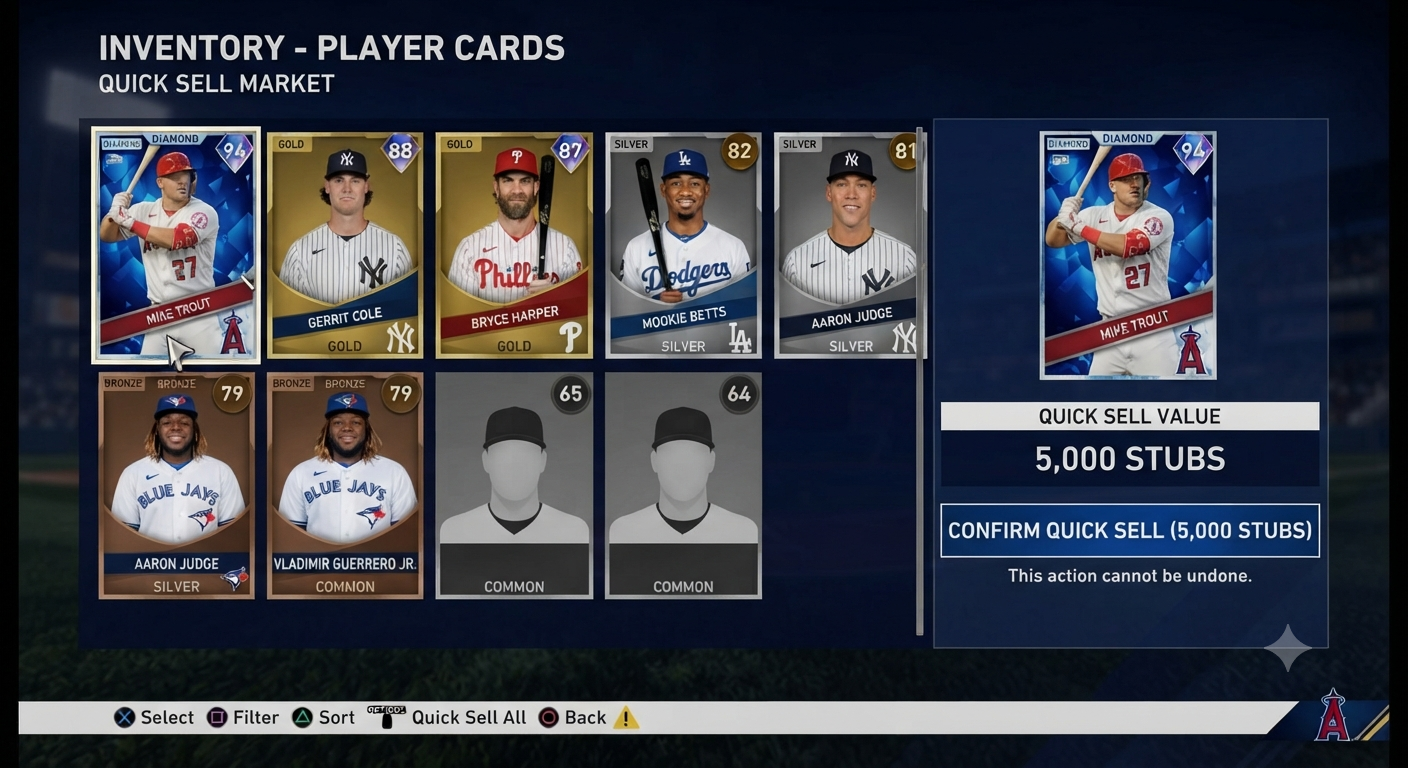
MLB The Show quicksell is the fastest way to turn an unwanted Diamond Dynasty card or item into guaranteed Stubs. It is instant, carries no marketplace tax, and removes the card permanently. The catch is simple: speed can cost you profit if the Community Market would pay more.
This MLB The Show quicksell guide uses the current MLB The Show 26 value structure as of July 2026 and explains the full decision, not just the chart. You will learn how Live Series and non-Live cards differ, how to calculate the true market break-even price, when to hold investments, and when pressing Quick Sell is genuinely the best move.
Current market-reference tools list Live Series values from 5 Stubs for Commons up to 10,000 for 92–99 OVR cards. Most non-Live cards pay approximately half of the equivalent Live Series amount. Does MLB The Show Quicksell Mean?
The MLB The Show quicksell feature is a guaranteed transaction between you and the game. Instead of waiting for another player to buy your card, you accept a fixed Stub amount based mainly on overall rating, rarity, and card type.
That fixed amount creates a practical price floor. A market listing may display a higher number, but after the 10% transaction tax, its actual payout can fall below the quicksell return. Quickselling itself is tax-free and irreversible. so different from the two marketplace shortcuts:
- Buy Now: You pay the lowest active sell order.
- Sell Now: You accept the highest active buy order.
- Quick Sell: The game pays the card’s fixed discard value immediately.
- Sell Order: You choose a listing price and wait for a buyer.
That distinction matters because “Sell Now” is not the same as MLB The Show quicksell. Sell Now uses another player’s buy order and is still subject to the marketplace tax.
Current MLB The Show Quicksell Values for Player Cards
The current structure separates Live Series cards from most non-Live Series cards, including many Legends, Flashbacks, Captains, special editions, and program rewards. Live Series receives the full published amount; non-Live generally receives 50%, rounded down. Rarity | Live Series | Non-Live Series |
|—|—:|—:|—:|
| 64 and below | Common | 5 | 2 |
| 65–74 | Bronze | 25 | 12 |
| 75 | Silver | 50 | 25 |
| 76 | Silver | 75 | 37 |
| 77 | Silver | 100 | 50 |
| 78 | Silver | 125 | 62 |
| 79 | Silver | 150 | 75 |
| 80 | Gold | 400 | 200 |
| 81 | Gold | 600 | 300 |
| 82 | Gold | 900 | 450 |
| 83 | Gold | 1,200 | 600 |
| 84 | Gold | 1,500 | 750 |
| 85 | Diamond | 3,000 | 1,500 |
| 86 | Diamond | 3,750 | 1,875 |
| 87 | Diamond | 4,500 | 2,250 |
| 88 | Diamond | 5,500 | 2,750 |
| 89 | Diamond | 7,000 | 3,500 |
| 90 | Diamond | 8,000 | 4,000 |
| 91 | Diamond | 9,000 | 4,500 |
| 92–99 | Diamond | 10,000 | 5,000 |
The MLB The Show quicksell values are particularly intriguing near the rarity thresholds. An 84 OVR Live Series card has a guaranteed value of 1500 Stubs at quicksell, while an 85 OVR variant already has a floor of 3000 Stubs.
An upgrade from 79 Silver to 80 Gold cards raises the minimum value by 250 Stubs. Such a threshold is precisely why many roster-update purchases gain popularity: Non-Live Cards Often Look Surprisingly Cheap
It is a common perception that each 99 OVR card should have a 10000 Stub quicksell value, but it is only partially true.
A non-Live variant usually has a value of 5000 Stubs because of the reduced multiplier. The card’s art, popularity, collection status, and competitiveness might increase its market price, but not its guaranteed value. Be sure to identify the card series before relying on its overall rating. There are significant differences between two 95 OVR cards that have different guaranteed values.
The 10% Tax Rule That Changes Every Decision
The Community Market removes 10% of a completed sale price, while MLB The Show quicksell pays the displayed amount without that deduction. Therefore, a card listed for 10,000 Stubs returns 9,000—not 10,000—to the seller. formula before choosing between a listing and MLB The Show quicksell:
Net market return = Sale price × 0.90
To find the lowest listing that beats the guaranteed quicksell amount:
Break-even listing price = Quicksell value ÷ 0.90
Round up to the next whole Stub when necessary. The practical comparison should use the price at which your sell order is likely to complete, not an unrealistic listing sitting far above the active market.
Useful Break-Even Prices
| Card | Quicksell | Minimum Listing to Match or Beat It |
|---|---|---|
| 80 OVR Live | 400 | 445 |
| 81 OVR Live | 600 | 667 |
| 82 OVR Live | 900 | 1,000 |
| 83 OVR Live | 1,200 | 1,334 |
| 84 OVR Live | 1,500 | 1,667 |
| 85 OVR Live | 3,000 | 3,334 |
| 86 OVR Live | 3,750 | 4,167 |
| 87 OVR Live | 4,500 | 5,000 |
| 88 OVR Live | 5,500 | 6,112 |
| 89 OVR Live | 7,000 | 7,778 |
| 90 OVR Live | 8,000 | 8,889 |
| 91 OVR Live | 9,000 | 10,000 |
| 92–99 OVR Live | 10,000 | 11,112 |
For example, suppose an 85 OVR Live Series player has an active sell-order range near 3,250 Stubs and a 3,000-Stub MLB The Show quicksell value. A completed sale at 3,250 returns roughly 2,925 after tax, so the guaranteed payout is better.
Now suppose buyers are regularly completing orders around 3,600. That sale returns roughly 3,240, giving you 240 more Stubs than quickselling.
One card is a small difference. Hundreds of inventory decisions make it significant. Current reference tables use the same tax-adjusted break-even method. MLB The Show Quicksell Is the Right Choice
Quickselling is not automatically a beginner mistake. It is the correct move when the guaranteed amount beats the realistic, after-tax market return.
Strong situations include:
- The market is pinned near the price floor. A listing cannot clear the tax-adjusted threshold.
- You need immediate liquidity. You want Stubs now for a time-sensitive card, pack, collection, or investment.
- The item has weak demand. A technically profitable listing may sit for hours or days.
- You bought close to the floor. Quicksell acts as a downside exit if the market spread disappears.
- You are clearing low-value duplicates. The time required to list every Common or Bronze may exceed the tiny added return.
- A roster investment has reached its target tier. Taking the guaranteed upgrade profit can be safer than waiting for a temporary market spike.
The best MLB The Show quicksell decision balances three things: net payout, sale speed, and opportunity cost. Ten extra Stubs are not meaningful if the card ties up your attention while a better flip is available.
Liquidity also has value. Receiving 20,000 Stubs immediately may help you buy a profitable card before its price rises, while waiting several hours for a slightly better sale could cause you to miss that opportunity.
When You Should Avoid Quickselling
Never discard a valuable card merely because the button is convenient. Check the market, collection status, program relevance, and expected supply before confirming.
Avoid MLB The Show quicksell when:
- The lowest realistic sell order is comfortably above break-even.
- The card is scarce, event-limited, or temporarily out of packs.
- A new program has created demand for a team, series, position, or player type.
- You still need the card for Live Series, team, set, or special collections.
- A roster update may raise the player’s rating and fixed value.
- The card is one you actively use in Ranked, Events, Conquest, Mini Seasons, or a themed squad.
- The card may be required for an upcoming exchange or mission.
- The market is experiencing temporary panic selling.
A card’s quicksell amount is a floor, not a fair valuation of its gameplay strength or scarcity. Market demand can push an average card far above its fixed value, while an excellent free reward may remain near its floor because supply is enormous.
Roster Updates and Quicksell Investment Strategy
MLB The Show quicksell strategy becomes especially valuable in Live Series investing. Players buy cards before roster updates because a rating increase can raise both rarity and the guaranteed Stub floor.
Consider an 84 OVR player purchased for 1,650 Stubs. If he upgrades to 85, his Live Series quicksell becomes 3,000.
That creates a potential gross gain of 1,350 Stubs per copy. Holding 50 copies would create a 67,500-Stub gross return if every card reached the predicted rating.
The biggest percentage jumps often happen when a player crosses a rarity boundary:
- 79 to 80: 150 to 400 Stubs
- 84 to 85: 1,500 to 3,000 Stubs
- 91 to 92: 9,000 to 10,000 Stubs
Current market tools describe roster updates as major price-moving events because threshold upgrades can rapidly change a card’s floor and market demand. ot Ignore the Downgrade Risk
Investing is not guaranteed. A cold stretch, injury, attribute adjustment, or smaller-than-expected upgrade can leave a card at the same rating—or push it lower.
Build a margin of safety by purchasing as close as possible to the existing quicksell floor. If you buy an 84 at 1,550, your downside is limited compared with buying the same card after hype drives it to 2,700.
Also decide your exit before the update. You can quicksell immediately after a successful upgrade, list into a price spike, or hold for another cycle.
Without a plan, investors often watch a profitable position reverse because they keep waiting for an unrealistic outcome.
Quicksell-Based “No-Risk” Flipping Explained
An MLB The Show quicksell-based low-risk flip begins by purchasing near or below the card’s guaranteed value. If the spread remains healthy, you relist for profit. If the market collapses, the fixed quicksell amount provides an exit.
Suppose an 83 OVR Live card quicksells for 1,200. You acquire copies around 1,205 and the active sell side supports completed listings near 1,500.
A 1,500 sale nets approximately 1,350 after tax, leaving roughly 145 Stubs of profit after the original purchase.
If the sell price drops below the useful break-even range, you can discard the card for 1,200 and absorb only a tiny loss. Market trackers label cards near their fixed value as lower-downside opportunities for this reason. ” is still informal language, not a literal guarantee. Orders may not fill, prices can move, rating downgrades can lower Live Series values, and your Stubs may remain tied up during a better opportunity.
Why Sales Volume Matters
A 500-Stub profit means little when the card sells only once every few hours. A 75-Stub margin on a fast-moving Gold card can produce more total profit because you can repeat the transaction.
Look at:
- Post-tax profit per card
- Sales frequency
- Available buy orders
- Number of competing sell orders
- Time until the next content release
- Percentage of your Stub balance tied up
Experienced flippers measure profit over time, not simply profit per transaction.
Quicksell vs. Exchanges: Which Gives Better Value?
Exchanges do not pay Stubs directly. They consume eligible cards and convert their assigned exchange points into progress, packs, or program rewards.
Before using MLB The Show quicksell, compare the card’s Stub value with the cost of replacing its exchange points. A high-rated duplicate may be convenient for an exchange, but several cheaper lower-rated cards can sometimes complete the same requirement for fewer total Stubs.
A useful method is:
- Record the card’s guaranteed quicksell payout.
- Check how many exchange points it contributes.
- Divide the Stub cost by its exchange points.
- Compare that ratio with cheaper cards on the market.
- Use the lowest-cost combination unless time matters more than efficiency.
Exchange tools commonly rank cards by Stubs per exchange point, which is more useful than looking at overall rating alone. ple, placing a 3,000-Stub Diamond into an exchange effectively costs you the 3,000 Stubs you could have received by quickselling it. If several inexpensive Silvers provide the required points for 1,800 total Stubs, using the Diamond wastes 1,200 Stubs of value.
Collections, No-Sell Cards and Duplicate Traps
Collection decisions deserve extra caution because locking a card can remove your ability to list it or use MLB The Show quicksell on that owned copy. Community guidance consistently warns that a collected card generally cannot be sold afterward, although additional duplicates may be treated separately depending on the item and current game rules. ocking anything into a collection:
- Check its current sell-order value.
- Calculate the after-tax payout.
- Confirm the collection reward is worth the lost liquidity.
- Keep track of which copy is locked when you own duplicates.
- Review any associated team, division, league, or set rewards.
- Do not assume every No Sell duplicate can be discarded.
Restrictions have varied by reward and release. Some duplicate No Sell cards have been eligible for certain actions, while others remain completely restricted. st rule is to inspect the exact card’s available actions in your inventory. Labels and duplicate behavior can differ, while the confirmation screen tells you what the game currently permits.
How to Quicksell Cards in MLB The Show
The menu wording can vary slightly by platform or yearly release, but the normal MLB The Show quicksell inventory workflow is straightforward:
- Open Diamond Dynasty.
- Go to My Collection or your profile area.
- Open My Inventory.
- Choose the relevant team, series, or item category.
- Select the card or item.
- Choose Quick Sell or Quick Sell Options.
- Review the displayed Stub amount.
- Confirm the transaction.
Current MLB The Show 26 guidance places the action inside My Inventory rather than the Community Market screen. Once confirmed, the card is removed and the Stubs are credited immediately. icates, some inventory screens also offer a bulk quicksell option. Use it carefully, especially around roster-update candidates, new exchanges, and collection requirements.
A Faster Inventory-Cleaning Workflow
Randomly clearing cards is an inefficient way to use MLB The Show quicksell. Sort your inventory into four practical groups before selling.
1. Collection Copies
Protect one copy of every card you expect to collect. Do not lock it until you understand the reward path and opportunity cost.
2. Active Investments
Create a list of Live Series players you are holding for upgrades. Review recent performance, rating thresholds, purchase price, and target exit.
3. Marketable Duplicates
Check cards with meaningful demand. List only when the expected net return comfortably beats the fixed value.
4. Floor-Value Clutter
Quickly clear low-demand duplicates whose post-tax upside is negligible. This is where MLB The Show quicksell saves the most time without sacrificing meaningful profit.
A disciplined routine prevents two common losses: discarding an investment just before an upgrade and wasting half an hour listing cards for one-Stub gains.
Common MLB The Show Quicksell Mistakes
The most expensive errors are usually calculation errors, not gameplay errors.
- Comparing the listing price with quicksell before tax: Always compare net proceeds.
- Assuming all Diamonds pay the same: Overall rating and Live/non-Live status matter.
- Treating Sell Now as tax-free: It is a marketplace transaction.
- Ignoring collections: A locked card can lose its resale flexibility.
- Bulk-selling every duplicate: Some may be upgrade candidates or newly required cards.
- Holding upgraded investments forever: A guaranteed profit only becomes real when you exit.
- Using an old value chart: Annual releases and live-service changes can alter values or restrictions.
- Ignoring opportunity cost: A slow listing can trap Stubs that could be used elsewhere.
- Selling during temporary market panic: Prices sometimes recover after packs or content drops.
The final confirmation screen is your last defense. Read the card name, quantity, and Stub total before accepting because quickselling is permanent. ently Asked Questions
What is the difference between quicksell and Sell Now in MLB The Show?
MLB The Show quicksell pays a fixed amount set by the game and does not charge the 10% marketplace tax. Sell Now accepts the highest active buy order from another player, so the displayed order price is reduced by tax before you receive your Stubs.
Compare the net Sell Now payout with the fixed MLB The Show quicksell value. The larger number is financially better, although speed and liquidity may still influence the choice.
Are MLB The Show quicksell values the same for Live and non-Live cards?
No. Live Series cards use the full player-value table, while most non-Live cards use a reduced amount equal to approximately half of the corresponding Live value, rounded down.
That means a 90 OVR Live Series card can quicksell for 8,000 Stubs, while a comparable non-Live card commonly pays 4,000. uickselling taxed in Diamond Dynasty?
No. You receive the full displayed quicksell amount.
Community Market sales are different: the game removes 10% from completed sales. That is why a listing must exceed the fixed value by approximately 11.12% to produce a higher net payout. you undo a quicksell in MLB The Show?
No. A confirmed transaction permanently removes the card or item from your inventory and credits the Stubs immediately.
Slow down when selling Diamonds, roster investments, collection pieces, and large duplicate stacks. There is no ordinary undo button after confirmation. ld I quicksell duplicate cards or list them?
Check the tax-adjusted market return first. List a duplicate when the realistic sale price produces a worthwhile premium; quicksell it when the market is at the floor or the added profit is too small to justify the time.
Also check whether the card may rise after a roster update or become useful in an exchange or program. A duplicate is not automatically worthless.
Conclusion: Use Quicksell as a Tool, Not a Habit
MLB The Show quicksell works best as a guaranteed floor, an instant-liquidity option, and a safety exit for cards purchased near their fixed value. It should never replace a quick market check.
Before confirming, identify the card type, find its fixed value, calculate the marketplace return after the 10% tax, and check collections or upcoming roster updates. Then act decisively: list when the premium is real, hold when the investment case is strong, and quicksell when the guaranteed payout is the smarter use of your Stubs and time.













Leave a Reply