
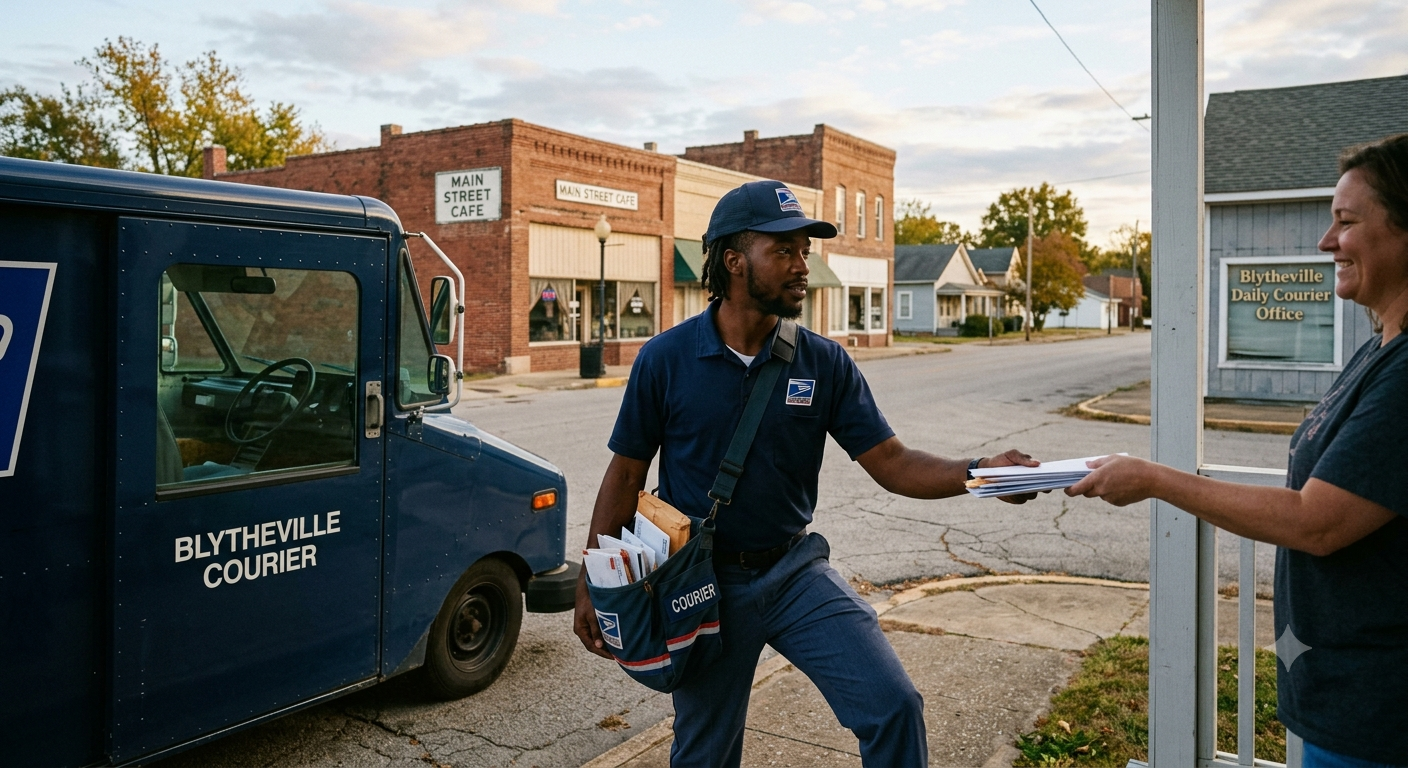
A search for Blytheville Courier usually leads to one of two questions: “Where is the local newspaper now?” or “How can I find an old article, obituary or family notice?” The name belongs to a long newspaper tradition in Blytheville, Arkansas, and its story includes several title changes, decades of community reporting and a later merger into the NEA Town Courier.
That distinction matters. Someone looking for today’s school news, police reports or civic events needs the current publication, while a genealogist may need a scanned issue from 1935, 1969 or 2007. This guide explains both paths, with practical steps for finding trustworthy information instead of getting lost among similarly named publications and generic courier services.
The Newspaper at a Glance
The publication’s lineage reaches back to the early twentieth century. Newspaper directory data lists the Blytheville Courier from 1902 to 1923, the Blytheville Courier News from 1923 to 1968 and the Courier News from 1968 onward.
A separate history of the Arkansas press dates the paper’s start to 1903, so researchers should be aware that early-source dates differ by about a year.
Today, the recognizable successor is the NEA Town Courier, formed after the Courier News and Town Crier merged at the start of 2019. Current public profiles describe it as a twice-weekly newspaper published on Wednesday and Saturday, with an office at 206 North Second Street in Blytheville.
Key takeaways:
- The historical name refers to a local newspaper, not a package-delivery business.
- The title changed as the paper evolved, so archive searches should use multiple name variations.
- Current reporting appears under the NEA Town Courier identity.
- Digitized archives exist, but their date coverage varies by platform.
- Local libraries and the Arkansas State Archives may hold material that commercial databases miss.
What Was the Blytheville Courier?
The Blytheville Courier was built around a classic community-newspaper model: report what matters close to home. That includes city decisions, school developments, local businesses, public safety, sports, civic clubs, elections, church activities, weddings, births, deaths and everyday milestones.
Its value was not limited to breaking news. Each edition also became a record of how Blytheville and Mississippi County changed through agricultural shifts, industrial growth, military activity, civil-rights conflicts and population movements.
Blytheville is one of Mississippi County’s two county seats and had 13,406 residents in the 2020 census. The city sits in northeastern Arkansas near the Missouri state line and the Mississippi River, placing it within a regional news environment influenced by Arkansas, Tennessee and Missouri.
That geography helps explain the importance of a locally focused publication. Regional television might report the biggest developments, but a community newspaper records the smaller decisions and personal events that shape daily life.
A Clear Timeline of the Newspaper’s Name Changes
From Blytheville Courier to Blytheville Courier News
Directory listings place the original title in circulation from 1902 to 1923. The Blytheville Courier name reflected the straightforward branding common among early local papers: a city name paired with a word suggesting the rapid delivery of news.
In 1923, the title became Blytheville Courier News. That version is the one many longtime residents, former subscribers and family-history researchers remember most clearly, especially when searching for mid-century stories and obituaries.
The change also creates a practical research issue. Searching only one publication title can cause researchers to overlook stories indexed under a different masthead.
The Courier News Era
In 1968, the title was shortened to Courier News. Newspaper databases preserve substantial portions of this period, including a searchable Ancestry collection covering 1968 through 1977 and broader commercial archives extending into later decades.
The shorter name did not erase the publication’s Blytheville identity. It continued to function as a local paper tied closely to the city and surrounding Mississippi County communities.
During this era, the newspaper documented both everyday life and larger regional changes. Its pages covered schools, industries, public officials, sports, businesses, crime, elections and social issues that affected residents directly.
The Transition to NEA Town Courier
The next major shift came when the Courier News and Town Crier merged, effective January 1, 2019. The combined identity, NEA Town Courier, broadened the geographic signal in the name while retaining “Courier” as a link to the older publication.
This is why an online search for Blytheville Courier may redirect readers toward a newer brand. People still remember the former masthead, archived articles continue to use it and many older citations point to stories published under previous names.
The modern identity also reflects a broader service area. Rather than focusing exclusively on one city, the current publication covers multiple northeast Arkansas communities.
What Does the Current Paper Cover?
The current outlet serves Blytheville and other communities in northeast Arkansas. Its reporting commonly includes community events, local government, schools, high-school sports and civic life.
Publicly indexed bylines also show coverage of police reports, business openings, health events, school activities, charitable organizations and local personalities.
For readers, the most useful categories are often:
- City and county government: Meetings, public projects, ordinances and municipal service updates.
- Education: Blytheville, Gosnell, Manila, Armorel and other area schools.
- Public safety: Police reports, emergency notices and court-related developments.
- Community life: Festivals, charity drives, club meetings, awards and local profiles.
- Sports: School teams, tournaments, schedules and athlete recognition.
- Obituaries and milestones: Deaths, anniversaries, weddings and family announcements.
- Business news: Openings, expansions, leadership changes and industrial developments.
This hyperlocal focus is the paper’s competitive advantage. A statewide outlet may cover a major factory announcement or election result, but it is less likely to record a school ceremony, small-business change or neighborhood fundraiser.
For residents who have moved away, the newspaper can also provide an ongoing connection to their hometown. Local names, photographs and event reports offer a level of familiarity that broad regional news cannot reproduce.
Why the Blytheville Courier Still Matters
Local journalism helps residents understand decisions affecting schools, roads, utilities, taxes, businesses and public safety. A government agenda may show what officials plan to discuss, but reporting can explain who supported the proposal, what objections were raised and what the final decision could mean.
The newspaper also provides continuity. Blytheville has moved from an early timber-based economy to cotton and other crops, military aviation and a modern industrial base strongly connected to steel production.
The city’s own materials identify steel mills and related industries as central to the area economy.
That makes this historical newspaper archive more than a collection of old pages. Read across several decades, it can reveal when employers arrived, how neighborhoods developed, what schools changed and which local institutions endured.
Historical scholarship also uses the paper as evidence. The Encyclopedia of Arkansas cites numerous Courier News reports in its account of the Blytheville boycotts of 1970–1971, demonstrating how local reporting can become a primary source for understanding major events.
The archive can therefore serve several audiences at once:
- Residents trying to understand local history
- Students completing research projects
- Journalists checking earlier coverage
- Genealogists tracing relatives
- Historians studying northeast Arkansas
- Businesses investigating regional development
- Former residents reconnecting with the community
How to Access Current Blytheville News
The current newspaper identifies itself online as the NEA Town Courier. Its public profile states that print editions are published every Wednesday and Saturday, while its listed physical location is 206 North Second Street in Blytheville.
Because publication schedules, prices and delivery zones can change, readers should verify subscription or advertising details directly with the newspaper. This is especially important for legal notices, obituary deadlines, election advertising and time-sensitive event announcements.
A practical reading routine is simple:
- Check the current publication’s website or social feed for immediate updates.
- Use the print edition for fuller local coverage, notices and community pages.
- Save the date, headline and author of useful articles.
- For older material, move to a newspaper archive instead of relying only on a general web search.
Social media is useful for discovering recent reports, but it should not always be treated as the complete edition. Photographs, legal notices, extended reports and community listings may appear more fully in print or on the publication’s main platform.
How to Search Blytheville Courier Archives
Not necessarily, as there can be multiple databases with different issues available at different times. The best way would be to try searching both sources and checking which years have the issues you need.
NewspaperArchive offers the Blytheville Courier News with issues dated 1928-2007, while Newspapers. com has over 164,000 pages of the Blytheville Courier News available for the period 1930-1977, and Ancestry provides the Blytheville Courier News issues from the 1968-1977 timeframe. It may also be possible that some issues were not scanned for any of the platforms, or not indexed correctly. However, it is not possible to confirm if the issues exist if only one database provides such an option.
The Arkansas State Archives not only holds a vast collection of newspapers but also maintains them on microfilm. In addition to that, the University of Central Arkansas has the Blytheville Courier News collection of the 1950s in its Rare Book and Special Collections.
Use Every Relevant Title Variation
Search these names separately:
- “Blytheville Courier”
- “Blytheville Courier News”
- “Courier News Blytheville”
- “NEA Town Courier”
- “Town Crier Blytheville”
A database may index the publication by the masthead used in a particular year. Searching only Blytheville Courier can therefore miss articles cataloged under “Courier News.”
When searching through Google or another general search engine, place the person’s name or event in quotation marks. Add a year, town, school, employer or street name to narrow the results.
Search Around a Date, Not Only on It
Old newspapers sometimes printed an obituary, wedding notice or court item several days after the event. Begin with a seven-day window, then expand to a month if the first search fails.
For major events, search both before and after the known date. Preview stories, meeting announcements and follow-up reports can be as informative as the main article.
An obituary may also appear twice. A short death notice might be published first, followed by a longer obituary after funeral arrangements are confirmed.
Expect OCR Errors
Digitized newspapers use optical character recognition, or OCR, to turn scanned pages into searchable text. Faded ink, damaged microfilm, decorative fonts and narrow columns can cause names to be misread.
Try surname variations, initials, maiden names, addresses, employers, schools and relatives’ names. For example, a failed search for “McDaniel” may succeed with “M Daniel,” “Mc Danicl” or the person’s first initial combined with a location.
OCR is especially likely to confuse:
- The letters “rn” with “m”
- The letter “l” with the number “1”
- The letter “O” with the number “0”
- Hyphenated names
- Faded capital letters
- Names printed across column breaks
Once you find a possible result, inspect the actual page image. Do not depend exclusively on the automatically generated transcript.
Using the Newspaper for Genealogy
The Blytheville Courier is especially useful for family-history research because local newspapers connect official facts with social context. A death certificate may provide dates, but an obituary can identify relatives, churches, employers, military service, burial locations and community affiliations.
Researchers should look beyond obituary pages. Useful clues may appear in:
- Birth and wedding announcements
- School honor rolls and graduation lists
- Church columns
- Military departure and return notices
- Property transfers
- Court reports
- Club membership news
- Business advertisements
- Funeral-home notices
- Anniversary features
Advertisements can be unexpectedly valuable. A family-owned business advertisement may establish where a relative worked, when a company opened or which address it occupied.
School and sports pages can help identify younger relatives who do not appear in property, voting or employment records. Captions may also provide full names that were shortened elsewhere.
Record the newspaper title, publication date, page number and headline whenever possible. Screenshots without citation details become difficult to verify later, especially when databases change their access systems.
How to Evaluate an Old Article Critically
A newspaper is a valuable primary source, but it is not automatically a complete or neutral account. Reporting standards, terminology, community power structures and access to sources varied across decades.
When using an archived local article for school, legal, historical or genealogical work, compare it with:
- Government records
- Census data
- Court documents
- City meeting minutes
- School yearbooks
- Cemetery records
- Oral histories
- Other local or regional newspapers
Separate what the article directly reports from what you infer. If two sources conflict, note the disagreement rather than forcing a false certainty.
Pay attention to article type as well. A signed news report, editorial, advertisement, letter to the editor and paid announcement serve different purposes and should not be evaluated in the same way.
Dates can also create confusion. A newspaper’s publication date is not necessarily the date on which the reported event happened.
Advertising, Notices and Community Submissions
A local paper can be useful for reaching readers who care about a specific place. Businesses may use it for retail promotions, hiring, openings and public announcements, while families and organizations may submit obituaries, events, recognition pieces or photographs.
Before submitting anything, confirm the current format, price, word limit, photograph requirements, publication date and deadline. A Wednesday-and-Saturday schedule means missing a cutoff could delay a time-sensitive announcement.
For better results, write a clear local headline and put the essential details first. Dates, times, addresses, names and telephone numbers should be checked twice before submission.
A community announcement should quickly answer:
- What is happening?
- Who is organizing it?
- When will it take place?
- Where will it be held?
- Is admission free or paid?
- Who should readers contact?
- Is registration required?
Businesses should also ask whether an advertisement appears in print, online or both. Audience reach, placement and production requirements may differ between formats.
The Future of Local News in Blytheville
Small newspapers face pressure from declining print advertising, changing reader habits and the speed of social media. Yet social platforms do not replace a consistent public record, professional editing or accountable reporting.
A Facebook post can disappear, be edited without a visible correction or become difficult to locate years later. A dated newspaper edition creates a more stable historical record.
The strongest future model is likely hybrid: fast digital updates, a dependable print product, searchable archives and direct community engagement. In that structure, the legacy of the Blytheville Courier remains relevant even when the masthead changes.
Readers also influence whether local reporting survives. Subscribing, buying individual editions, purchasing legitimate archive access, advertising locally and sending accurate news tips all support the reporting ecosystem.
Community support does not mean treating the newspaper as beyond criticism. Strong local journalism also depends on readers requesting corrections, distinguishing news from opinion and expecting transparent sourcing.
Frequently Asked Questions
Is the Blytheville Courier still being published?
The historic paper no longer appears under exactly the same standalone name. Its lineage continues through the NEA Town Courier, created after the Courier News and Town Crier merger took effect on January 1, 2019.
Current public profiles describe Wednesday and Saturday editions.
Where can I find old Blytheville Courier obituaries?
Start with NewspaperArchive, Newspapers.com or Ancestry, then check library and state-archive holdings if the required year is missing. Search the deceased person’s surname, relatives, funeral home, cemetery and church.
Use several newspaper title variations because the masthead changed over time.
What years are available online?
Coverage depends on the database. NewspaperArchive lists 1928–2007, Newspapers.com lists 1930–1977, and Ancestry lists 1968–1977.
None of those ranges alone guarantees that every issue or page is present. Missing editions may survive only on microfilm or in physical collections.
Is the Blytheville Courier the same as NEA Town Courier?
They are not identical titles, but they belong to the same newspaper lineage. The older Courier News merged with the Town Crier, and the combined publication adopted the NEA Town Courier name.
People may still use the historical name when discussing old articles, family notices or memories of the paper.
How do I submit an obituary, advertisement or local event?
Contact the current newspaper and ask for its latest submission rules, rates and deadlines. Provide verified names, dates, locations and contact information.
Request a proof when accuracy is especially important. This is particularly useful for obituaries, legal notices and paid advertisements containing several names or dates.
Conclusion: Use the Right Name for the Right Search
The fastest way to find accurate information is to match the newspaper name to the period you are researching. Use Blytheville Courier for the earliest years, “Blytheville Courier News” for much of the twentieth century, “Courier News” for the later standalone era and “NEA Town Courier” for current coverage.
For today’s news, begin with the current outlet and confirm its latest print or digital options. For historical research, search multiple databases, allow for OCR errors and record complete citations.
That approach turns a vague keyword into a reliable path toward current reporting, family history and more than a century of Blytheville’s community record.













Leave a Reply